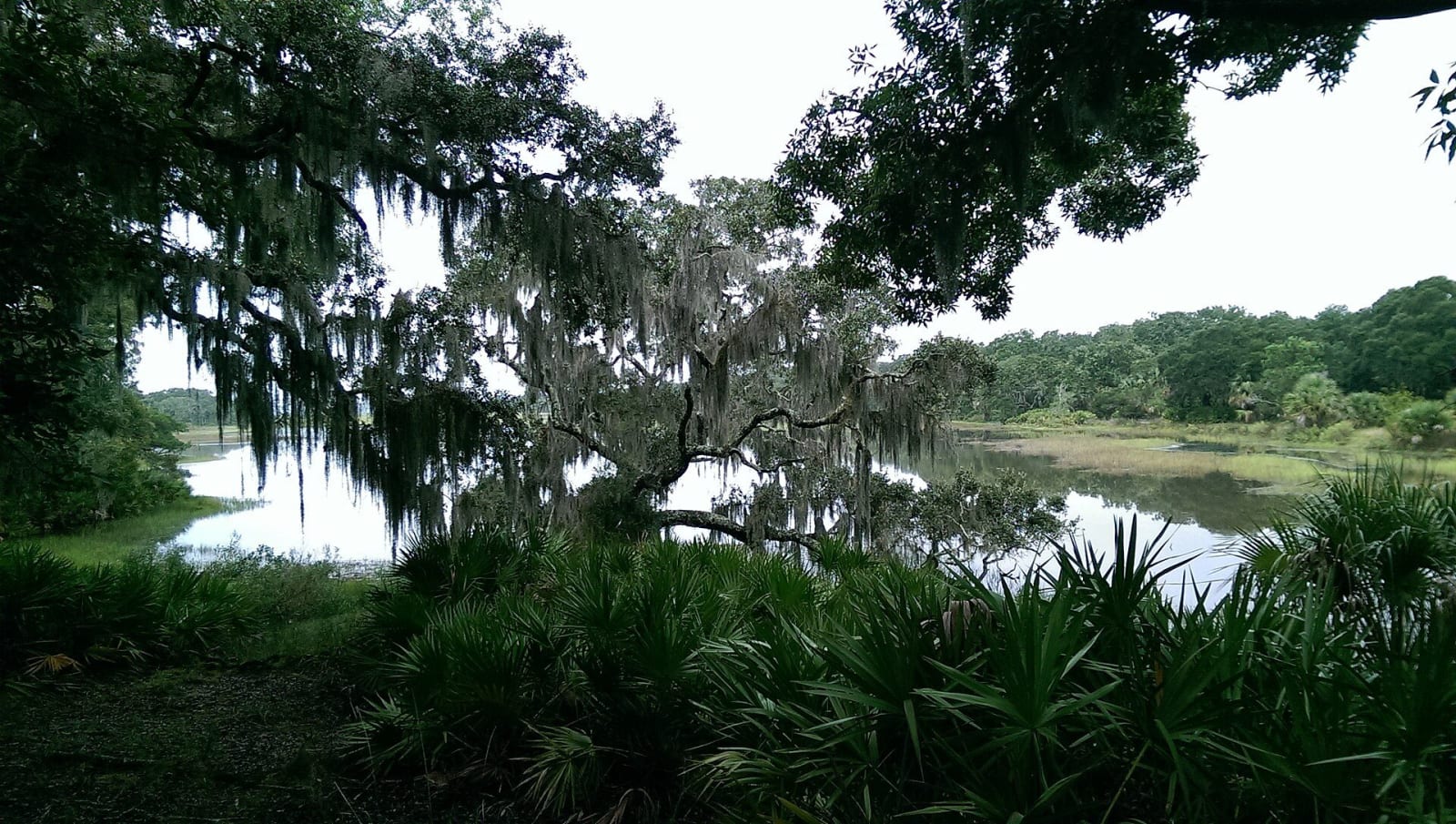
Coosaponakeesa was born about 1700 at Coweta, a Muscogee (Creek) town, to a Muscogee mother and Edward Griffin, an English trader out of Charles Town. She belonged to her mother's Wind Clan, and her mother's kin included the Coweta leader Brims. Around 1707 her father took her to Pon Pon, South Carolina, where she was baptized and schooled. After the Yamasee War of 1715 she returned to Coweta, fluent in Muskogee and English, the two languages she would live between.
The post at Yamacraw
Around 1717 she married John Musgrove, a trader whose mother was also Creek. In 1732, at the invitation of the Yamacraw leader Tomochichi, the couple opened a trading post near the Savannah River. When James Oglethorpe landed at Yamacraw Bluff in February 1733, she interpreted his talks with Tomochichi, and from 1733 to 1743 she was his principal interpreter. The historian Andrew K. Frank writes that Oglethorpe got most of what he understood about the Muscogee directly from her. She also supplied the town with meat and bread and helped bring Muscogee warriors against Spanish Florida.
John Musgrove died in June 1735; their three sons were already dead. She moved her business to the Cowpens, upriver from the town, which Frank calls probably the center of the colony's deerskin trade. In 1737 she married Jacob Matthews, once her indentured servant, and with him opened a second post, Mount Venture, on the Altamaha. He died in 1742. In 1744 she married the Reverend Thomas Bosomworth, a newly arrived Anglican minister.
The grant and the arrest
Oglethorpe left Georgia in 1743. Accounts differ on what he left her, £200 and a diamond ring or £100 and a promised yearly sum, and by most accounts the promise of more went unpaid. She had land, at least on Muscogee terms. Tomochichi granted her ground near Savannah in 1737, and the Lower Muscogee leader Malatchi later granted the Bosomworths three sea islands his people claimed: Ossabaw, Sapelo and St. Catherines. British officials refused to recognize the grants, holding that a nation could cede land only to another nation, never to a person.
In the summer of 1749 Malatchi and more than 200 Muscogee came to Savannah with her to press the claim. Shut out of the talks as interpreter, she interrupted the meeting and was arrested, and her husband had to apologize publicly for her. Officials also dismissed her claim of royal descent, which, Frank notes, few scholars accept.
St. Catherines
In 1752, at South Carolina's request, she helped end a Muscogee-Cherokee war and was paid in Colleton County land rather than the money promised. The Bosomworths took their case to the Board of Trade in London in 1754, which referred it to Georgia. Governor Henry Ellis, who arrived in 1757, brokered the compromise: she kept St. Catherines Island and about £2,100 and gave up the rest. Accounts date it 1759 or 1760.
She and Bosomworth retired to St. Catherines, where she died sometime after 1763, probably in the summer of 1765.
The bluff where she met Oglethorpe is the riverfront edge of the Savannah Historic District. St. Catherines is privately held and closed to visitors; Sapelo Island, another of Malatchi's islands, is reached by state ferry from Meridian.