Row of 1890s commercial buildings with ornate cornices on the courthouse square in Georgetown, under an overcast sky.
Carol M. Highsmith / public domain via Library of Congress
Texas · Region

Georgetown, Corsicana & the Blackland Prairie

Fort Parker, Fort Boggy, the Confederate Reunion Grounds, Corsicana's oil park, Georgetown's square, Inner Space Cavern, Cameron, Round Rock and Blind Lemon's grave.

9 places to explore

This belt of black prairie between the Brazos and the Trinity was Native country before it was cotton land. Parks and Wildlife says the Keechi had a village near present-day Centerville and the Kickapoo lived along the Trinity. On May 19, 1836, a large force of Comanche and allies attacked the Parker stockade on the Navasota and took five captives. One was Cynthia Ann Parker, who stayed about 25 years; her son Quanah became the most influential Comanche leader of the reservation era. In 1840 settlers on Boggy Creek built a palisade and asked for Rangers.

Cameron became a county seat in 1846 and Georgetown in 1848, and Round Rock took its name in 1854 from a stone in Brushy Creek where the Chisholm Trail crossed. In 1888 Confederate veterans began holding reunions at a bend of the Navasota near Mexia. Blind Lemon Jefferson, born on a Freestone County farm, is buried at Wortham.

Oil arrived in 1894, when a Corsicana water well struck oil at 1,027 feet and started the first Texas field to produce oil and gas in important quantities. The Mexia boom followed in the early 1920s. At Georgetown, highway drillers found Inner Space Cavern in 1963, and the county's fifth courthouse anchors a Victorian square. Cameron's 1895 jail is now a museum.

What to See in Georgetown, Corsicana & the Blackland Prairie

9 places across the region, grouped by what they are.

Geology & Rock Formations
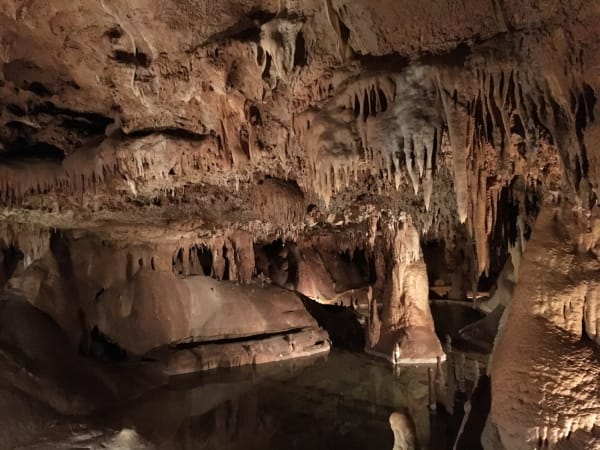
Stalactites hanging from a brown cave ceiling over a still pool and a rounded flowstone column, lit warmly inside Inner Space Cavern.

Inner Space Cavern

Georgetown

A Georgetown cave found in 1963 when highway engineers drilled test holes, holding Pleistocene fossils and 72-degree rooms that visitors reach by an artificial tunnel.

View details →

Hikes & Trails

Open-sided pavilion with a red roof, peeled-log posts and an ironstone rock base on a wooded rise at Fort Boggy State Park.

Fort Boggy State Park

Centerville

A 1,847-acre park in Leon County named for a settlers' palisade of 1840, with a 15-acre lake, short trails and the story of Tennessee farmers, the Keechi and a Ranger captain.

View details →

Historic Sites

Octagonal shingle-roofed dance pavilion with a louvered cupola, open sides and picnic tables beneath oaks at the Confederate Reunion Grounds.

Confederate Reunion Grounds State Historic Site

Mexia

Where Limestone County Confederate veterans gathered each summer from 1888, later a water supplier in the Mexia oil boom, now a Texas Historical Commission site on the Navasota River.

View details →
A weathered log cabin with a stone-footed foundation and a tall palisade of upright logs inside the rebuilt Old Fort Parker stockade, on a lawn under a pale sky.

Old Fort Parker

Groesbeck

A rebuilt 1830s family stockade near the Navasota River, where a May 1836 attack killed men of the Parker settlement and took five captives, among them nine-year-old Cynthia Ann Parker.

View details →
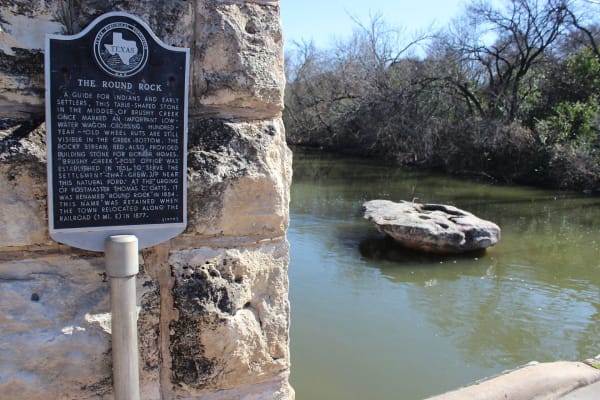
The flat limestone Round Rock sitting in the green water of Brushy Creek, beside the stone bridge pier carrying the Texas Historical Commission marker.

The Round Rock

Round Rock

A table-shaped stone in Brushy Creek gave Round Rock its name in 1854; the Chisholm Trail crossed the creek near it, and Old Town stayed behind when the railroad pulled the town east.

View details →

Towns & Gateways

A gray granite headstone reading Lemon Jefferson, September 1893 to December 1929, with the lines "See that my grave is kept clean," beside a spray of artificial flowers.

Blind Lemon Memorial Cemetery

Wortham

The Freestone County grave of the Texas blues singer Blind Lemon Jefferson, who recorded for Paramount in Chicago from 1926 and died there in December 1929.

View details →

Architecture

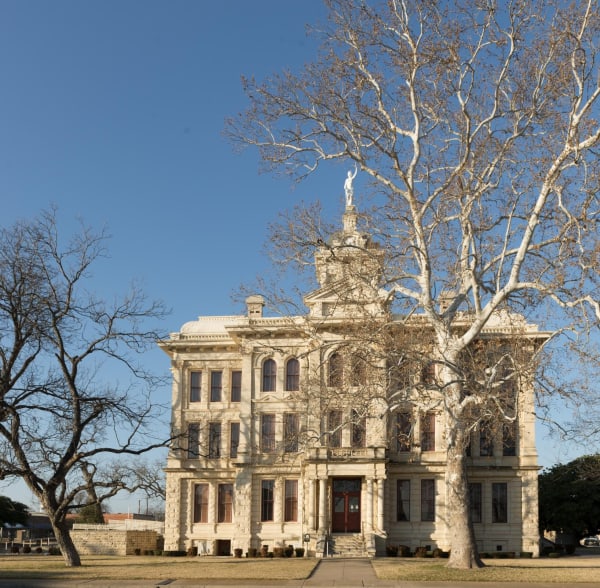
Cream limestone Milam County Courthouse in Cameron with a clock tower and a white statue on the cupola, framed by bare sycamores in winter light.

Milam County Courthouse and Jail

Cameron

Cameron's 1892 Renaissance Revival courthouse and the 1895 St. Louis-built jail beside it, now the county museum, are listed together on the National Register.

View details →
Tan brick Williamson County Courthouse in Georgetown with a four-column portico and a domed cupola topped by a figure of Justice.

Williamson County Courthouse

Georgetown

The fifth Williamson County courthouse, a Beaux Arts building by C. H. Page, rises over a Georgetown square of more than 50 Victorian-era buildings.

View details →

Industry & Mining

A steel drilling tower rising above a red-brick sign reading Petroleum Industry Park, with trimmed shrubs in front and a blue sky behind.

Petroleum Industry Park

Corsicana

The pipes and drilling tower mark where a city water well struck oil on June 9, 1894, the start of the first Texas field to produce oil and gas in important quantities.

View details →

Georgetown, Corsicana & the Blackland Prairie rewards the unhurried. Pick a base, fan out, and let the country between the headline stops surprise you.

← Explore more of Open Road Guide