 Robert Lz / CC BY 2.0 via Flickr
The Story
Muscogee (Creek) and Cherokee people lived along the Broad River until colonial land cessions, and after the Revolution veterans with land grants settled it. From 1868 to 1904 Gabriel Watson ran a mill complex here on the South Fork: a gristmill that also carded wool, a sawmill, a blacksmith shop and a cotton gin, with a community store nearby. His house and the store burned in 1904, and a few stone piers of the gristmill remain south of the river.
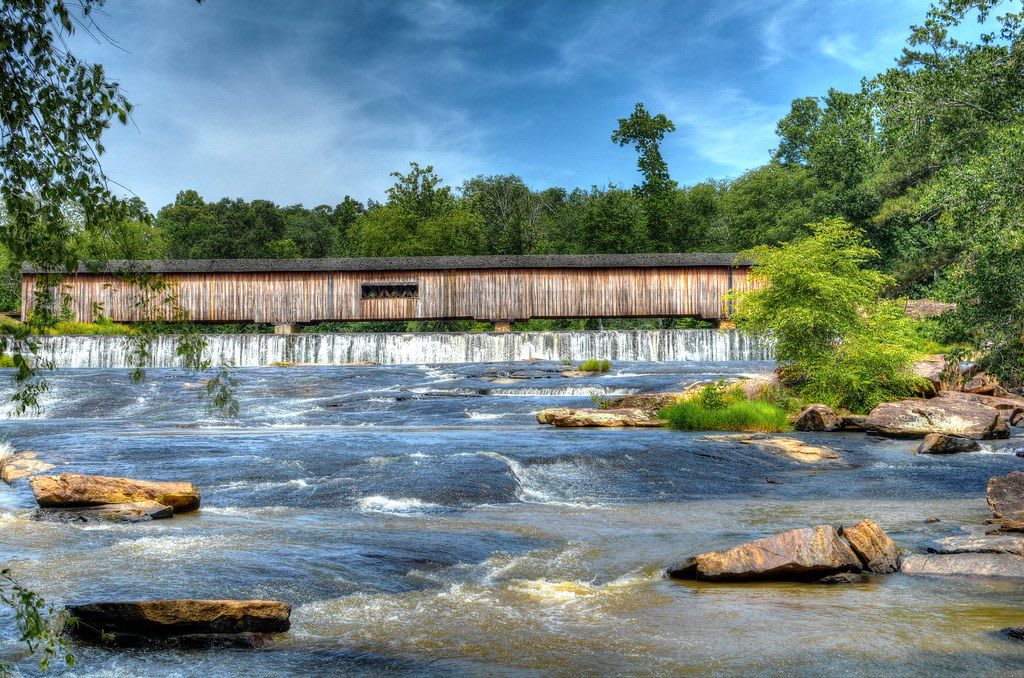
The county paid $3,000 for the bridge in 1885. Its builder, Washington W. King, was the son of Horace King, who was born into slavery in South Carolina in 1807, was freed in 1846 and became the most respected bridge builder in west Georgia and Alabama. Washington King and his brothers carried on the family firm. The bridge is a Town lattice truss, a web of heart-pine planks crossed at an angle and fastened with wooden pegs, resting on three stone piers and one of concrete. At 229 feet it is the longest of Georgia's remaining covered bridges, and it still carries cars, with a 9-foot clearance and a 3-ton limit.
About 1906 a stone dam was built just downstream to feed a raceway that runs more than 600 yards to the ruins of a power plant, which sent electricity to a cotton mill 12 miles away in Crawford until the 1950s. In summer people wade the shoals below the bridge. Campers with large rigs enter from GA 22 rather than crossing the bridge.
Visitor Info
On the Map
Nearby
The closest stops worth working into your route
Historical markers nearby
Roadside plaques and monuments within a short detour