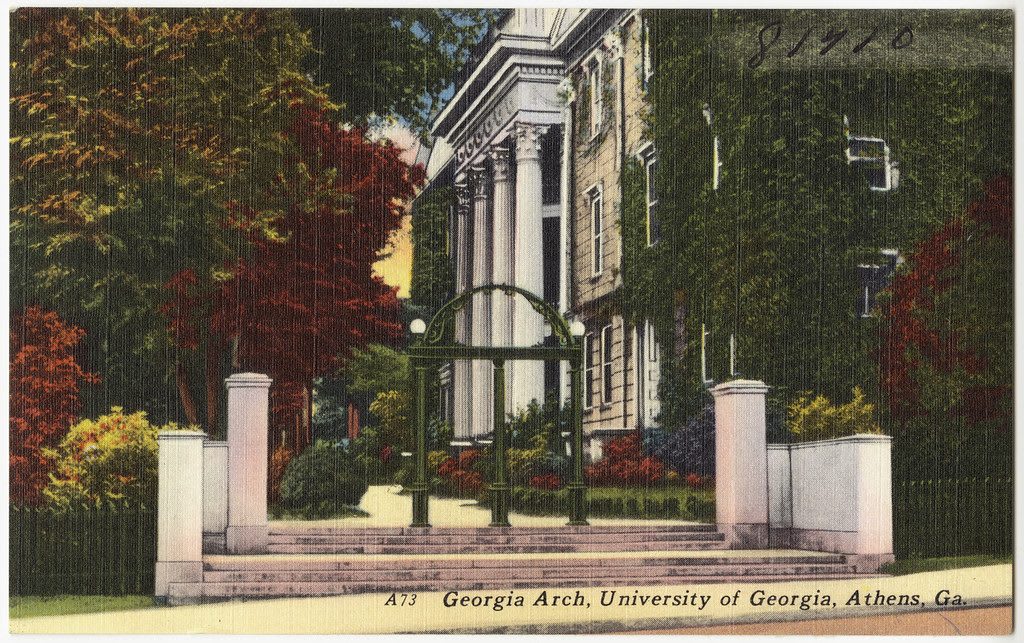
 Boston Public Library / CC BY 2.0 via Flickr
The Story
The Cherokee and Muscogee (Creek) nations held this country until the land cessions that followed the Revolution, and white settlers came almost as soon as the war ended. In 1785 the legislature approved Abraham Baldwin's charter for a University of Georgia, the first university created by a state government, but it existed only on paper until 1801, when John Milledge bought 633 acres on the Oconee River frontier and gave them as its site. Josiah Meigs taught the first classes that September, and the first permanent building, finished in 1806 and now called Old College, still stands on the quadrangle.
By 1860 enslaved people made up nearly half of Clarke County's population. In November 2015, construction of an addition to Baldwin Hall uncovered the remains of people buried on that ground in the 1800s, most of them likely enslaved or formerly enslaved. They were reburied at Oconee Hill Cemetery in 2017, and in 2018 the university dedicated a memorial on the south end of Baldwin Hall's front lawn, built of granite from an Oglethorpe County quarry owned by an African American family for more than a century.
On January 6, 1961, a federal judge ruled that Hamilton Holmes and Charlayne Hunter had been kept out only because of their race. They registered three days later at the Academic Building through crowds shouting slurs, and after a riot outside Hunter's dormitory on January 11 they were suspended, then returned under a new court order. The building has carried their names since 2001. Start at the cast-iron Arch on Broad Street, installed in 1857.
Visitor Info
On the Map
Nearby
The closest stops worth working into your route
Historical markers nearby
Roadside plaques and monuments within a short detour