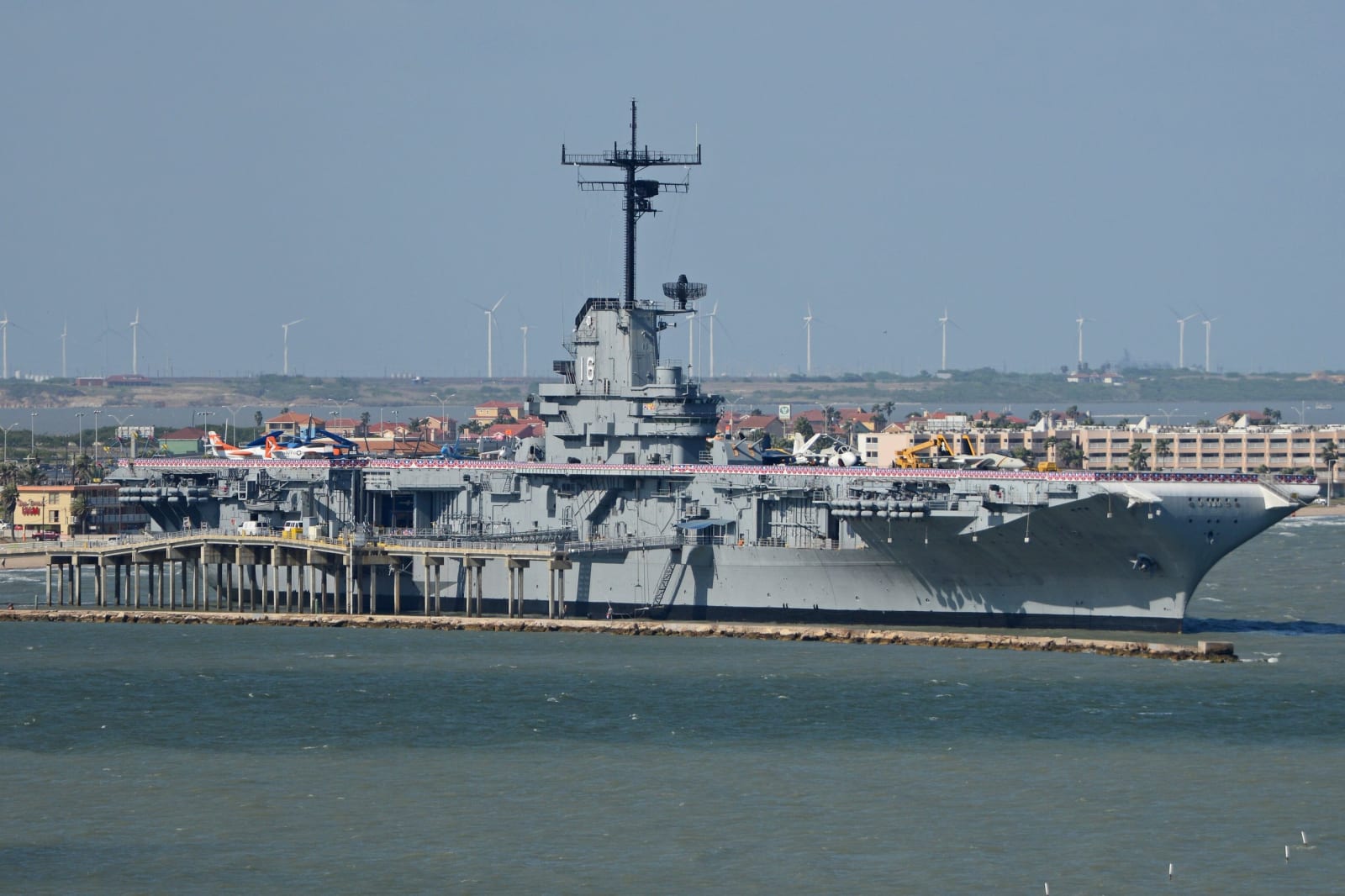
 Alan Wilson / CC BY-SA 2.0 via Wikimedia Commons
The Story
The ship was being finished at the Fore River yard in Massachusetts as the Cabot when word came that the first Lexington, CV-2, had been sunk at the Coral Sea. The new carrier took the name and was commissioned in February 1943. She spent twenty-one months in combat and took part in nearly every major operation in the Pacific; the museum credits her planes with 372 enemy aircraft destroyed in the air and 475 on the ground. On November 5, 1944, off Luzon, her aircraft sank the cruiser Nachi, and that afternoon a burning Japanese plane crashed near her island and wrecked most of it; her crew had the fires under control within twenty minutes. Japan announced her sunk at least four times, and Tokyo Rose called her the Blue Ghost.
After the war she was decommissioned, recommissioned in 1955 and from 1962 served nearly thirty years at Pensacola as the Navy's training carrier. In 1980 she became the first carrier with women stationed aboard as crew. When the Navy retired her in 1991, as its last Essex-class carrier, a Corpus Christi task force called Landing Force 16 won her with a $3 million city bond; she reached Naval Station Ingleside in January 1992 and opened as a museum that October. She is a National Historic Landmark, and the museum has never taken government operating money.
The flight deck runs 910 feet. The hangar bays hold a Pearl Harbor exhibit, scale models, a flight simulator and a giant-screen theater.
Visitor Info
On the Map
Nearby
The closest stops worth working into your route
Historical markers nearby
Roadside plaques and monuments within a short detour