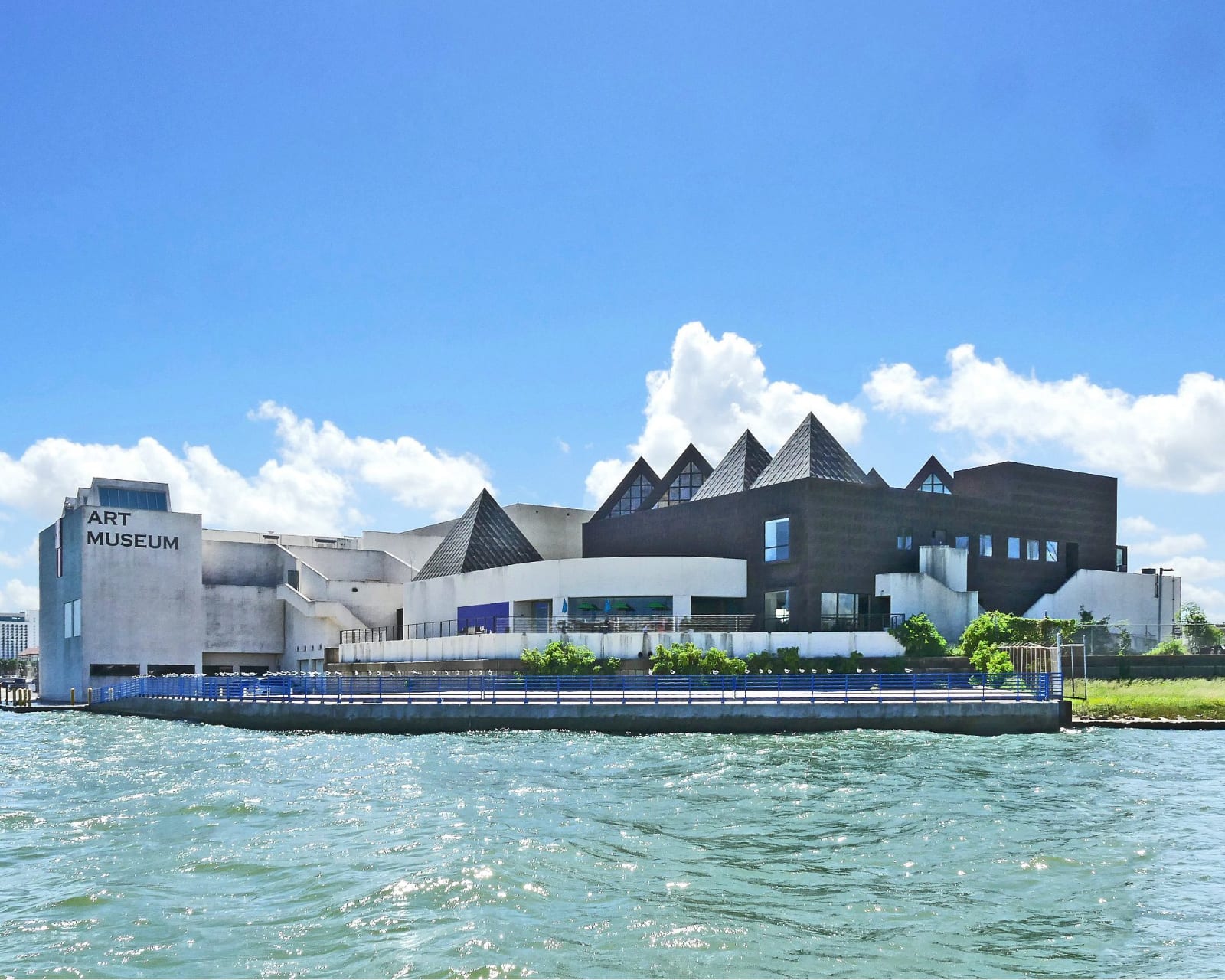
 Jim Evans / CC BY-SA 4.0 via Wikimedia Commons
The Story
The museum began as the city's Centennial Museum in 1936 and took its present name in 1945, when Corpus Christi gave it to two art groups. By the 1960s it was out of room, and two patrons, Patsy and Edwin Singer, went to New York to ask Philip Johnson for a building. He asked for $1 million; they raised it. Ground was broken in 1970 and the museum opened on the bayfront in 1972. It is often counted among Johnson's finest small public buildings and is an early example of postmodern architecture in the United States.
In 1998 the board hired the Mexican architect Ricardo Legorreta, who had just finished San Antonio's central library, to add to it. His William B. and Maureen Miller Wing opened in October 2006 and nearly doubled the museum's space. The museum has been affiliated with Texas A&M University-Corpus Christi since 1995.
The collection, of more than 2,000 works, is mostly from the Americas and above all from Texas: paintings, photographs, sculpture, ceramics, glass, works on paper and installations. Hurricane Hanna's surge flooded the barge dock in July 2020 without harming the art. Admission is free on the first Friday, second Saturday, third Thursday and fourth Sunday of each month.
Visitor Info
On the Map
Nearby
The closest stops worth working into your route
Historical markers nearby
Roadside plaques and monuments within a short detour