Home / West Virginia / The Central Mountains / Trans-Allegheny Lunatic Asylum
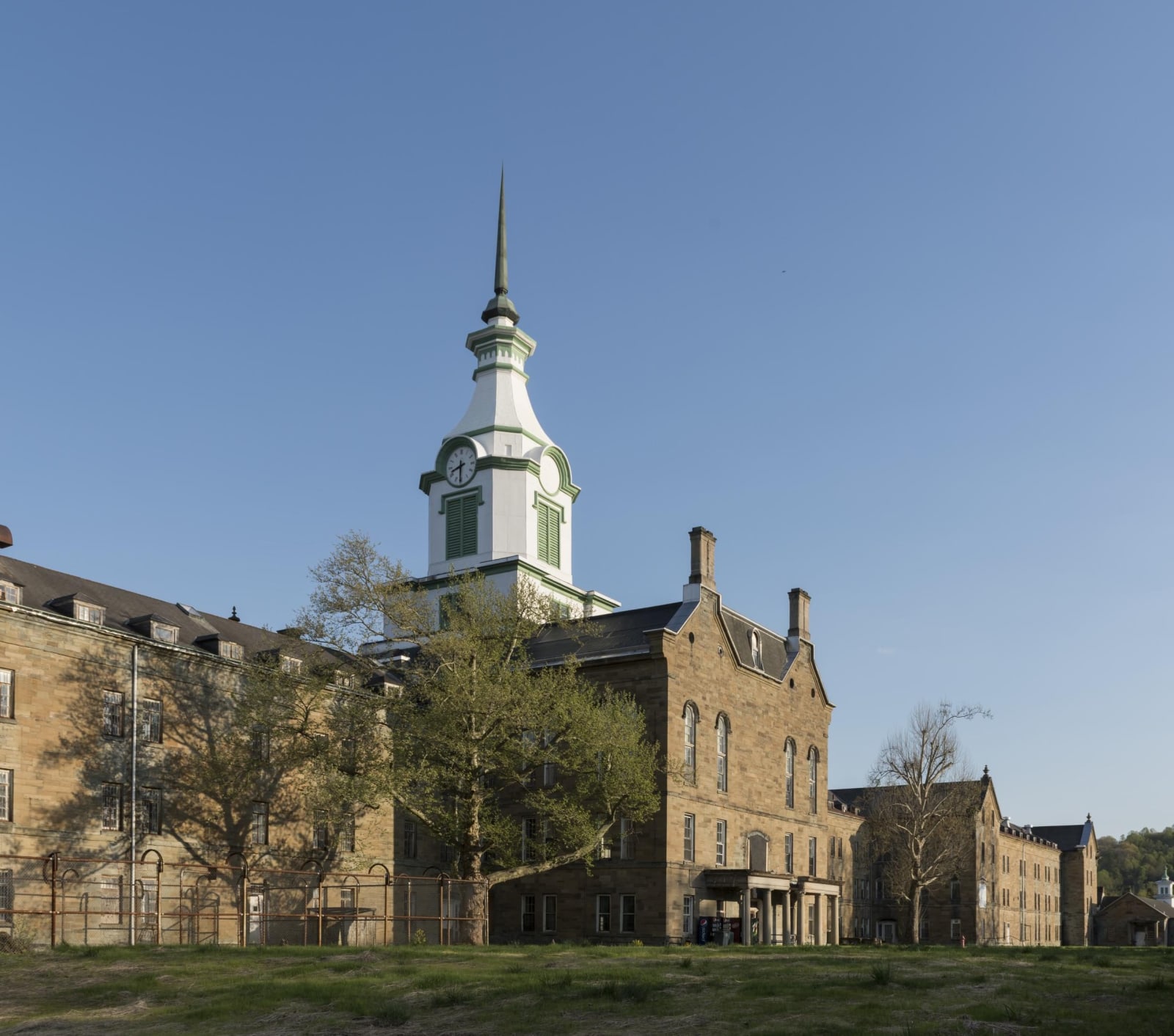
Long sandstone hospital wings meet under a tall white clock tower with green trim, seen across a lawn on a clear evening.Carol M. Highsmith / public domain via Library of Congress
🏛️Historical

Trans-Allegheny Lunatic Asylum

Part ofThe Central Mountains

Weston's hand-cut sandstone state hospital, open from 1864 to 1994, where a building meant for 250 patients held more than 1,800 by 1949.

⏱
Duration
One to three hours, depending on the tour.
🎟
Admission
Ticketed guided tours; prices vary by tour (asylum site, 2026).
📅
Best Season
Spring through fall for history tours, which close over winter; ghost hunts run year-round (asylum site, 2026).

The Story

Virginia authorized a third asylum for its western counties in the 1850s, and Lewis County, with friends in Richmond, got it. Work began across the West Fork from Weston late in 1858, first with prison labor, then with German and Irish masons who cut blue sandstone from a quarry at Mount Clare. Richard S. Andrews of Baltimore drew a Kirkbride plan, long wings meant to give each of 250 patients quiet, light and air. In June 1861 Union troops took the state's construction gold from a Weston bank to Wheeling, where the Reorganized Government of Virginia spent it finishing the work.

The first patients came on October 22, 1864. There were 717 by 1880 and more than 1,800 by 1949, when reporters found poor sanitation and too little furniture, light and heat. Black patients were kept in separate rooms from 1873. A patient's fire in 1935 destroyed six men's wards. Between 1952 and 1955 Walter Freeman's West Virginia Lobotomy Project operated on 787 people at the state's four hospitals, Weston among them, many without their consent. The hospital kept its own farm, dairy and cemetery, and how many people died here is still not counted.

The hospital closed in May 1994, pushed partly by a lawsuit from patients' families, and its people moved to the new Sharpe Hospital nearby. The state auctioned the building in 2007 and its private owner restored the old name. Choose a history tour over a ghost tour: the first-floor museum keeps patients' art-therapy work beside the restraints and hydrotherapy tub.

Visitor Info

⏱
Time Needed
One to three hours, depending on the tour.
🎟
Admission
Ticketed guided tours; prices vary by tour (asylum site, 2026).
📅
Best Season
Spring through fall for history tours, which close over winter; ghost hunts run year-round (asylum site, 2026).
🛣️
Highway
US 33 / US 19

On the Map

Nearby

The closest stops worth working into your route

historical4.1 mi away
Jackson's Mill
Stonewall Jackson's boyhood farm on the West Fork, worked by enslaved people, and since 1921 the country's first state 4-H camp.
historical9.8 mi away
Watters Smith Memorial State Park
A Harrison County pioneer farm on Duck Creek, settled by 1796 and kept by one family for 150 years, with log outbuildings and an 1876 farmhouse museum.
historical13 mi away
Buckhannon
Upshur County's seat on the Buckhannon River, home of West Virginia Wesleyan and the Strawberry Festival, named for a Lenape war leader or a Virginia colonel.
historical14 mi away
Pringle Tree Park
A hollow sycamore on the Buckhannon River, said to grow from the roots of the tree two Fort Pitt deserters lived in from about 1764 to 1767.
natural15 mi away
West Virginia Wildlife Center
The state's French Creek game farm of 1923, turned into a hillside zoo of native and once-native animals along a 1.25-mile forest trail.
historical18 mi away
Bulltown Historic Area
The salt licks where the Lenape leader Captain Bull's village stood until settlers destroyed it in 1772, later a turnpike crossing and an 1863 battlefield.

Historical markers nearby

Roadside plaques and monuments within a short detour

Marker0.2 mi away
Withers' Grave
Weston
Marker0.3 mi away
Weston
Weston
Marker0.4 mi away
Weston Colored School
Weston
Marker6 mi away
Gen. Lightburn
Jane Lew
Marker6.1 mi away
First M. P. Church
Jane Lew
Marker7 mi away
Harrison County/Lewis County
Jane Lew