Home / West Virginia / The Central Mountains / Jackson's Mill
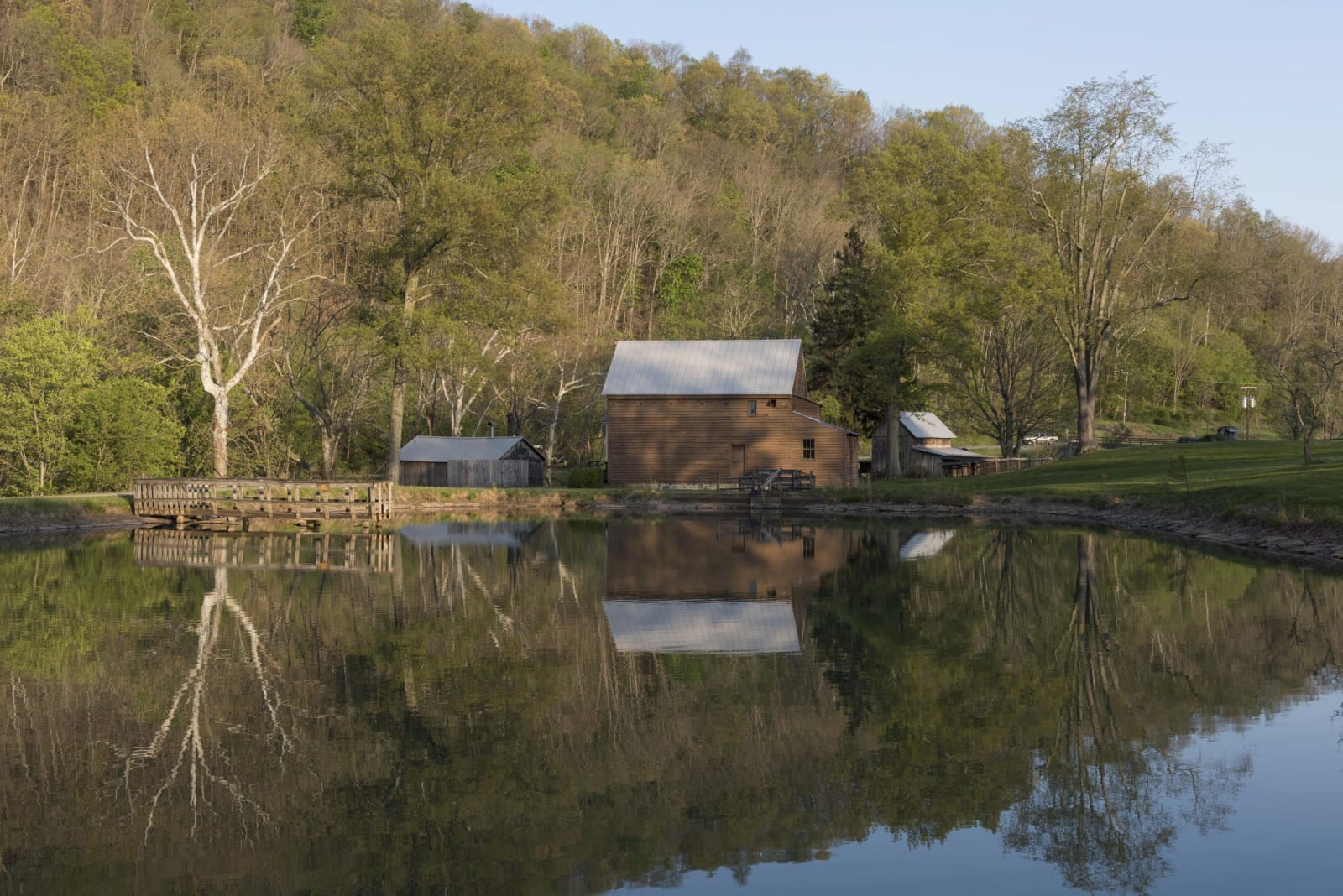
A brown timber mill and two small outbuildings stand beside a still pond that mirrors them, under a wooded spring hillside.Carol M. Highsmith / public domain via Library of Congress
🏛️Historical

Jackson's Mill

Part ofThe Central Mountains

Stonewall Jackson's boyhood farm on the West Fork, worked by enslaved people, and since 1921 the country's first state 4-H camp.

⏱
Duration
One hour.
🎟
Admission
No fee to walk the historic area; check with WVU Jackson's Mill for building hours.
📅
Best Season
Summer, when the historic area and camp are busiest; the grounds are open year-round.

The Story

Edward Jackson settled this bend of the West Fork around 1800 and built a house, a gristmill and a sawmill. After his parents died, in 1826 and 1831, the boy Thomas J. Jackson and his sister Laura came here to live with their uncle Cummins Jackson, a bachelor who farmed 1,500 acres of river bottom with the labor of several enslaved people. Thomas left for West Point in 1842. The gristmill that stands on the bank dates from about 1841.

He became a general of the Confederacy, a republic built to keep people enslaved, and in Lexington his own household held six: Amy, Hetty, George, Cyrus, Albert and Emma. The boulder the Daughters of the American Revolution set at the house site in 1915 praises his genius and Christian character and says nothing of them. It belongs to the same Lost Cause years that raised his statues across the South, and reads best as a record of that memory.

The place found another life in 1921, when West Virginia University Extension leaders chose it for the first state 4-H camp in the country. The Monongahela power company gave the first five acres, and the camp grew to about 500, with the 1926 Mount Vernon Dining Hall, cottages named for the counties that built them, the 1790s McWhorter cabin and Blaker's Mill, a 1794 Greenbrier County gristmill moved here in the 1980s. Walk the historic area by the river; the family cemetery is there too.

Visitor Info

⏱
Time Needed
One hour.
🎟
Admission
No fee to walk the historic area; check with WVU Jackson's Mill for building hours.
📅
Best Season
Summer, when the historic area and camp are busiest; the grounds are open year-round.
🛣️
Highway
US 19

On the Map

Nearby

The closest stops worth working into your route

historical4.1 mi away
Trans-Allegheny Lunatic Asylum
Weston's hand-cut sandstone state hospital, open from 1864 to 1994, where a building meant for 250 patients held more than 1,800 by 1949.
historical6 mi away
Watters Smith Memorial State Park
A Harrison County pioneer farm on Duck Creek, settled by 1796 and kept by one family for 150 years, with log outbuildings and an 1876 farmhouse museum.
historical15 mi away
Buckhannon
Upshur County's seat on the Buckhannon River, home of West Virginia Wesleyan and the Strawberry Festival, named for a Lenape war leader or a Virginia colonel.
historical15 mi away
Pringle Tree Park
A hollow sycamore on the Buckhannon River, said to grow from the roots of the tree two Fort Pitt deserters lived in from about 1764 to 1767.
natural19 mi away
West Virginia Wildlife Center
The state's French Creek game farm of 1923, turned into a hillside zoo of native and once-native animals along a 1.25-mile forest trail.
historical22 mi away
Bulltown Historic Area
The salt licks where the Lenape leader Captain Bull's village stood until settlers destroyed it in 1772, later a turnpike crossing and an 1863 battlefield.

Historical markers nearby

Roadside plaques and monuments within a short detour

Marker3.4 mi away
First M. P. Church
Jane Lew
Marker3.4 mi away
Gen. Lightburn
Jane Lew
Marker3.5 mi away
Harrison County/Lewis County
Jane Lew
Marker4 mi away
Weston Colored School
Weston
Marker4.2 mi away
Weston
Weston
Marker4.3 mi away
Withers' Grave
Weston