Home / West Virginia / The New River Gorge / Thurmond
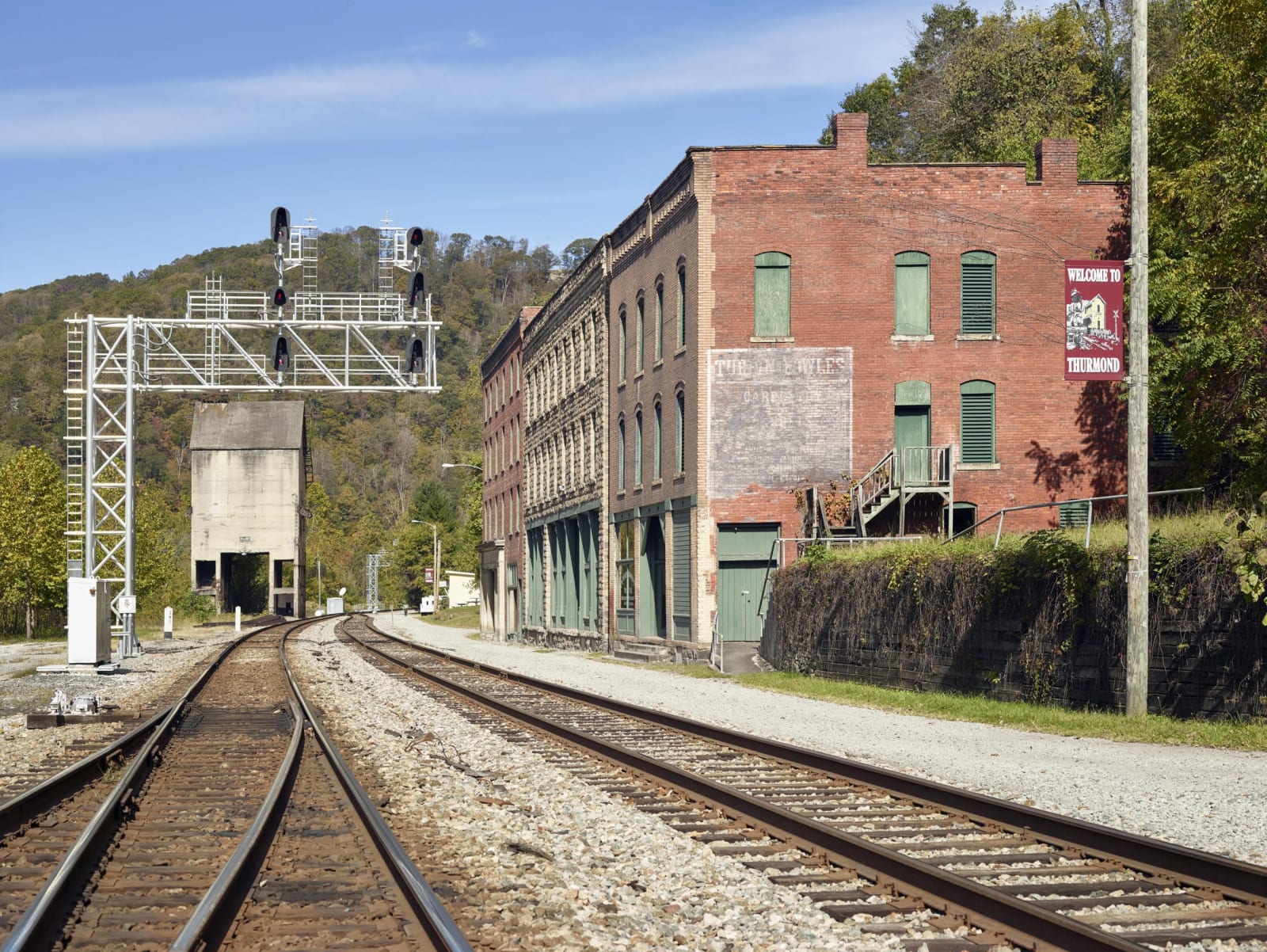
Railroad tracks run past a row of old brick commercial buildings and a concrete coaling tower in a wooded river valley.Carol M. Highsmith / public domain via Library of Congress
🏛️Historical

Thurmond

Part ofThe New River Gorge

The C&O railroad town at the bottom of the gorge, first in revenue on the line in 1910, with its restored depot and an empty business block kept by the Park Service.

⏱
Duration
One to two hours.
🎟
Admission
Free (NPS, 2026).
📅
Best Season
Late May to October. The depot visitor center is open daily from Memorial Day weekend through Labor Day weekend and on weekends in September and October (NPS, 2025).

The Story

William Dabney Thurmond bought 73 acres beside the new Chesapeake and Ohio mainline in 1873, the year the line was finished through the gorge, and the town that grew on it became the railroad's hub for the New River coalfield. Feeder lines came down from the mines to a yard with water tanks, coaling facilities and engine shops. In 1910 the C&O's operation at Thurmond led the railroad in revenue, originating more freight than Cincinnati and Richmond combined, and about 75,000 passengers came through that year on as many as fifteen passenger trains a day.

Captain Thurmond, a strict Baptist, owned nearly all the land and kept saloons and brothels out of his town. They went across the river to the neighborhood called Ballyhack, where a poker game at the Dunglen hotel ran for 14 years before an arsonist burned the building. Thurmond reached 462 residents in 1930. The Depression, good roads, two large fires and finally the C&O's change from steam to diesel in the 1950s emptied it, since diesels needed none of the town's water, coal or repair work.

The town is still incorporated and still holds a reunion for former residents. The Park Service restored the depot as a visitor center in 1995 and has stabilized more than twenty other buildings, including the trackside business block of Commercial Row. Freight and Amtrak trains still pass. The way down is WV 25 from Glen Jean, seven miles of narrow, winding road, and Thurmond is also a put-in for rafters on the New.

Visitor Info

⏱
Time Needed
One to two hours.
🎟
Admission
Free (NPS, 2026).
📅
Best Season
Late May to October. The depot visitor center is open daily from Memorial Day weekend through Labor Day weekend and on weekends in September and October (NPS, 2025).
🛣️
Highway
WV 25

On the Map

Nearby

The closest stops worth working into your route

industrial5.9 mi away
Kaymoor
The Low Moor Iron Company's mine town on the south wall of the gorge, worked from 1899 to 1962 and reached by a miners' trail of switchbacks and stairs.
historical6.5 mi away
Fayetteville Historic District
The Fayette County seat on the plateau above the gorge, wrecked in the Civil War, a courtroom town for the coalfield, revived by the bridge and the rivers.
industrial6.6 mi away
Nuttallburg
John Nuttall's 1870s coal town at the mouth of Short Creek, where the conveyor and tipple of Henry Ford's mines still climb the north wall of the gorge.
natural7.5 mi away
Babcock State Park
A 4,127-acre Depression-era park on Glade Creek, built by the CCC from local stone and blight-killed chestnut, with the 1976 Glade Creek Grist Mill.
natural7.5 mi away
New River Gorge National Park and Preserve
The national park around the longest and deepest river gorge in the Appalachians, entered at Canyon Rim beside the 1977 steel arch bridge.
natural9.1 mi away
Grandview
The rim park above the deepest part of the gorge, 1,400 feet over the New River, with Catawba rhododendrons in May and outdoor drama in summer.

Historical markers nearby

Roadside plaques and monuments within a short detour

Marker3.8 mi away
Oak Hill Railroad Depot
Oak Hill
Marker4.6 mi away
Bank of Glen Jean
Glen Jean
Marker5.7 mi away
Indirect Firing
Fayetteville
Marker6 mi away
DuBois High School
Mount Hope
Marker6.5 mi away
Segregated Coal Town
Nuttallburg
Marker6.6 mi away
Battle of Fayetteville
Fayetteville