Home / West Virginia / The New River Gorge / Babcock State Park
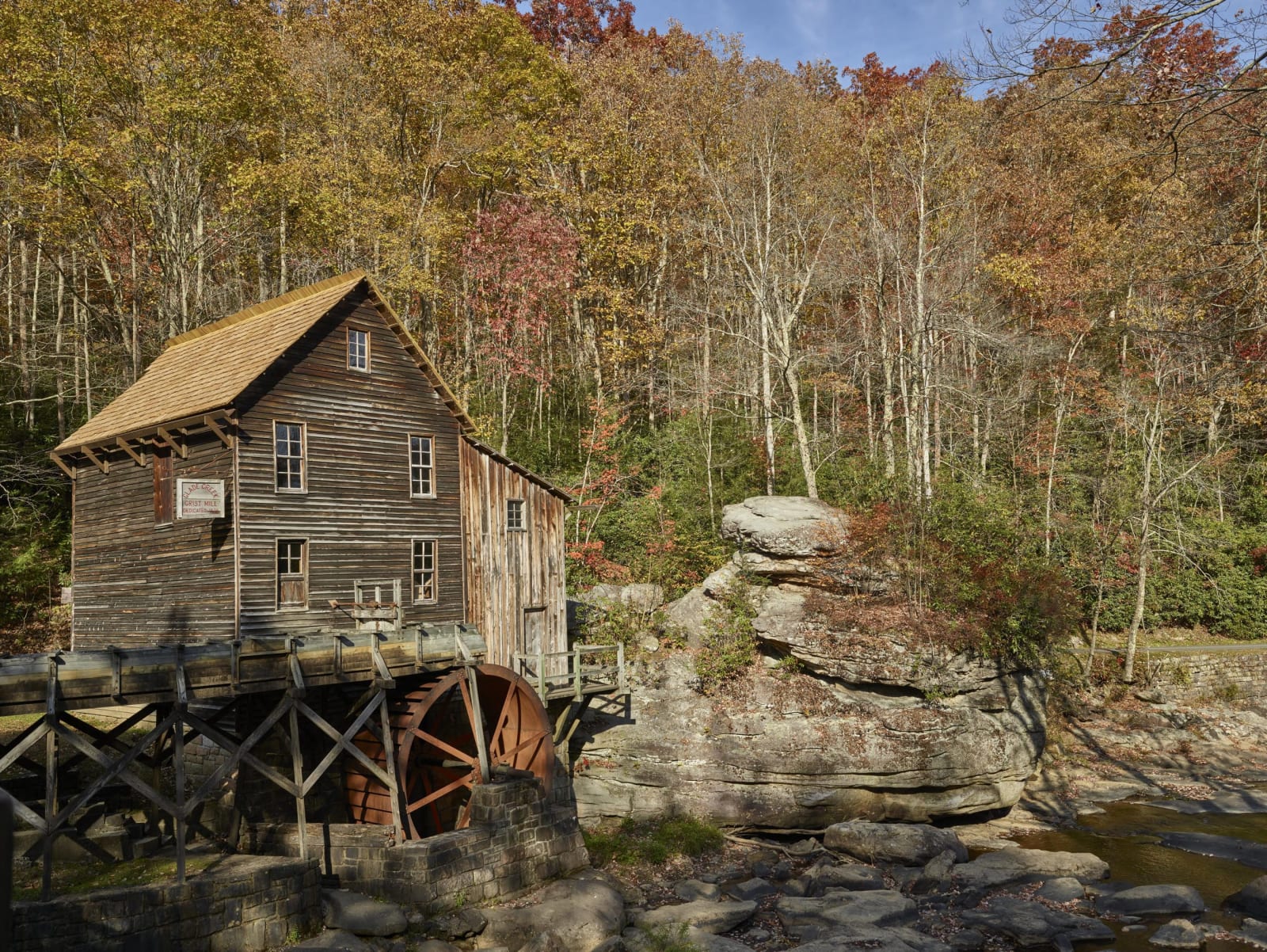
A weathered wooden grist mill with a red water wheel sits on rocks beside a creek, under autumn woods.Carol M. Highsmith / public domain via Library of Congress
🌲Natural

Babcock State Park

Part ofThe New River Gorge

A 4,127-acre Depression-era park on Glade Creek, built by the CCC from local stone and blight-killed chestnut, with the 1976 Glade Creek Grist Mill.

⏱
Duration
One hour at the mill; a day with the trails.
🎟
Admission
Free day use; cabins and campsites are charged (2026).
📅
Best Season
Year round; the campground is open spring through fall. The mill grinds when the creek allows (West Virginia State Parks, 2026).

The Story

Logging and the fires that followed had stripped these hillsides bare when two Civilian Conservation Corps camps, Camp Beaver and Camp Lee, opened at Clifftop in the 1930s. Between 1934 and 1937 the young enrollees built the headquarters, 13 cabins, a stable, the superintendent's house and the picnic grounds from stone quarried in the park and American chestnut killed by the blight, and forged the door latches and other ironwork on site. The park opened on July 1, 1937, one of the state's earliest. By the mid-1950s the forest had grown back over the ridges and native trout were in the streams again.

The much-photographed Glade Creek Grist Mill near headquarters is not old. J. C. Boley, a CCC enrollee at Babcock who became its superintendent and later an assistant chief of the state parks, conceived it to recall Cooper's Mill, which stood where the administration building's parking lot is now. Dedicated in 1976, it was assembled from the parts of older West Virginia mills, its frame from the 1890 Stoney Creek mill near Marlinton, and it grinds cornmeal that is sold when the water allows.

More than 20 miles of trails follow Glade Creek and Manns Creek through rhododendron toward the New River, and the 19-acre Boley Lake, a campground and more cabins were added from the 1960s. Acid drainage from strip mines once fouled Glade Creek so badly that a modern pool replaced the natural one in the 1970s. Drone flyers must check in at the park office.

Visitor Info

⏱
Time Needed
One hour at the mill; a day with the trails.
🎟
Admission
Free day use; cabins and campsites are charged (2026).
📅
Best Season
Year round; the campground is open spring through fall. The mill grinds when the creek allows (West Virginia State Parks, 2026).
🛣️
Highway
WV 41

On the Map

Nearby

The closest stops worth working into your route

industrial6.8 mi away
Nuttallburg
John Nuttall's 1870s coal town at the mouth of Short Creek, where the conveyor and tipple of Henry Ford's mines still climb the north wall of the gorge.
historical7.5 mi away
Thurmond
The C&O railroad town at the bottom of the gorge, first in revenue on the line in 1910, with its restored depot and an empty business block kept by the Park Service.
industrial8.1 mi away
Kaymoor
The Low Moor Iron Company's mine town on the south wall of the gorge, worked from 1899 to 1962 and reached by a miners' trail of switchbacks and stairs.
natural9.4 mi away
New River Gorge National Park and Preserve
The national park around the longest and deepest river gorge in the Appalachians, entered at Canyon Rim beside the 1977 steel arch bridge.
historical10 mi away
Fayetteville Historic District
The Fayette County seat on the plateau above the gorge, wrecked in the Civil War, a courtroom town for the coalfield, revived by the bridge and the rivers.
natural12 mi away
Grandview
The rim park above the deepest part of the gorge, 1,400 feet over the New River, with Catawba rhododendrons in May and outdoor drama in summer.

Historical markers nearby

Roadside plaques and monuments within a short detour

Marker2.3 mi away
Camp Washington-Carver
Clifftop
Marker3.4 mi away
Andrew & Charles Lewis March
Hilton Village
Marker4.9 mi away
Layland Mine Disaster
Layland
Marker6.5 mi away
Spy Rock
Lookout
Marker6.9 mi away
Segregated Coal Town
Nuttallburg
Marker7.1 mi away
Gen. Robert E. Lee
Rainelle