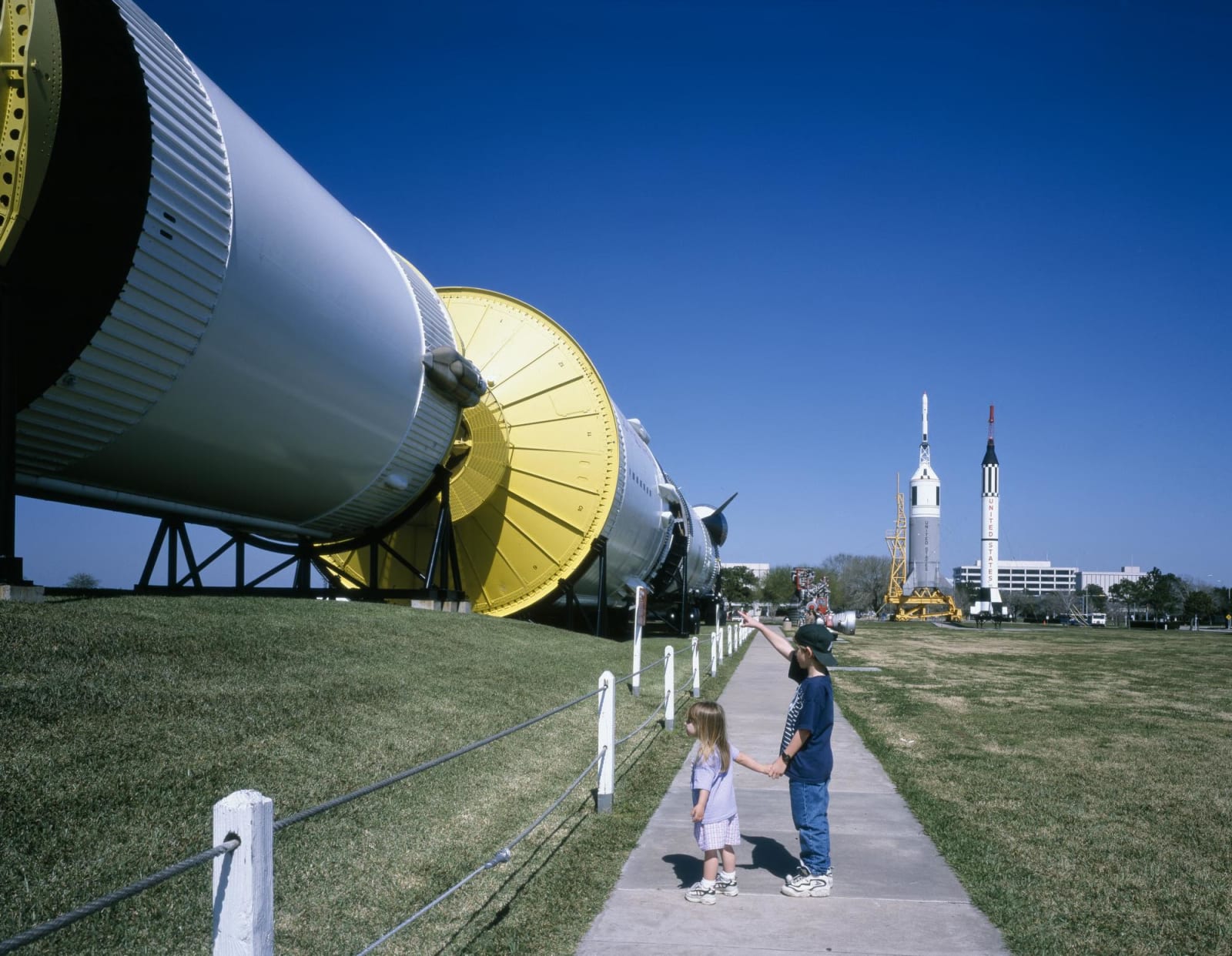
 Carol M. Highsmith / public domain via the Library of Congress
The Story
On September 19, 1961, NASA announced that its new Manned Spacecraft Center would be built at the edge of Clear Lake, an inlet of Galveston Bay, on a thousand acres Rice University was to transfer to the government. The center opened in September 1963 and became Mission Control for human flights beginning with Gemini 4. It was renamed the Lyndon B. Johnson Space Center on August 17, 1973.
Space Center Houston opened in 1992 as its official visitor center, run by a nonprofit foundation rather than by NASA, and became a Smithsonian Affiliate in 2014. Its starship gallery holds three flown spacecraft: Gordon Cooper's Mercury capsule Faith 7, the Gemini 5 capsule, and America, the Apollo 17 command module that orbited the Moon in December 1972 on the last crewed lunar mission. Outside, Independence Plaza sets a full-scale shuttle replica on NASA 905, one of the two Boeing 747s that carried the orbiters, and visitors can walk through both.
The open-air tram leaves for the Johnson Space Center itself, with stops that include Building 30, home of the restored Apollo-era Mission Operations Control Room, and Rocket Park, where a Saturn V lies assembled from stages built for flight and left over when the last Apollo missions were cancelled.
Visitor Info
On the Map
Nearby
The closest stops worth working into your route
Historical markers nearby
Roadside plaques and monuments within a short detour