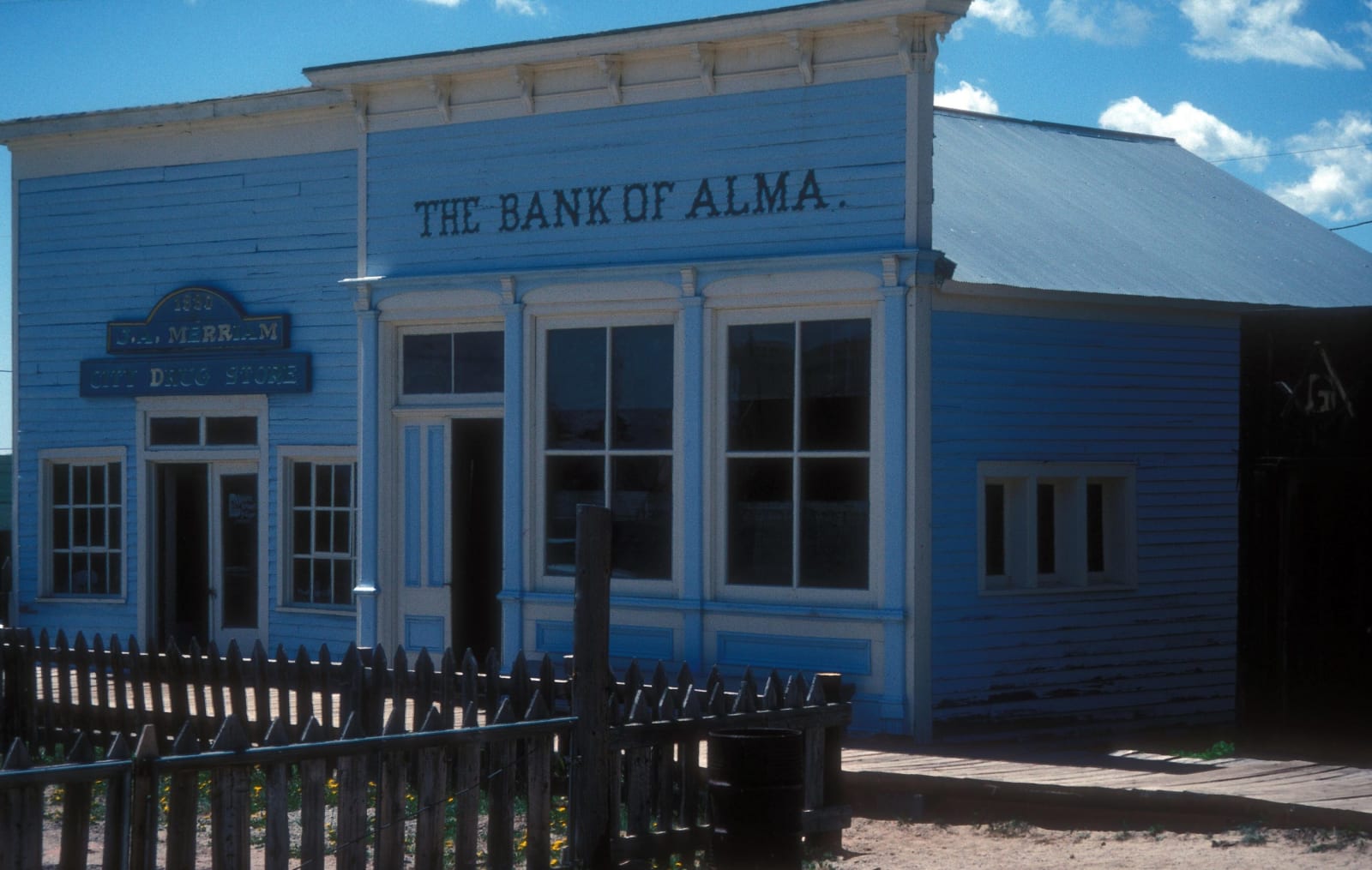
 Jerrye and Roy Klotz MD / CC BY-SA 3.0 via Wikimedia Commons
The Story
In the 1950s Leon Snyder, a Colorado Springs lawyer who spent his free time fishing the streams of South Park, kept coming on the remains of mining camps falling to weather and vandals in the gulches. With Everett Bair, Fairplay's unofficial historian, he set out to save what could be moved. He wanted, he said, buildings in movable condition that would together make a complete town, and he particularly did not want an imitation one.
Owners donated buildings or sold them for little, Park County lent a bulldozer to clear the way, and from 1957 cabins, shops and a saloon came in on trucks from Alma and other camps across the 900-square-mile basin. South Park City opened in 1959 for the centennial of Fairplay and the gold rush, around a handful of buildings that already stood on the lot, and the collection was essentially complete by 1966: about forty buildings, among them Rache's saloon from Alma, a brewery, a post office, a dentist's office and a mine shaft, stocked with tens of thousands of objects, and a Denver, South Park and Pacific locomotive of the type that worked the line over the passes.
Moved buildings rarely qualify for the National Register, but the museum was listed in 2014 as what it had become after half a century: an example of how the 1950s set out to preserve the frontier. It opens from mid-May to mid-October on Front Street in Fairplay, in the basin whose name was later borrowed for an animated television series.
Visitor Info
On the Map
Nearby
The closest stops worth working into your route