Home / Texas / La Grange, Gonzales & the Painted Churches / San Felipe de Austin State Historic Site
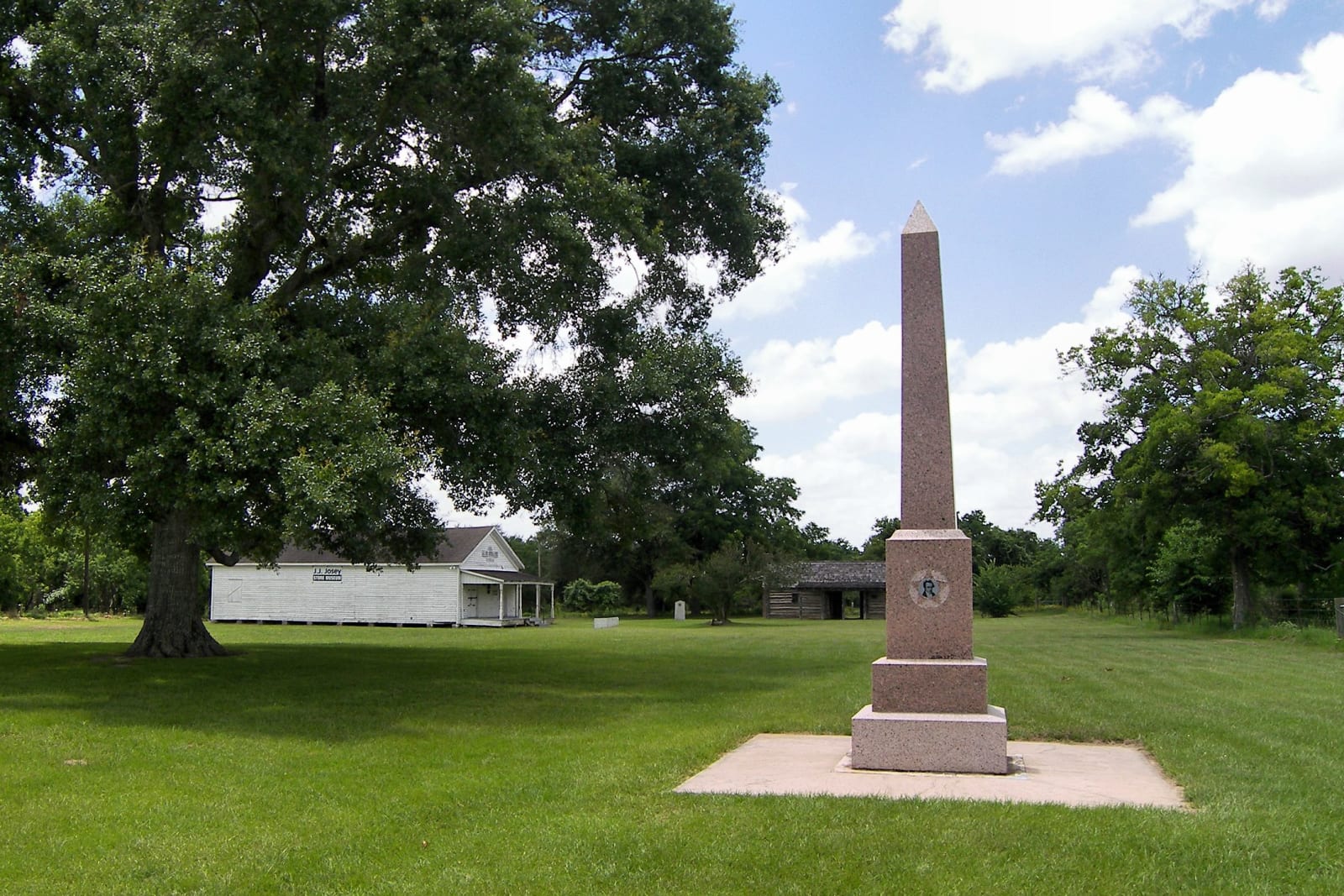
The commemorative obelisk at San Felipe de Austin State Historic Site, standing on a lawn beside a large oak, with a log building in the distance.Larry D. Moore / CC BY 4.0 via Wikimedia Commons
🏛️Historical

San Felipe de Austin State Historic Site

Part ofLa Grange, Gonzales & the Painted Churches

Stephen F. Austin's colonial capital on a Brazos bluff, the town of the Consultation and the first Texas newspapers, burned by its own garrison in the Runaway Scrape of 1836.

⏱
Duration
One to two hours for the museum and townsite.
🎟
Admission
Adults $10; seniors, veterans, teachers and first responders $8; children 6-17 $5; 5 and under free; family (two adults and a child) $22.
📅
Best Season
Year round, Tuesday to Sunday 9 a.m. to 5 p.m. The enslaved-people exhibit, Bypassed by Freedom but Building a Legacy, runs from Memorial Day weekend through Labor Day.

The Story

Stephen F. Austin chose a high bluff over the Brazos near John McFarland's ferry in 1823, after first considering the lower Colorado. The governor of the Eastern Interior Provinces, Felipe de la Garza, proposed the name, for the empresario and for his own patron saint. Surveyor Seth Ingram laid out a Mexican grid of avenues and four plazas, and the town sprawled along the Atascosito Road instead. In 1828 it had about 200 people, ten of them Hispanic, and men outnumbered women ten to one.

San Felipe was where the colony did its business. The land office was here; seven mail routes met here from 1826; the Texas Gazette began on September 25, 1829, and Gail Borden's Telegraph and Texas Register on October 10, 1835. The Conventions of 1832 and 1833 met here, and the Consultation of November 1835 made it the seat of the provisional government until the March 1836 convention at Washington-on-the-Brazos. The cotton plantations in the bottoms around it were worked by enslaved people, whose stories the site has made the subject of a summer exhibit.

On March 30, 1836, Moseley Baker's garrison ordered the town evacuated and burned it to keep it from Santa Anna. It never recovered; Bellville took the county seat in 1846. The museum holds a field desk of Austin's, an 1830s printing press and artifacts from excavations of the townsite.

Visitor Info

⏱
Time Needed
One to two hours for the museum and townsite.
🎟
Admission
Adults $10; seniors, veterans, teachers and first responders $8; children 6-17 $5; 5 and under free; family (two adults and a child) $22.
📅
Best Season
Year round, Tuesday to Sunday 9 a.m. to 5 p.m. The enslaved-people exhibit, Bypassed by Freedom but Building a Legacy, runs from Memorial Day weekend through Labor Day.
🛣️
Highway
I-10 / FM 1458

On the Map

Nearby

The closest stops worth working into your route

natural15 mi away
Attwater Prairie Chicken National Wildlife Refuge
Ten thousand acres of native coastal prairie northeast of Eagle Lake, kept for a critically endangered grouse, many of whose birds are hatched in captivity and released here.
historical28 mi away
Stafford Opera House
A cattleman's bank and theater of 1886 on the Columbus square, in a river town Sam Houston burned in 1836 and a county marked by a long feud and a 1935 lynching.
historical36 mi away
Star of the Republic Museum
A star-shaped museum of the Republic of Texas years, 1836 to 1846, built at Washington-on-the-Brazos after a Brenham campaign and opened on March 1, 1970.
historical36 mi away
Washington-on-the-Brazos State Historic Site
The townsite on the Brazos where delegates met in a cold, unfinished hall in March 1836 to declare Texas independent, with Independence Hall rebuilt and Anson Jones's Barrington farm worked as in 1850.
historical39 mi away
Independence and Old Baylor Park
A crossroads north of Brenham that was the richest town in Texas when it won Baylor University in 1845, refused the railroad, and lost the college to Waco and Belton in 1886.
cultural40 mi away
Round Top and Festival Hill
A German village on the old La Bahía Road, named for a house tower, with an 1867 stone church, a Fourth of July kept since 1851 and a concert hall a pianist built without blueprints.

Historical markers nearby

Roadside plaques and monuments within a short detour

Marker0.1 mi away
Early Roads to San Felipe
San Felipe
Marker0.1 mi away
Stephen F. Austin
San Felipe
Marker0.2 mi away
J. J. Josey General Store
San Felipe
Marker0.2 mi away
Near This Site Stood a Town Hall
San Felipe
Marker0.6 mi away
San Felipe de Austin Cemetery
San Felipe
Marker0.9 mi away
On This Site Stood the Only Home Owned in Texas by Stephen F. Austin
San Felipe