Home / Tennessee / Nashville & the Cumberland / Ryman Auditorium
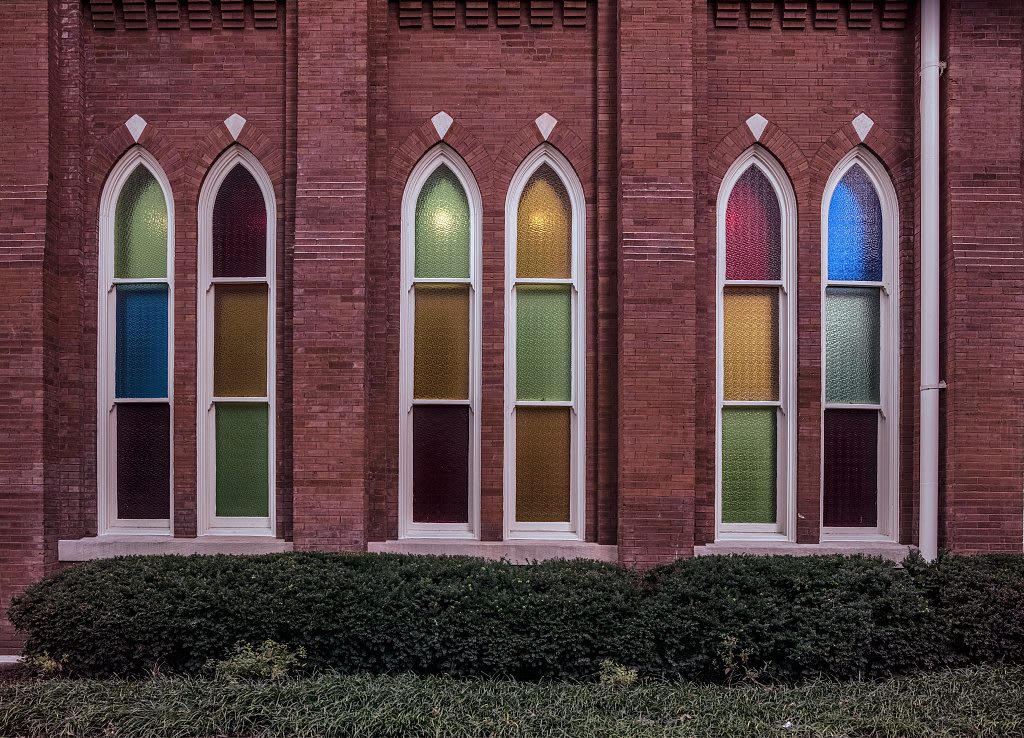
Tall arched stained-glass windows set in the red brick side wall of the Ryman Auditorium.Carol M. Highsmith / public domain via Library of Congress
🎭Cultural

Ryman Auditorium

Part ofNashville & the Cumberland

The 1892 brick tabernacle in downtown Nashville that was the Grand Ole Opry's home from 1943 to 1974, now a National Historic Landmark and working concert hall.

⏱
Duration
One to two hours for a tour, an evening for a show.
🎟
Admission
Show tickets and daytime tours are sold by the Ryman; prices vary (2026).
📅
Best Season
Year round; the Ryman books concerts and daytime tours throughout the year.

The Story

Steamboat captain Tom Ryman and the preacher Sam Jones raised the money for a gospel tabernacle, and the Nashville architect Hugh Thompson gave it a Victorian Gothic brick front with steep gables and tall pointed windows. It opened in 1892 as the Union Gospel Tabernacle and took Ryman's name after he died in 1904. For decades it was the city's big room for lectures, opera and touring acts. Booker T. Washington spoke here, and Marian Anderson sang in 1932.

The building also carries the South's racial order in plain sight. The balcony, added in 1897 with money from the Confederate Veterans Association, was called the Confederate Gallery until a 2017 plaque replaced that name. Tennessee's Jim Crow laws called for segregated audiences, and some shows were billed for "White Audiences Only" or "Colored Audiences Only," though period photographs show mixed crowds in practice. The Fisk Jubilee Singers performed here in 1913.

The Grand Ole Opry broadcast its weekly show over WSM from this stage from 1943 to 1974, and the honky-tonks along the alley behind it, Tootsie's Orchid Lounge among them, grew up around those nights. After the Opry left for Opryland the hall was nearly lost. It was stabilized in 1988-90, restored in the 1990s and named a National Historic Landmark in 2001. Today it is a working concert hall with daytime tours.

Visitor Info

⏱
Time Needed
One to two hours for a tour, an evening for a show.
🎟
Admission
Show tickets and daytime tours are sold by the Ryman; prices vary (2026).
📅
Best Season
Year round; the Ryman books concerts and daytime tours throughout the year.
🛣️
Highway
Rep. John Lewis Way North

On the Map

Nearby

The closest stops worth working into your route

cultural0.1 mi away
National Museum of African American Music
A downtown Nashville museum, opened in 2021, tracing gospel, blues, jazz, rhythm and blues and hip-hop through Black history from 1619 to 2016.
historical0.2 mi away
Civil Rights Room at the Nashville Public Library
A room in the downtown library with a circular lunch counter, a timeline and oral histories of the 1960 Nashville sit-ins, a few blocks from the stores where they began.
architectural0.4 mi away
Tennessee State Capitol
William Strickland's Greek Revival capitol on Nashville's Capitol Hill, finished in 1859 and built from the bottom up with the labor of enslaved men.
historical1.1 mi away
Fort Negley
The largest inland stone fort of the Civil War, built in 1862 on St. Cloud Hill by more than 2,700 conscripted Black laborers, hundreds of whom died.
historical1.6 mi away
Fisk University and Jubilee Hall
The 1866 school for freed people whose Jubilee Singers paid for Jubilee Hall, a National Historic Landmark, and whose students helped start Nashville's sit-ins.
historical9.9 mi away
Andrew Jackson's Hermitage
Andrew Jackson's cotton plantation east of Nashville, where visitors can walk to the quarters, Alfred's Cabin and the Enslaved Cemetery as well as the mansion.

Historical markers nearby

Roadside plaques and monuments within a short detour

Marker0 mi away
Birth of Bluegrass
Nashville
Marker0.2 mi away
Downtown Presbyterian Church
Nashville
Marker0.2 mi away
Maxwell House Hotel
Nashville
Marker0.2 mi away
First Masonic Hall
Nashville
Marker0.2 mi away
Sampson W. Keeble
Nashville
Marker0.3 mi away
War Memorial Auditorium Building
Nashville