Home / Georgia / The Okefenokee & Southeast Georgia / Okefenokee National Wildlife Refuge: Suwannee Canal Recreation Area
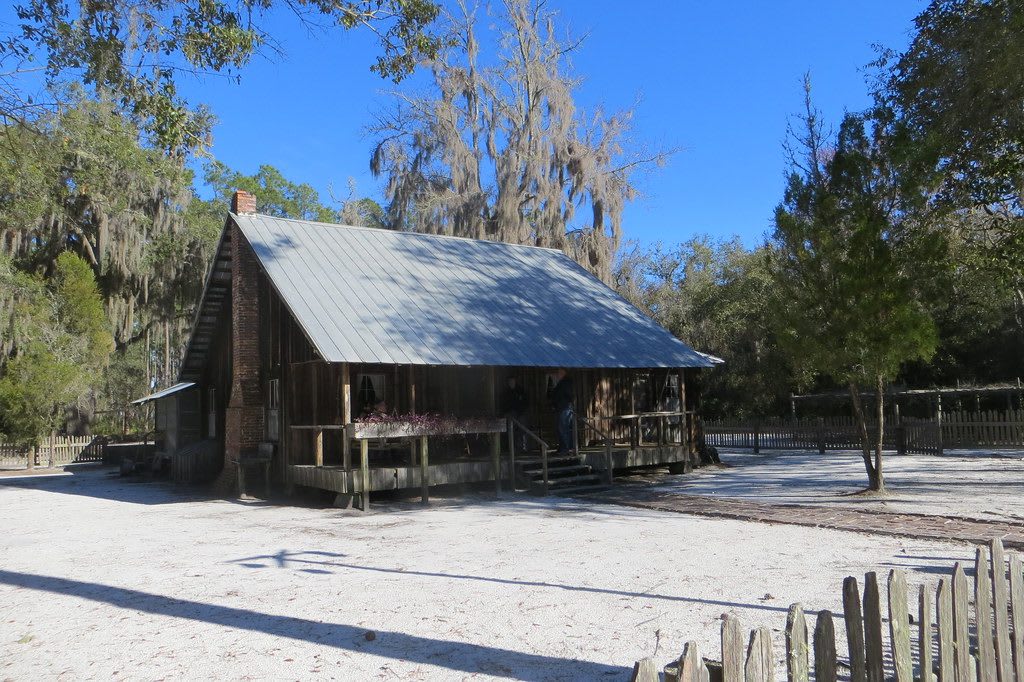
The weathered board-and-batten Chesser Island homestead with a tin roof and porch, set on swept white sand under moss-hung trees.NatalieMaynor / CC BY 2.0 via Flickr
🌲Natural

Okefenokee National Wildlife Refuge: Suwannee Canal Recreation Area

Part ofThe Okefenokee & Southeast Georgia

The refuge's main east entrance near Folkston: the 1891 drainage canal, the Chesser Island homestead, a boardwalk and tower, and the roads a Black CCC company built.

⏱
Duration
Half a day for the drive, boardwalk and visitor center; a full day with a boat tour or paddle.
🎟
Admission
$5 per vehicle, valid seven days; $15 annual refuge pass; federal passes accepted (USFWS, 2026).
📅
Best Season
Year round; fall through spring is coolest and brings sandhill cranes, while summer is hot and buggy. The recreation area opens 30 minutes before sunrise and closes at 5:30 p.m. November to February and 7:30 p.m. March to October (USFWS, 2026).

The Story

People lived in and around the Okefenokee for thousands of years before Europeans came, and during the Weeden Island and Savannah periods, roughly A.D. 500 to 1200, they raised sand mounds on its islands. Spanish records called the swamp Laguna de Oconi, and Timucuan villages and Spanish missions stood in or near it between 1620 and 1656. Later it was Muscogee (Creek) hunting ground and a refuge for the Seminole, until 1838, when Georgia militia and U.S. troops ringed it with forts and burned a Seminole village on the island they renamed for Charles Rinaldo Floyd. The name itself most likely comes from Hitchiti words for bubbling water.

The ditch at the start of Swamp Island Drive is the Suwannee Canal, dug from 1891 by a company that bought the swamp from the state and meant to drain it for farms and cypress logging; it went broke within a few years. Farther in, the W. T. Chesser family settled Chesser Island in 1858, and the house standing now was built by Tom and Iva Chesser in 1927. The last Chessers left in 1958.

When Roosevelt created the refuge in 1937, CCC Company 1433, an all-Black unit of 181 young men, came from Douglas to a camp seven miles from Folkston and stayed until November 1941, building roads and facilities still in use and clearing the canoe trails. Stop at the Richard S. Bolt Visitor Center, drive the seven-mile loop past the homestead, and walk the boardwalk to Owl's Roost Tower over Chesser Prairie. In 2026 the refuge became a World Heritage Site.

Visitor Info

⏱
Time Needed
Half a day for the drive, boardwalk and visitor center; a full day with a boat tour or paddle.
🎟
Admission
$5 per vehicle, valid seven days; $15 annual refuge pass; federal passes accepted (USFWS, 2026).
📅
Best Season
Year round; fall through spring is coolest and brings sandhill cranes, while summer is hot and buggy. The recreation area opens 30 minutes before sunrise and closes at 5:30 p.m. November to February and 7:30 p.m. March to October (USFWS, 2026).
🛣️
Highway
GA 121

On the Map

Nearby

The closest stops worth working into your route

roadside10 mi away
Folkston Funnel Railfan Platform
A covered train-watching platform in downtown Folkston where the CSX main line funnels nearly all Florida rail traffic, with dozens of trains a day and the Auto Train.
natural15 mi away
Okefenokee State Park
The western gateway into the Okefenokee, formerly Stephen C. Foster State Park: Billys Lake, the cypress logged by rail a century ago, boat tours and some of the darkest skies in the Southeast.
natural23 mi away
Okefenokee Swamp Park
The nonprofit north entrance to the Okefenokee south of Waycross, run since 1946: boardwalks, a 90-foot tower, boat tours, a swamp railroad and Pioneer Island.
natural28 mi away
Laura S. Walker State Park
A New Deal park on worn-out farmland near Waycross, the first Georgia park named for a woman: a 120-acre lake, pitcher plants, gopher tortoises and a golf course.
natural35 mi away
Cumberland Island National Seashore
Georgia's largest and southernmost barrier island, reached by passenger ferry from St. Marys: maritime forest, 18 miles of beach and the ruins of Dungeness.
cultural37 mi away
Okefenokee Heritage Center
Waycross's regional history and arts center: a 1912 Baldwin steam locomotive, Native and Black heritage exhibits, a Sacred Harp room, Gram Parsons and an 1830s house.

Historical markers nearby

Roadside plaques and monuments within a short detour

Marker7.4 mi away
Oldest Industry in Charlton
Folkston
Marker10 mi away
Center Village or Centerville
Folkston
Marker16 mi away
Treaty of Coleraine
Folkston
Marker28 mi away
Vereen Bell Highway
Waycross
Marker29 mi away
Floyds' Fairfield and Bellview Plantations
Colesburg
Marker29 mi away
Camden County
Woodbine