Home / Mississippi / The Mississippi Delta / Mound Bayou
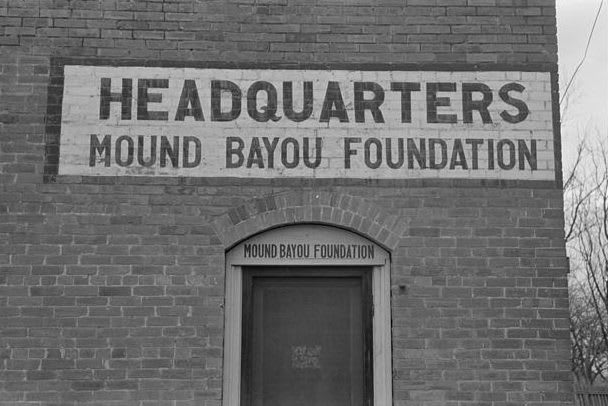
A 1939 photograph of a brick wall with a painted sign reading Headquarters, Mound Bayou Foundation, above an arched doorway also marked Mound Bayou Foundation.Russell Lee / public domain via Library of Congress (FSA/OWI, 1939)
🏛️Historical

Mound Bayou

Part ofThe Mississippi Delta
On this driveUS 61, the Blues Highway: Vicksburg to Clarksdale

The Bolivar County town founded in 1887 by men who had been enslaved at Davis Bend, built to be Black-owned, home of Taborian Hospital and a museum on Roosevelt Street.

⏱
Duration
One to two hours.
🎟
Admission
Check ahead; the museum's hours and any fee are not published reliably.
📅
Best Season
Year round; confirm the museum is open before driving out.

The Story

Mound Bayou was founded in July 1887 by Isaiah T. Montgomery, his cousin Joshua P. T. Montgomery and Benjamin T. Green, all of whom had been enslaved at Davis Bend, as a town where Black families would own the land. A railroad needed settlers, and Isaiah Montgomery, its land agent, recruited people to clear swampland for themselves in a country of plantations. The townsite lay near older Chickasaw burial mounds.

By the early 1900s the town had banks, cotton gins, a sawmill and a school system outside the control of the white towns around it, and it drew the notice of Booker T. Washington, Theodore Roosevelt and Julius Rosenwald. In 1942 the Knights and Daughters of Tabor opened Taborian Hospital, an Art Deco building designed by McKissack and McKissack, with Black physicians on staff. Its chief surgeon, Dr. T. R. M. Howard, housed Black reporters and witnesses in his home during the Emmett Till trial and escorted them to Sumner. Medgar Evers sold insurance for Howard here, and Fannie Lou Hamer died at the hospital in 1977.

The twentieth century was harder on the town than the nineteenth. Businesses failed and local politics turned bitter, and by the late 1960s it was a small, struggling Delta town. The historic district is on the National Register, and the Mound Bayou Museum of African American Culture and History at 200 Roosevelt Street tells the town's story, including the building where the song "Let's Get It On" was first performed. Call ahead before driving out.

Visitor Info

⏱
Time Needed
One to two hours.
🎟
Admission
Check ahead; the museum's hours and any fee are not published reliably.
📅
Best Season
Year round; confirm the museum is open before driving out.
🛣️
Highway
US 61

On the Map

Nearby

The closest stops worth working into your route

historical11 mi away
Parchman Farm (Mississippi State Penitentiary)
The state penitentiary on Sunflower County cotton land, built in 1900 as a prison plantation, where Freedom Riders were held in 1961; a working prison with no visits and a Blues Trail marker at its gate.
cultural12 mi away
Dockery Farms
The plantation on the Sunflower River where Charley Patton lived and played from about 1900, now a working farm, a National Register district and a Mississippi Blues Trail stop.
historical15 mi away
Fannie Lou Hamer Memorial Garden
The small park on Byron Street in Ruleville where Fannie Lou Hamer is buried beside her husband, with a Freedom Trail marker and a 2012 bronze statue.
historical21 mi away
Emmett Till Interpretive Center and the Tallahatchie County Courthouse
The 1955 courthouse in Sumner where Emmett Till's killers were acquitted, restored to that year, and the interpretive center across the street that opened after the county's 2007 apology.
cultural24 mi away
Delta Blues Museum
The state's oldest music museum, in a restored 1918 freight depot in Clarksdale, with Muddy Waters's rebuilt cabin and instruments from Delta players.
cultural30 mi away
B.B. King Museum and Delta Interpretive Center
A museum built around the brick cotton gin in Indianola where B.B. King worked in the 1940s, with his grave in a memorial garden on the grounds.