 Landry76 / CC BY-SA 4.0 via Wikimedia Commons
The Story
E. W. Marland, a Pittsburgh lawyer, lost his first fortune in the Panic of 1907 and in 1908 came to the Miller brothers' 101 Ranch to drill. In June 1911 he struck it on the Ponca allotment of Willie Cries-for-War. The Ponca and Tonkawa fields that followed fouled the river bottoms, and according to the Historical Society's history of the Ponca, they had to give up their winter camps along the Arkansas. Marland Oil, formed in 1921, ran service stations shaped like its red triangle across eleven states. It borrowed heavily from J. P. Morgan's bank, and in 1928 the bankers took control of the company and folded it into what became Conoco.
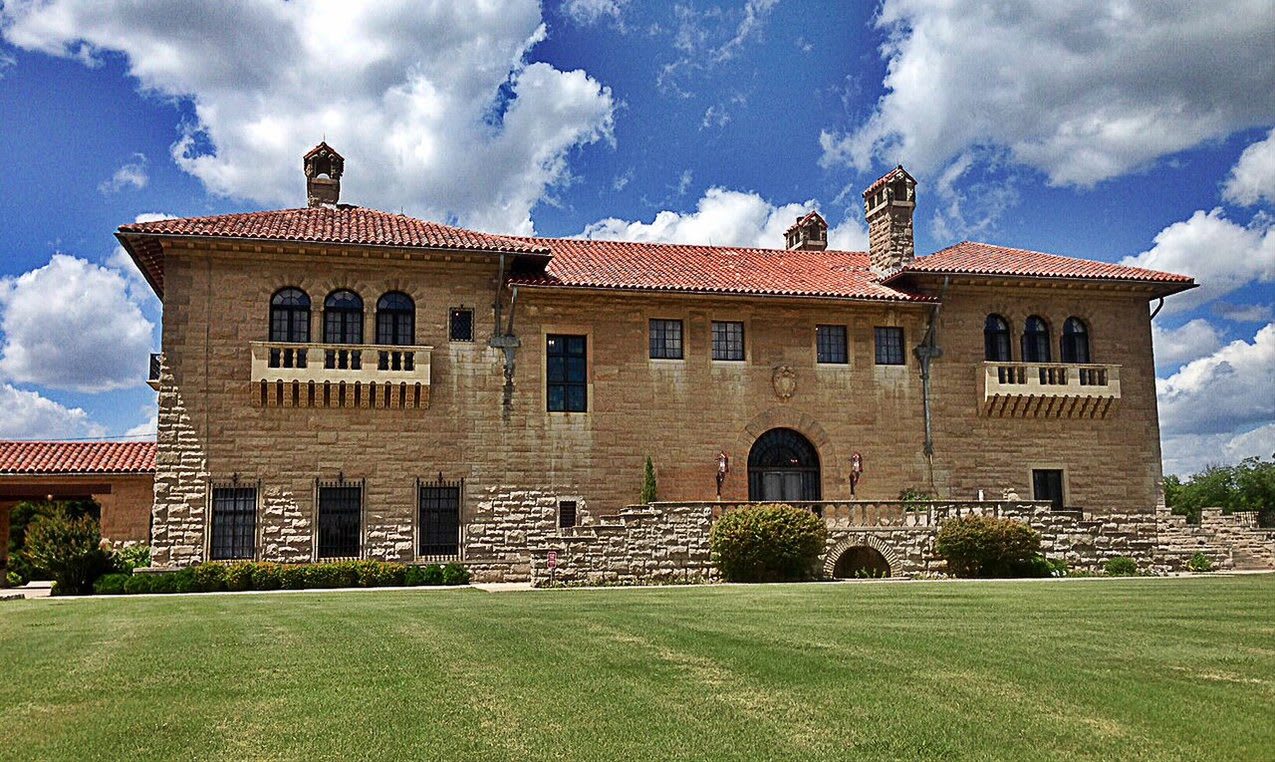
That same year Marland finished his house. The Tulsa architect John Duncan Forsyth modeled it on the Palazzo Davanzati in Florence and built it of limestone cut on the site. It has 55 rooms over three floors, a ballroom ceiling covered in gold leaf, and an Otis elevator lined in buffalo leather. The estate says it cost $5.5 million. After his first wife Virginia died, Marland had the adoption of her niece Lydie annulled and married her in 1928. The Marlands could afford to live in the mansion only until about 1931. He went on to Congress and served as governor from 1935 to 1939.
Carmelite monks bought it in 1941, and the Felician Sisters ran a convent and school there after 1948. In 1975 Ponca City voters passed a one-cent sales tax, Conoco paid half, and the city bought the estate for $1.4 million.
Visitor Info
On the Map
Nearby
The closest stops worth working into your route
Historical markers nearby
Roadside plaques and monuments within a short detour