 Carol M. Highsmith / public domain via Library of Congress
The Story
On August 13, 1878, five men from Luray, among them the tinsmith Andrew J. Campbell, his kin William and John "Quint" Campbell, and the photographer Benton Stebbins, noticed cool air rising from a sinkhole on Cave Hill and dug for about four hours until the smallest of them could slide down a rope by candlelight. The first column they saw they named for Washington. Three of them bought the tract at a debt auction that September without saying what was under it, and in 1881 the Supreme Court of Virginia threw out the sale. Word had already spread, and the Smithsonian sent a party of scientists in 1880 who ranked the cave's decoration with any in the world.
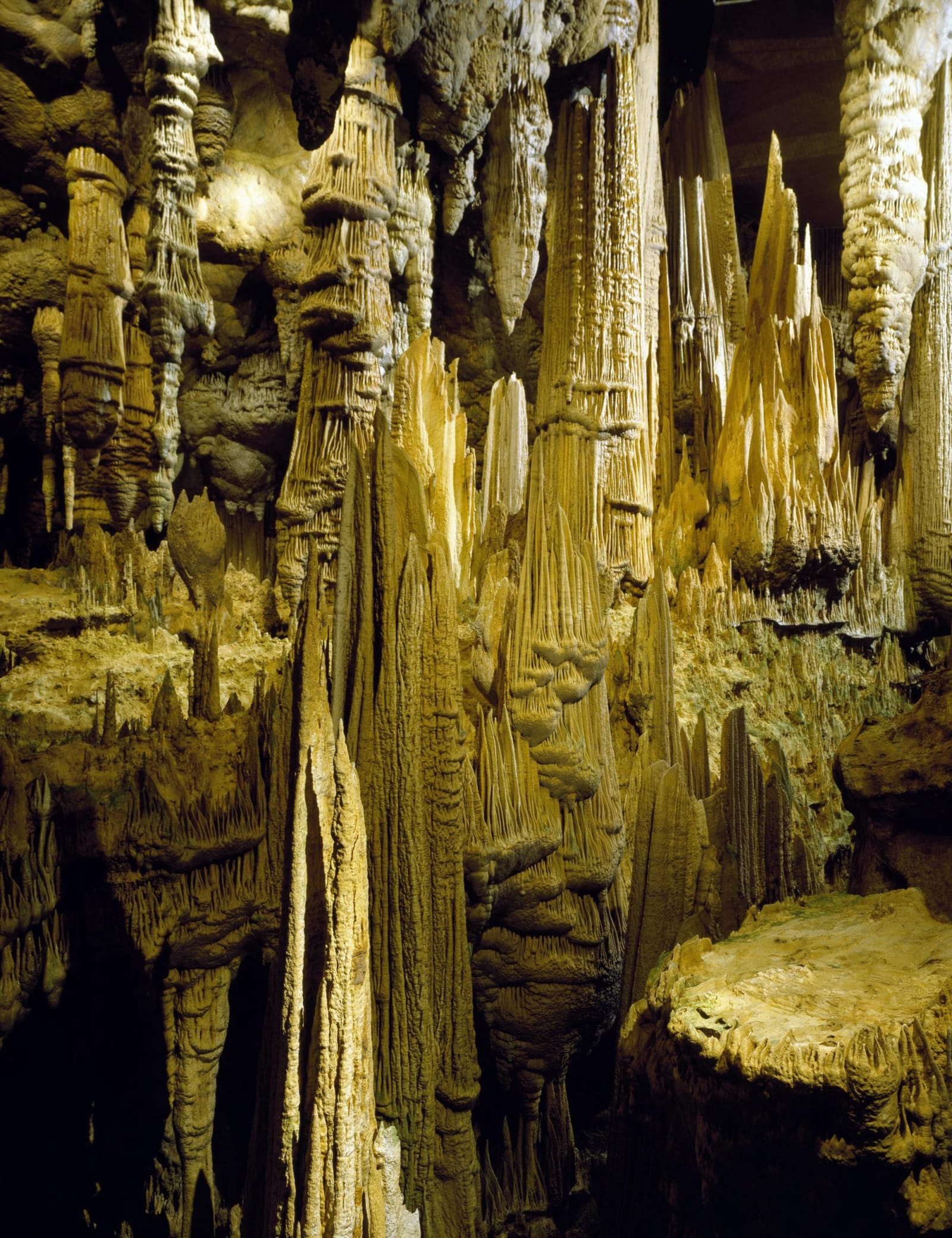
The caverns formed in Ordovician dolomite and are still growing, about a cubic inch every 120 years. The paved walk runs a mile and a half past the 35-foot Empress Column, the rippled flowstone curtains of Saracen's Tent and Dream Lake, a pool about 20 inches deep that mirrors the ceiling so cleanly it looks bottomless.
In 1954 Leland W. Sprinkle, a Pentagon mathematician and electronics scientist, watched a guide tap a formation with a mallet and spent three years searching the chambers with tuning forks for stalactites that rang at the right pitch. His Great Stalacpipe Organ strikes them with rubber-tipped plungers, today mostly on an automatic system. The company Theodore Clay Northcott chartered has owned the caverns since 1905, his descendants still run them, and the National Park Service named them a National Natural Landmark in 1974.
Visitor Info
On the Map
Nearby
The closest stops worth working into your route
Historical markers nearby
Roadside plaques and monuments within a short detour