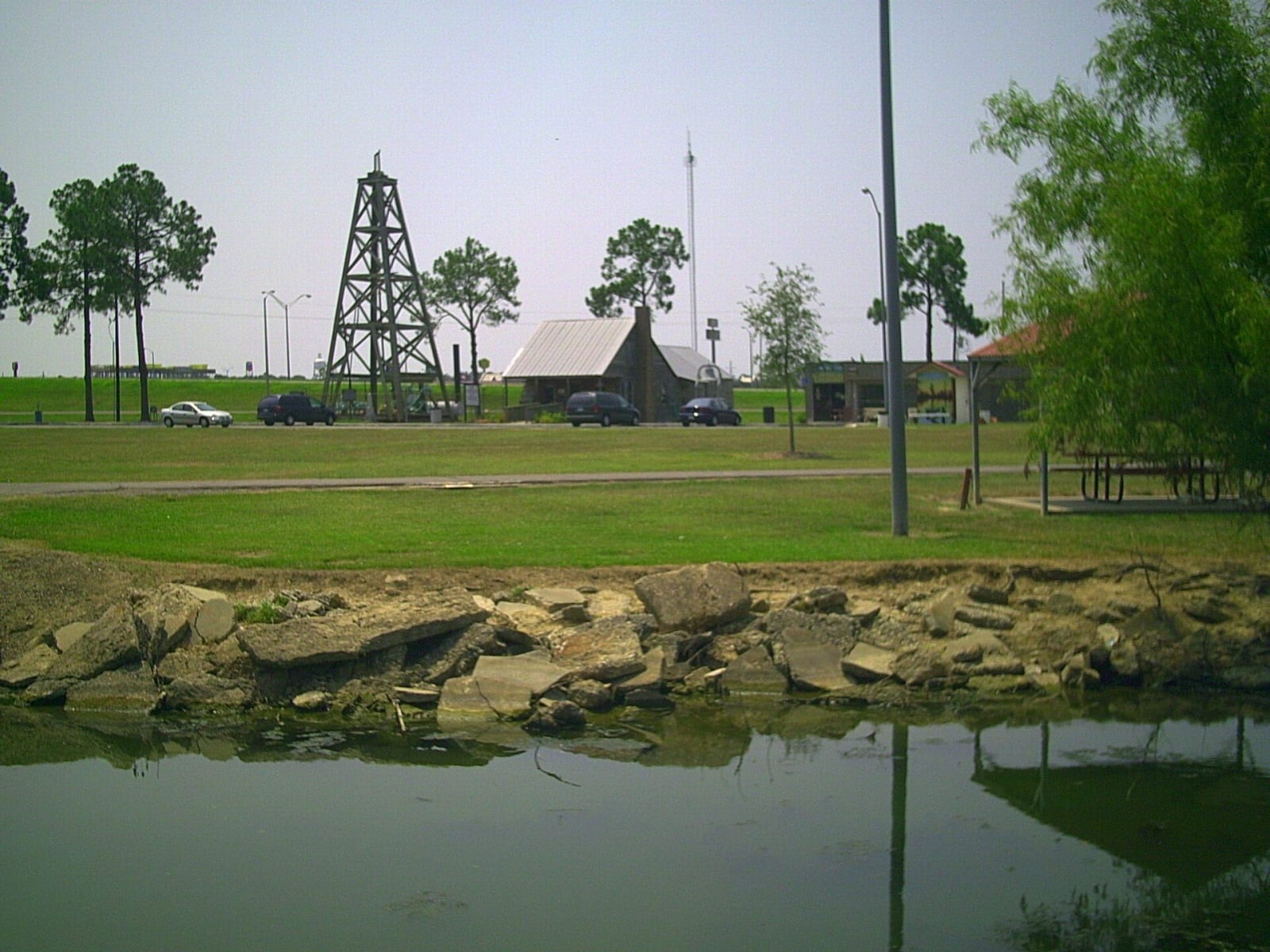
 Richard Byrd / CC BY 2.0 via Wikimedia Commons
The Story
On September 21, 1901, well No. 1 on Jules Clement's farm, drilled for the Jennings Oil Company by W. Scott Heywood and his associates, came in about five miles northeast of Evangeline, and with it Louisiana's oil and gas industry began. The Heywood brothers, veterans of the Texas boom, had come to look into gas seeping from Clement's rice field. Clement, a French-speaking farmer, leased land for two wells, each planned to about 1,000 feet. When the first pipe came up short, the crew drilled the second well from the bottom of the first, and it gushed.
The Jennings field's output climbed to 100,000 barrels a day, and by 1907, when production declined, it had yielded 50 million barrels. Most of the oil went for industrial fuel, including for rice and sugar operations. The Heywoods stored the surplus in large earthen tanks above ground, which later held saltwater and contaminated the soil. Jennings became a boomtown, and Clement became a millionaire by today's standards.
The Legislature dedicated 11 acres beside the Jennings exit on Interstate 10 as the Louisiana Oil and Gas Park in 1975. A marker written in French with an English translation records the discovery well, a plaque is dedicated to the oil pioneers, and a replica of the first derrick stands here; Hurricane Laura damaged the replica in 2020, and workers rebuilt it in 2022 using parts of the old structure. The park holds the parish tourism center and Gator Chateau, where visitors hold baby alligators. Gator Chateau is free and open Monday through Saturday, 9 a.m. to 5 p.m.
Visitor Info
On the Map
Nearby
The closest stops worth working into your route
Historical markers nearby
Roadside plaques and monuments within a short detour