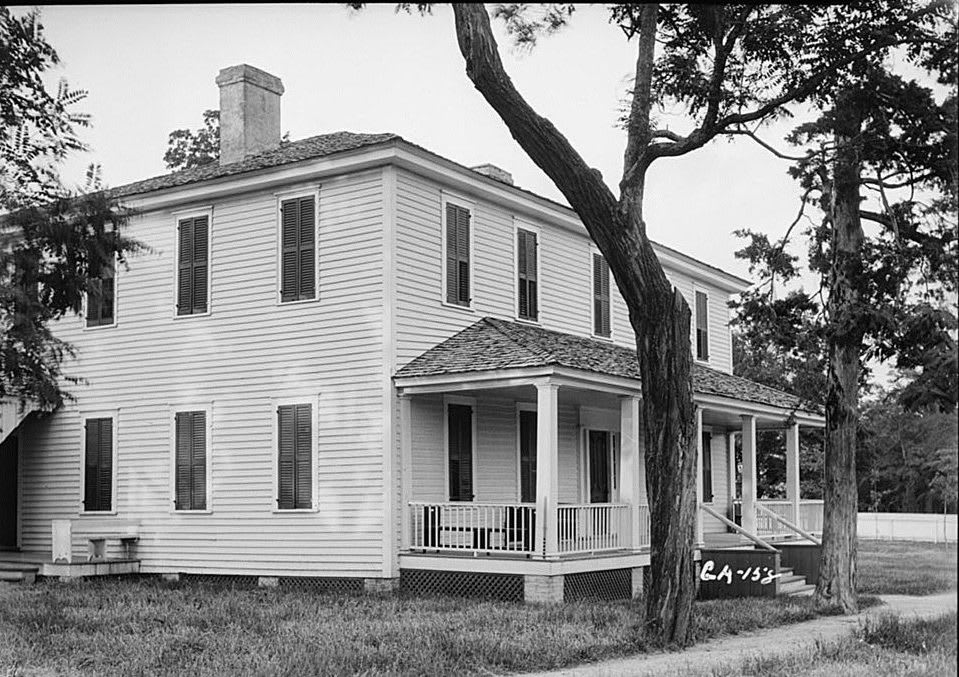
 Historic American Buildings Survey (HABS GA-153) / public domain via Library of Congress
The Story
Alexander Hamilton Stephens was born near Crawfordville in 1812, orphaned at fourteen, and bought this place in 1845, keeping it until his death in 1883 and rebuilding the white frame house in 1872-75. He served sixteen years in Congress before the war, signed Georgia's secession ordinance with misgivings, and became vice president of the Confederacy.
In Savannah on March 21, 1861, he explained what the new nation stood on. Its cornerstone, he said, "rests upon the great truth that the negro is not equal to the white man; that slavery, subordination to the superior race, is his natural and normal condition." That was the order of this household. Stephens held thirty-one people in slavery at emancipation, among them Harry and Eliza Stephens, whose house stood where the museum now is; one of the two slave quarters they also lived in survives behind the main house. Union cavalry arrested him in his library in 1865. After five months in prison he came back and wrote A Constitutional View of the Late War between the States here, a two-volume defense of the Confederacy, and he later returned to Congress and died in office as governor.
Guided tours take in the house, refurnished in its 1875 state, and the outbuildings, several rebuilt by the Civilian Conservation Corps in the 1930s. Stephens and his brother Linton are buried on the front lawn by an 1893 statue. The museum the state built in 1952 holds a large Civil War collection. The state park around it, begun in 1933, has fishing lakes, cottages and about twenty miles of horse trails.
Visitor Info
On the Map
Nearby
The closest stops worth working into your route
Historical markers nearby
Roadside plaques and monuments within a short detour