Home / West Virginia / The Greenbrier Valley / Hinton Historic District
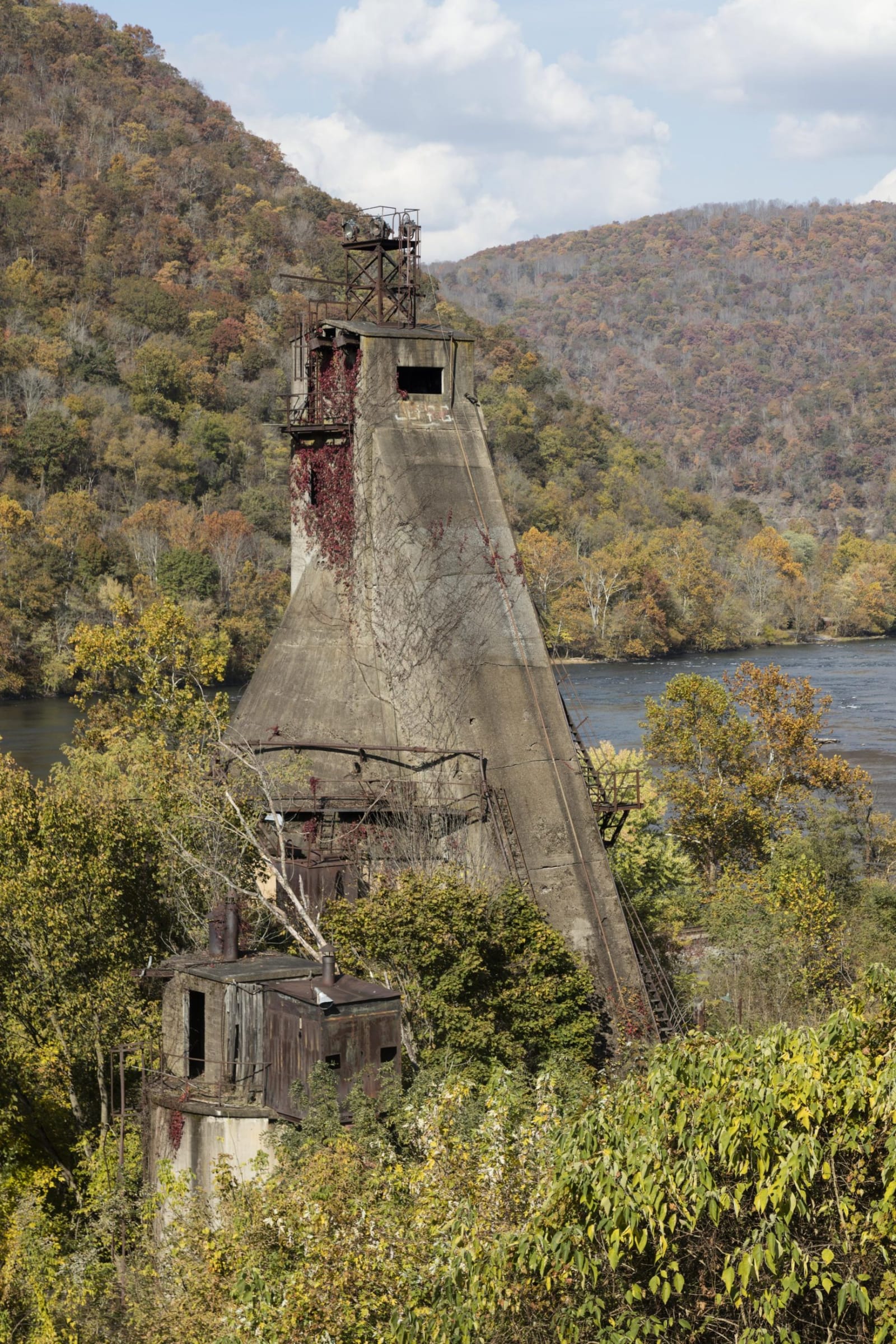
An old concrete railroad coaling tower overgrown with vines above the New River at Hinton, with autumn hillsides behind.Carol M. Highsmith / public domain via Library of Congress
🏛️Historical

Hinton Historic District

Part ofThe Greenbrier Valley

The C&O division town at the meeting of the Greenbrier and New rivers, laid out in 1874, with its 1905 depot, Victorian blocks and a Black church founded in 1878.

⏱
Duration
One to two hours.
🎟
Admission
Free to walk the district.
📅
Best Season
Year round; Railroad Days in October, the Water Festival in August.

The Story

Isaac Ballengee took up 210 acres where the Greenbrier meets the New in 1777, and before the railroad only six families lived here. The Chesapeake & Ohio bought the land from his son in 1871, laid out a town in 1874, and Hinton was incorporated in 1880. By 1892 the C&O roundhouse held 17 engine stalls and the car shop room for 40 cars, and 540 men worked there.

The C&O and other lines recruited thousands of Black workers to build and maintain the tracks, and from 1870 to 1930 African Americans moved into West Virginia through rail centers like Hinton, for work, for the vote and for schools their children could attend. Second Baptist Church on James Street was organized in 1878 in the home of Henrietta Hostler; its brick church was dedicated on February 13, 1927. Segregation shaped the region's towns, and Black communities built their own churches, lodges and schools.

The boom ended with diesel. In the 1950s the C&O laid off hundreds of steam-engine specialists, and the town fell from 6,654 people in 1930 to 2,266 in 2020. What remains is brick streets, ornate commercial blocks and porch-fronted Victorian houses, listed as a historic district in 1984. The 1905 red-brick depot still sees Amtrak trains, with exhibit panels on both sides; stay off the tracks. Railroad Days come in October.

Visitor Info

⏱
Time Needed
One to two hours.
🎟
Admission
Free to walk the district.
📅
Best Season
Year round; Railroad Days in October, the Water Festival in August.
🛣️
Highway
WV 3

On the Map

Nearby

The closest stops worth working into your route

historical7.2 mi away
John Henry Historical Park
The Talcott park at the Great Bend Tunnel, where some 800 men, many of them freedmen, drove the C&O through Big Bend Mountain in 1870-72 and the John Henry ballad was born.
natural14 mi away
Grandview
The rim park above the deepest part of the gorge, 1,400 feet over the New River, with Catawba rhododendrons in May and outdoor drama in summer.
industrial18 mi away
Beckley Exhibition Coal Mine
A real 1906 coal mine under a Beckley city park, toured by mantrip with retired miners since 1962, with a coal camp of moved buildings above.
architectural19 mi away
Indian Creek Covered Bridge
A roadside covered bridge south of Union built about 1898 by Oscar and Ray Weikel, brothers of sixteen and eighteen, and restored by the Monroe County Historical Society.
cultural20 mi away
Tamarack
The state's juried showcase of West Virginia crafts, opened on the turnpike at Beckley in 1996 in a round building with red spires.
natural21 mi away
Babcock State Park
A 4,127-acre Depression-era park on Glade Creek, built by the CCC from local stone and blight-killed chestnut, with the 1976 Glade Creek Grist Mill.

Historical markers nearby

Roadside plaques and monuments within a short detour

Marker0.2 mi away
Hinton
Hinton
Marker1.8 mi away
Fort Culbertson
Hinton
Marker1.9 mi away
Wreck on the C & O
Hinton
Marker2.2 mi away
Home of Jack Warhop
Hinton
Marker4.7 mi away
Pack's Ferry
Bellepoint
Marker4.8 mi away
Giles, Fayette & Kanawha Turnpike
Hinton