 daveynin / CC BY 2.0 via Flickr
The Story
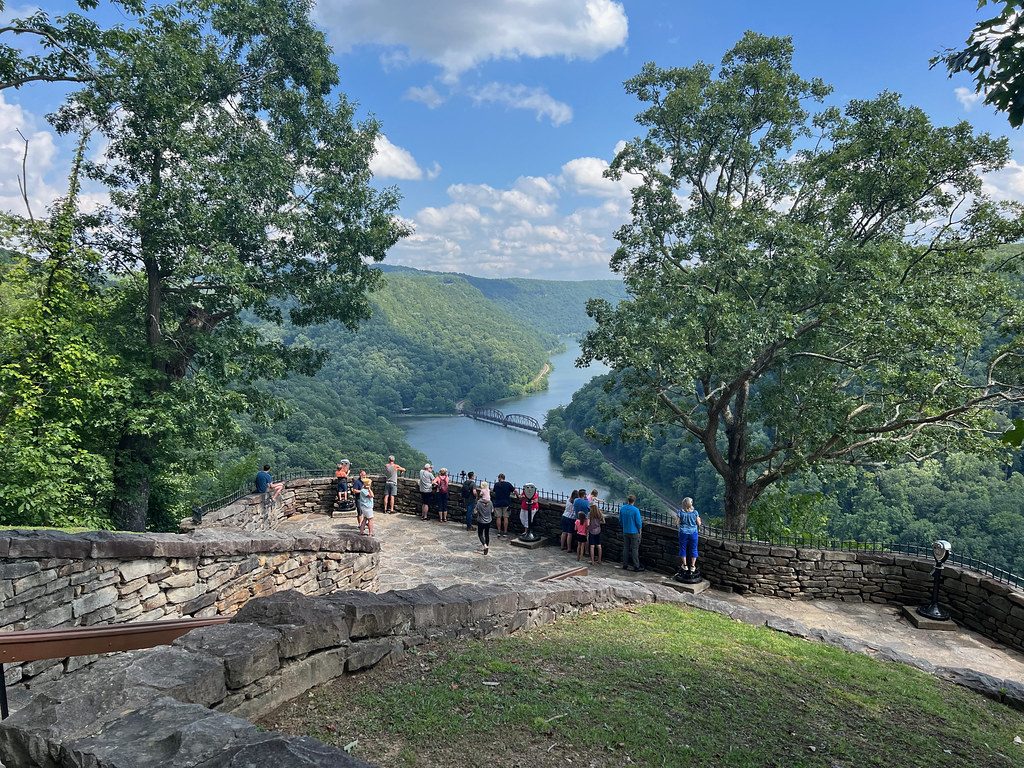
The park is named for the ospreys that once rode the air off these cliffs, called Marshall's Pillars after Chief Justice John Marshall visited in 1812, and a trail used by Native people passed this way long before the state bought the land in 1935. Civilian Conservation Corps crews built the stone shelter, the shop and the round-towered restrooms at the main overlook on U.S. 60.
The lake below is the intake of the Hawks Nest Tunnel. Beginning in April 1930, Union Carbide's New Kanawha Power Company and its contractor, Rinehart and Dennis, drove a three-mile tunnel under Gauley Mountain to carry the New River to a powerhouse serving the company's plant at Alloy. Of almost 5,000 workers, 2,982 worked underground, most of them Black men who had come from the South. They drilled with no dust control or breathing protection through rock so pure in silica that a third of the tunnel was enlarged to mine it. Young men died of acute silicosis within two years of the start. Counts ran from the 109 deaths the company admitted to the 476 a 1936 congressional hearing found; later studies put the dead at about 764 and close to 1,000.
Cora Jones, whose husband and three sons died, brought the first suit; 538 in all ended in a $200,000 settlement, with awards of $30 to $1,600. A memorial dedicated in 2012 near Summersville marks the reburied graves of about 48 of the workers. From the main overlook you can see the dam that still feeds the tunnel.
Visitor Info
On the Map
Nearby
The closest stops worth working into your route
Historical markers nearby
Roadside plaques and monuments within a short detour