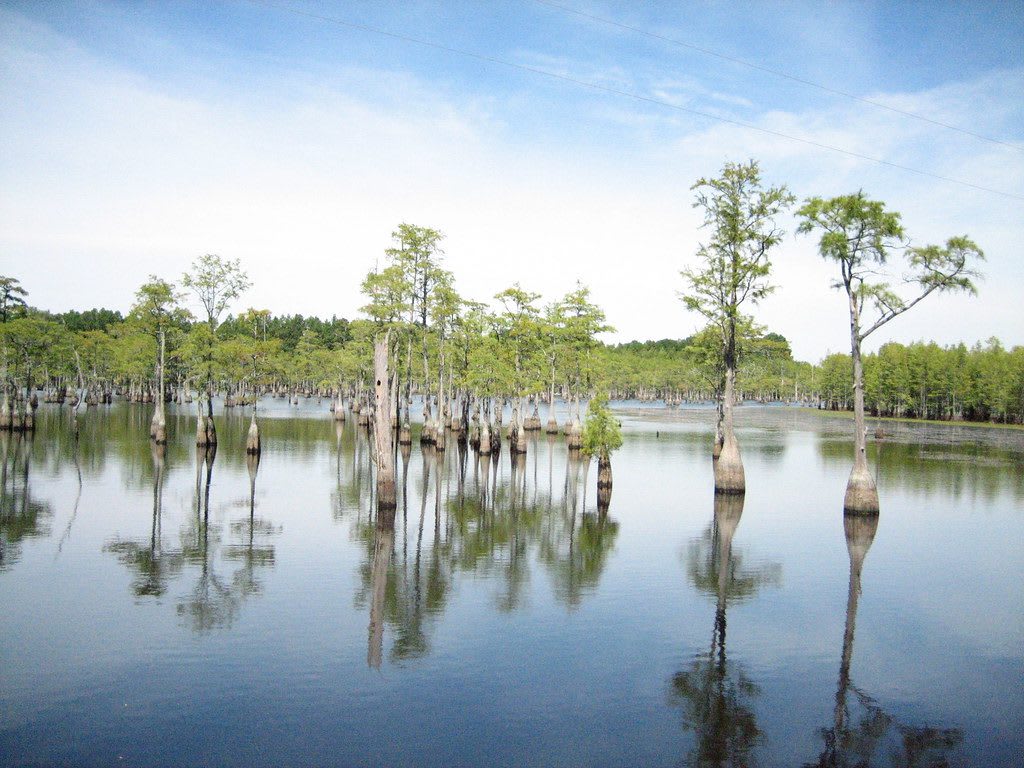
 Paul Luffel (PakaLoeff) / CC BY 2.0 via Flickr
The Story
The Muscogee (Creek) lost this country in the cessions of 1773 and 1783, and settlers drawn by land lotteries cleared farms from the longleaf pine barrens. In 1879 Alexander Hendricks and James M. Parrish bought land on Fifteen Mile Creek from J. J. Moring and dammed it, building the dam by hand. Their millhouse sat on the dam itself, and the road ran straight through it: farmers drove wagonloads of corn and cotton inside, and the mail carrier passed through on his way to the post office on the far side. Timber for the building was cut nearby, hewn by hand and fastened with pegs.
The mill sawed lumber first, then ginned cotton in a small half-bale gin, and in 1885 millstones were added. The turbine turned on bearings of lignum vitae, a South American wood so dense and oily that it lubricated itself underwater. By 1944 only the gristmill still ran, and it ground corn, sometimes around the clock, until 1973. Restored in 1998, it is one of the state's two working gristmills, and the covered bridge has been closed to cars since 1984. The park is named for George L. Smith, an Emanuel County native and speaker of the Georgia House.
The 412-acre millpond is dark and studded with cypress, tupelo and Spanish moss. Three paddling trails cross it, with canoes and kayaks for rent; watch for submerged stumps, herons and white ibis. About seven miles of foot trails cross old sand dunes of longleaf pine, wiregrass and turkey oak, where gopher tortoises dig their burrows.
Visitor Info
On the Map
Nearby
The closest stops worth working into your route
Historical markers nearby
Roadside plaques and monuments within a short detour