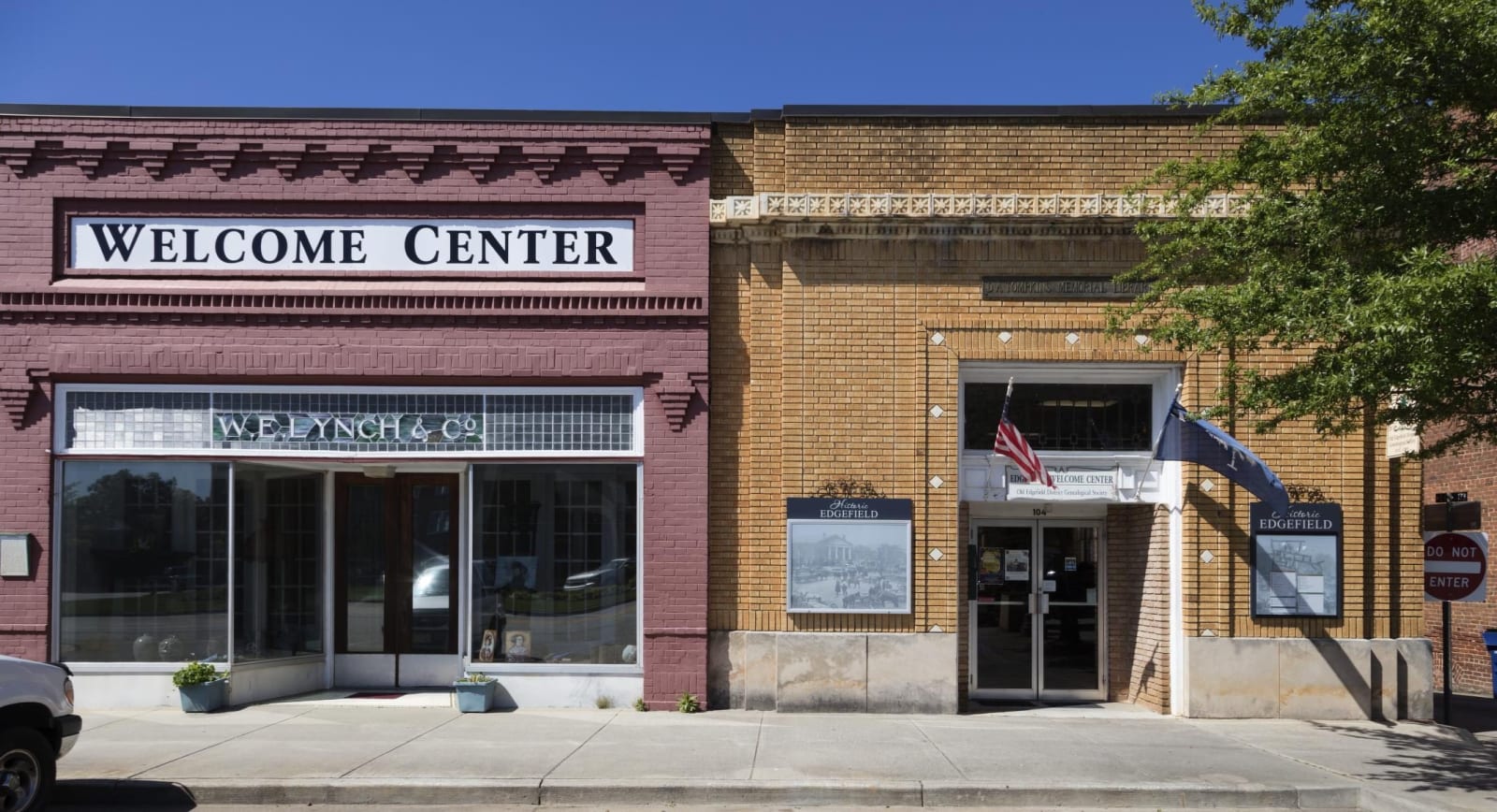
 Carol M. Highsmith / public domain via Library of Congress
The Story
Edgefield has kept its courts on this square since 1785, and the courthouse standing now was finished in 1839 by Charles Beck, a longtime protégé of Robert Mills. The monuments in the square's park show how the town chose to remember itself: an obelisk raised by the Ladies Memorial Association in 1900 to the Confederacy, a cause fought to keep people enslaved, and a 1984 statue of Strom Thurmond, the county's native son, who ran for president in 1948 on a segregationist ticket and was a major force behind the Southern Manifesto against school desegregation.
The work the square does not honor is in its clay. From about 1810 Abner Landrum's Pottersville, a mile outside town, turned out alkaline-glazed stoneware, and across the district enslaved African Americans did most of the labor in a dozen pottery factories. One of them, Dave, born about 1800, learned to read and write when the law forbade it. He turned jars holding up to 40 gallons, signed and dated many of them, and cut short verses into the wet clay: "I wonder where is all my relations / Friendship to all and every nation," he wrote in 1857. After freedom he took the name David Drake. His jars now sit in major museums, and since 2025 several have been returned to a trust held by his descendants.
Old Edgefield Pottery, steps off the square, is a working studio, gallery and small museum where a resident potter keeps the tradition and shows two of Dave's pieces. The county historical society runs two museums nearby.
Visitor Info
On the Map
Nearby
The closest stops worth working into your route
Historical markers nearby
Roadside plaques and monuments within a short detour