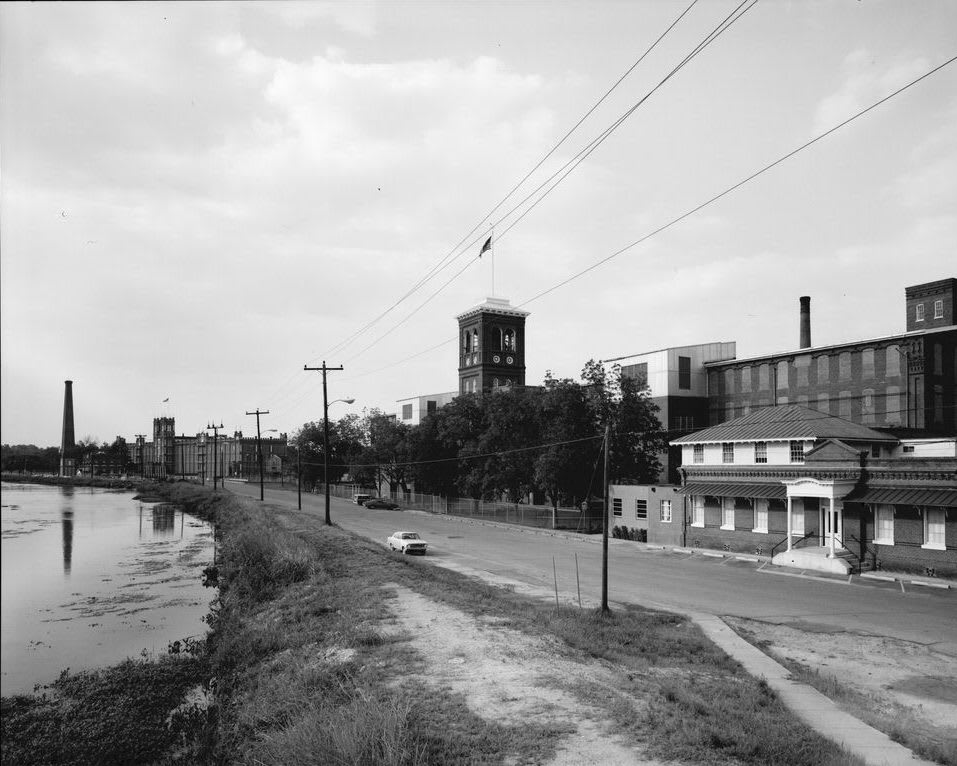
 Historic American Engineering Record (HAER GA-5) / public domain via Library of Congress
The Story
Augusta stood at the fall line, where the Savannah River drops over shoals and boats from the coast could go no farther. In 1844 Henry Cumming hired the railroad engineer John Edgar Thomson to survey a canal from above the rapids into the city, and digging began in May 1845. White laborers from the railroad country started the work, but the summer heat broke the crews, and enslaved and free Black men finished it. Water filled the first level in November 1846, and the Augusta Factory began weaving cotton in 1848. During the Civil War the Confederate Powder Works stretched two miles along the banks, and its tall chimney was later kept as a memorial to the Confederate dead.
From 1872 the canal was widened and deepened, with more than 200 Chinese immigrants hired for the labor, many of whom stayed to found one of the oldest Chinese communities in the eastern United States. The Enterprise, Sibley and King mills went up between 1877 and 1882, with mill villages of families who came in from the depressed countryside. Workers struck in 1886 and 1898, and the owners broke both strikes by evicting them from company houses.
The canal still supplies city water and turns turbines at the old mills, and Congress made it a National Heritage Area in 1996. The Discovery Center in Enterprise Mill covers how the canal was built and how mill families lived, and guided boats patterned on the old Petersburg cargo boats leave from its dock. A seven-mile towpath runs up to the headgates above the rapids.
Visitor Info
On the Map
Nearby
The closest stops worth working into your route
Historical markers nearby
Roadside plaques and monuments within a short detour