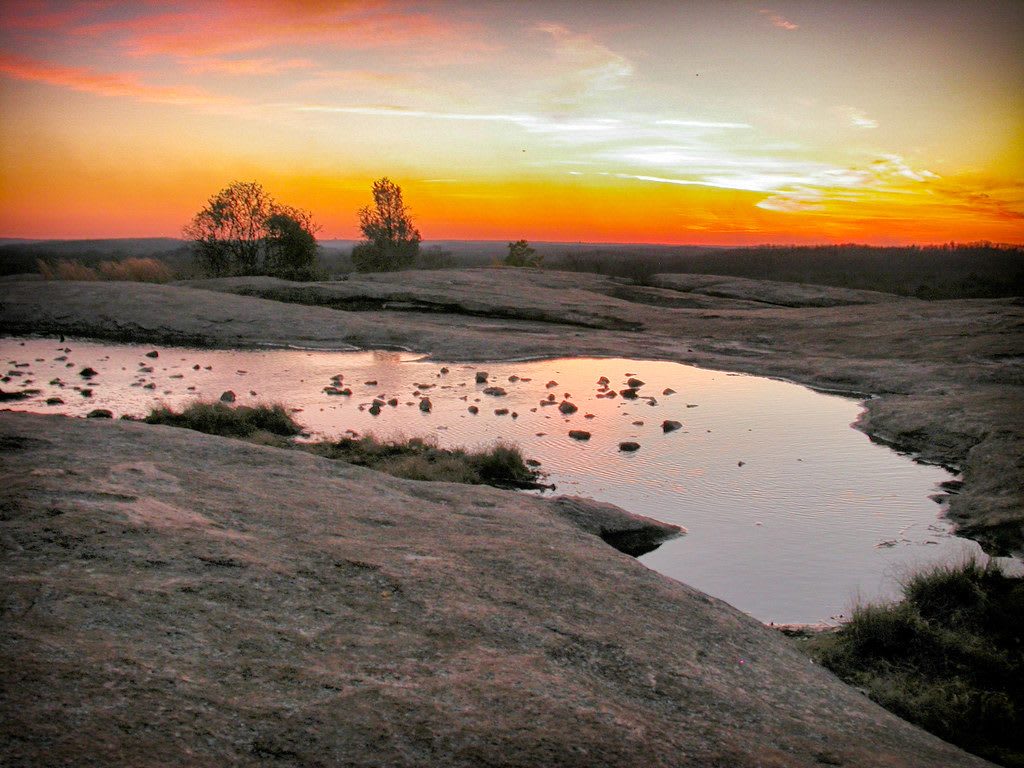
 moonglampers / public domain mark via Flickr
The Story
When white settlers arrived in the early 1800s, this granite country east of Atlanta was probably thinly peopled ground between the Muscogee (Creek) and the Cherokee, used as a trade and travel corridor. The Muscogee ceded it in 1821, and Georgia handed it out by land lottery. Arabia Mountain and Bradley Mountain, joined by a low saddle, form a monadnock that tops out at 955 feet.
The Georgia Railroad made Lithonia a quarry district in the late 1800s. Cutters worked the swirled gneiss sold as Tidal Grey, first by hand and from 1879 with drills and dynamite, and their ledges, drill holes and office ruins still mark the rock. The Davidson family, who owned several quarries, became the world's largest supplier of poultry grit. On April 18, 1972, Charles Davidson Jr. gave the 500-acre outcrop to DeKalb County rather than let a competitor develop it, and the preserve has grown to about 2,550 acres.
On the bare rock, shallow pools hold red diamorpha, and yellow daisies cover the granite in early fall. The preserve anchors a national heritage area created in 2006, which takes in Panola Mountain, Lithonia and Flat Rock, a community of formerly enslaved people and their descendants nearby. Its archive keeps the 1917 T. A. Bryant Sr. house and a cemetery with burials from slavery times. Start at the nature center on Klondike Road and walk out onto the rock.
Visitor Info
On the Map
Nearby
The closest stops worth working into your route
Historical markers nearby
Roadside plaques and monuments within a short detour