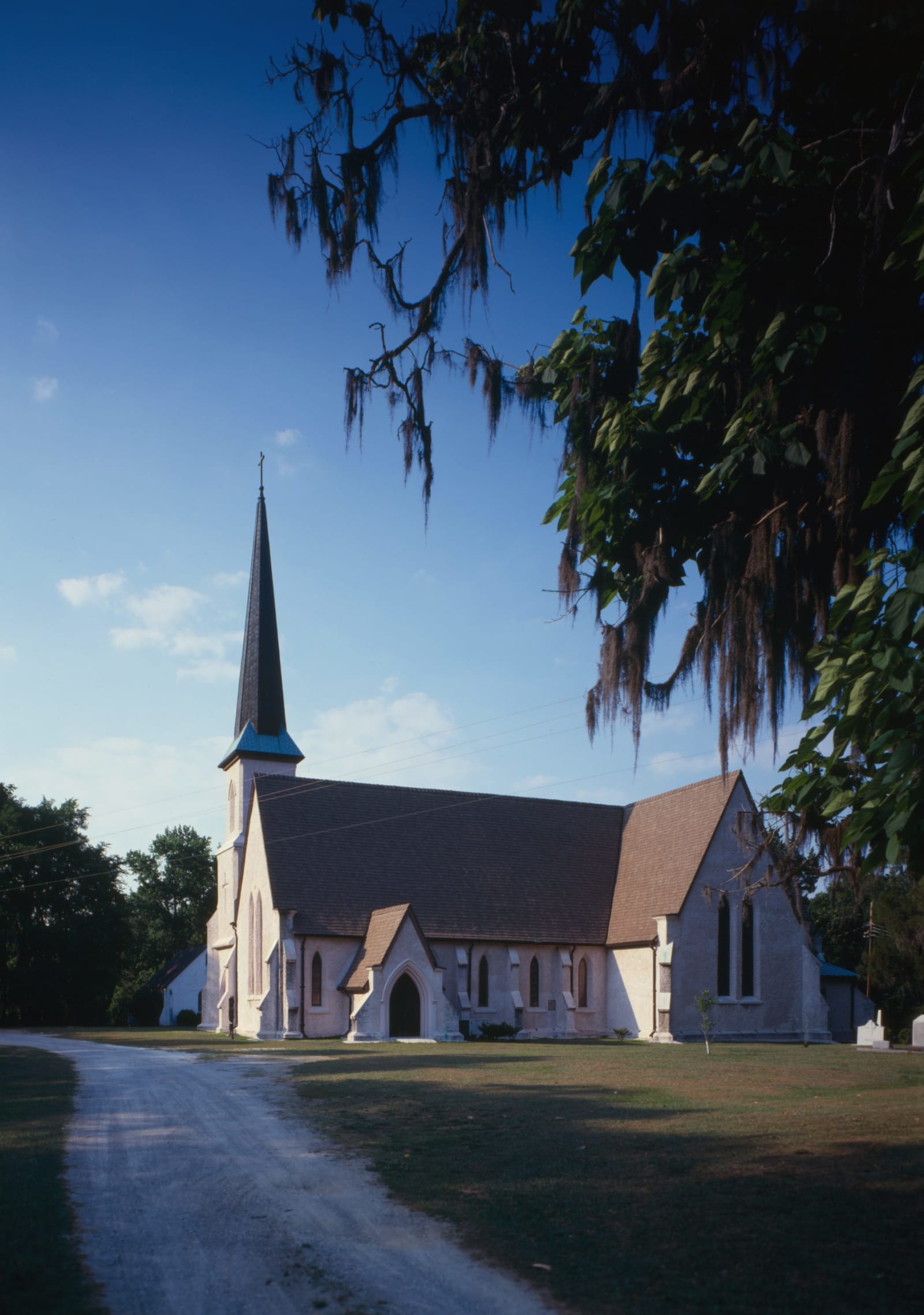
 Historic American Buildings Survey (HABS SC-13-14) / Public domain via Library of Congress
The Story
Thomas Sumter laid out Stateburg in 1783 hoping the legislature would make it the new capital; it lost, served as a county seat until 1800, and settled into a summer and then year-round home for planters in the High Hills of Santee. Sumter gave the land on which this church stands. Built in 1850-52 to a design by the Charleston architect Edward C. Jones, it has walls of rammed earth, packed and stuccoed, rising about forty feet under a steep tile roof, with Gothic arches and an interior painted to look like stone. It was named a National Historic Landmark in 1973, and its Erben organ dates from 1851.
The church holds the grave of Joel Roberts Poinsett, the first American minister to Mexico and the man who popularized the poinsettia, who died in Stateburg in 1851. It also holds a story about how slavery worked in the High Hills. William Ellison was born enslaved near Winnsboro about 1790 as April, learned to build cotton gins, bought his freedom in 1816 and moved to Stateburg. His gin shop prospered, and he became a planter: by 1860 he held nearly nine hundred acres and sixty-three enslaved people, most of them put to raising cotton. In this church other Black people were confined to the galleries, while the Ellisons sat in their own pew at the back of the main floor.
The congregation still worships here. Across the highway is the Borough House plantation, with rammed-earth buildings from 1820; it is private and seen from the road.
Visitor Info
On the Map
Nearby
The closest stops worth working into your route
Historical markers nearby
Roadside plaques and monuments within a short detour