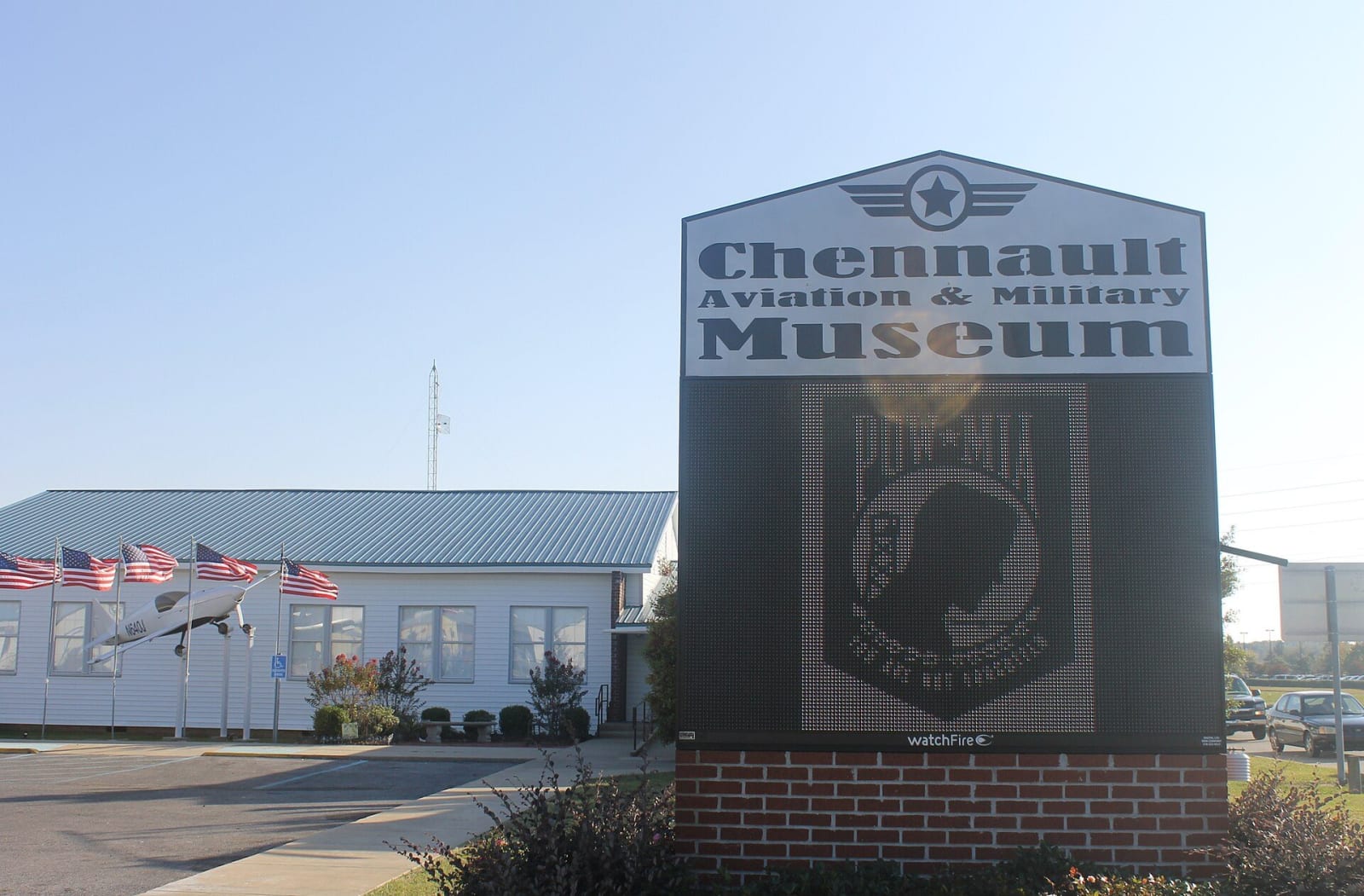
 Billy Hathorn / CC BY-SA 3.0 via Wikimedia Commons
The Story
The museum began as a reunion. In 1986 airmen who had trained at Selman Field in Monroe during the Second World War met for the first time, and the idea grew into the Aviation Historical Museum of Louisiana, which opened on November 11, 2000. A bill in the Louisiana Legislature renamed it for Claire Chennault in August 2008. It separated from the state museum system in 2015, and Chennault's granddaughter, Nell Calloway, became its chief executive in 2017.
Chennault was born in Commerce, Texas, in 1893, and his family moved to northeast Louisiana. In 1941 he organized the American Volunteer Group, the Flying Tigers, which first fought the Japanese on December 20 of that year and, by the count the LSU Military Museum gives, destroyed 299 planes in the air in under six months. He commanded the Fourteenth Air Force from 1943 and died in New Orleans on July 27, 1958; he is buried at Arlington National Cemetery. A room called "Way of a Fighter" is given to him.
Other galleries cover Selman Field's navigator school, the Civil Air Patrol, and Delta. Huff Daland Dusters, Delta's predecessor, moved from Macon, Georgia, to Monroe in 1925, Delta Air Service was incorporated on December 3, 1928, and the company's headquarters left Monroe for Atlanta in 1941. An aircraft park beside the building has an F-86L Sabre, a MiG-15UTI, an A-7E Corsair II and a Huey. The address is 701 Kansas Lane; the museum lists free admission and Tuesday to Saturday hours of 9 a.m. to 4 p.m. (November 2026).
Visitor Info
On the Map
Nearby
The closest stops worth working into your route
Historical markers nearby
Roadside plaques and monuments within a short detour