Home / Texas / The High Plains & the Canadian River Breaks / Canadian River Wagon Bridge
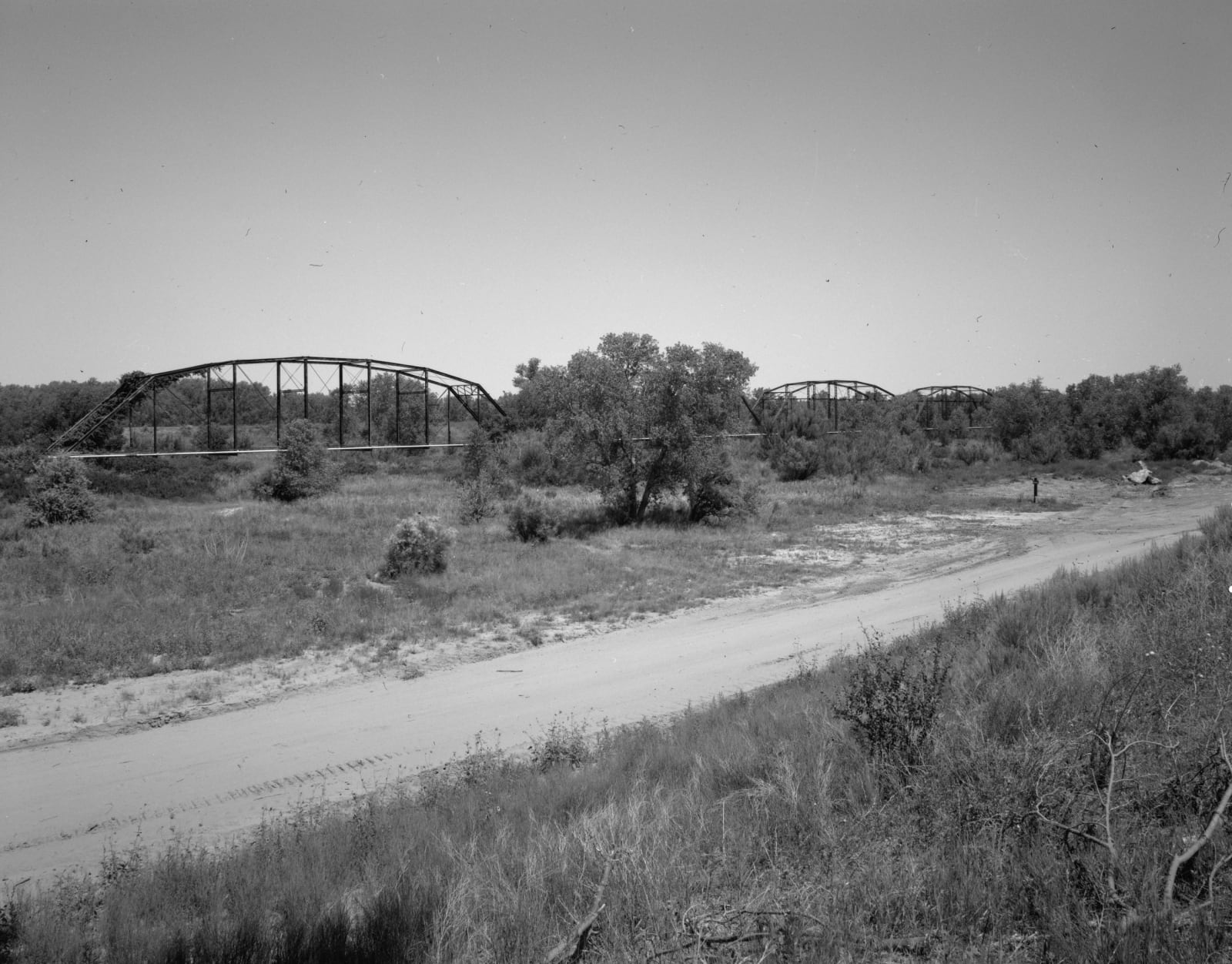
The steel Parker trusses of the Canadian River Wagon Bridge rising above cottonwoods and grassland beside a sandy road, in a black and white survey photograph.Historic American Engineering Record / public domain via the Library of Congress
🏗️Architectural

Canadian River Wagon Bridge

Part ofThe High Plains & the Canadian River Breaks

The longest pin-connected bridge in Texas, 3,255 feet of Parker trusses across the Canadian River at Canadian, built for wagons in 1916 and reopened as a footpath in 2000.

⏱
Duration
Thirty minutes to an hour for the walk across and back.
🎟
Admission
Free.
📅
Best Season
Year round; spring and fall are the most comfortable for the walk.

The Story

The Canadian River floods. Bridges built here in 1888 and 1889 both washed out. In 1915 Hemphill County voters approved a more permanent crossing, and the bridge finished in 1916 had seventeen pin-connected Parker through trusses, each 155 feet long and 27 feet high, for a length of 2,635 feet. Its 16-foot roadway rested on concrete piers with steel footings driven 65 feet into the riverbed.

In 1923 high water cut a new channel around the north end and widened the river, and the county paid the Austin Bridge Company of Dallas to add four more trusses of the same size. That made the bridge 3,255 feet long, the longest pin-connected bridge in Texas, and the longest metal truss bridge in the state until the Rainbow Bridge between Orange and Port Arthur opened in 1938. By the 1950s its single lane was too narrow for passing traffic, and in 1953 a new concrete and steel highway bridge, paid for with state highway funds, bypassed it. The old bridge was left without a deck, carrying a natural gas pipeline, and was recorded by the Historic American Engineering Record.

Canadian did not let it go. A committee of residents raised money and matching grants, laid a new plank deck and side rails, and after five years of work reopened it on July 1, 2000 as a walking and biking trail over the river and its wetlands. The walk across and back is about a mile and a quarter.

Visitor Info

⏱
Time Needed
Thirty minutes to an hour for the walk across and back.
🎟
Admission
Free.
📅
Best Season
Year round; spring and fall are the most comfortable for the walk.
🛣️
Highway
US-60

On the Map

Nearby

The closest stops worth working into your route

historical1.1 mi away
River Valley Pioneer Museum
The Hemphill County museum in Canadian, a Santa Fe division town of 1887 on the river breaks that held one of the first commercial rodeos in Texas and voted itself dry in 1903.
cultural1.3 mi away
The Citadelle Art Museum
A 1910 Baptist church saved from demolition in 1977, made into a family home filled with art, and given to Canadian in 2009 as one of the Panhandle's few art museums.
natural4.8 mi away
Gene Howe Wildlife Management Area
Five thousand acres of sand sage and cottonwood bottomland along the Canadian River east of Canadian, bought by the state in 1950 for wildlife research and open to walkers with a permit.
recreational11 mi away
Lake Marvin
A small 1930s conservation lake on Boggy Creek east of Canadian, named for the Panhandle congressman whose name is on the 1937 law that turned the plains' ruined farms back to grass.
historical22 mi away
Roberts County Museum
The county museum in Miami's old Santa Fe depot, holding mammoth bones and Clovis points from a 1934 dig, in the cow town that has held a cow-calling contest since 1949.
historical29 mi away
Old Mobeetie Jail Museum
The 1886 stone jail of the Panhandle's first county seat, the buffalo hunters' Hidetown on Sweetwater Creek that ran the courts for fifteen counties before losing its fort, railroad hopes and county seat.

Historical markers nearby

Roadside plaques and monuments within a short detour

Marker0.4 mi away
Canadian River Trails
Marker0.4 mi away
Hemphill County
Marker0.4 mi away
Robert R. Young
Marker1.1 mi away
Moody Hotel
Marker1.2 mi away
R. Dick Bussell
Marker1.2 mi away
John Hemphill