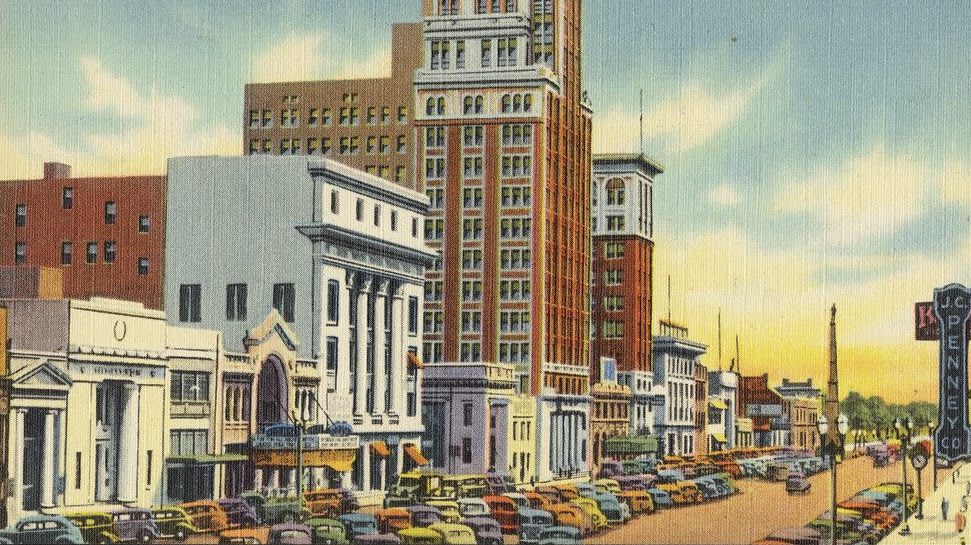
 Tichnor Brothers postcard, Boston Public Library / CC BY 2.0 via Flickr
The Story
Augusta was laid out in 1736 as a trading town for skins and furs from the Muscogee (Creek) and nations to the west, and Broad Street, planned in 1780, grew into the wide market street of the cotton country. In 1825-26 alone its warehouses stored 143,633 bags of cotton grown and picked by enslaved people. In 1858 survivors of the slave ship Wanderer were sent to the slave markets of Augusta and Savannah.
From 1830 to February 7, 1878, when a tornado flattened it, the Lower Market stood in the middle of the street at Fifth. One column survived. Around 1930 the city hired a New York publicity firm to draw tourists, and newspapers across the country printed a story that a preacher denied the right to preach there had cursed the market. Later tales made the pillar a whipping post, which no record supports. A car destroyed the pillar in December 2016, and it was not rebuilt.
On May 11, 1970, after sixteen-year-old Charles Oatman was killed in the Richmond County jail and his body brought to the hospital mutilated, a protest at the Municipal Building spilled onto Broad Street and then to Gwinnett Street, now Laney-Walker Boulevard. Police were given shoot-to-kill orders, and by dawn they had killed six Black men, every one unarmed and shot in the back: Charlie Mack Murphy, William Wright Jr., Sammie McCullough, John Stokes, John Bennett and Mack Wilson. Two officers were tried and acquitted; in 2021 the Justice Department reopened the case.
Visitor Info
On the Map
Nearby
The closest stops worth working into your route
Historical markers nearby
Roadside plaques and monuments within a short detour