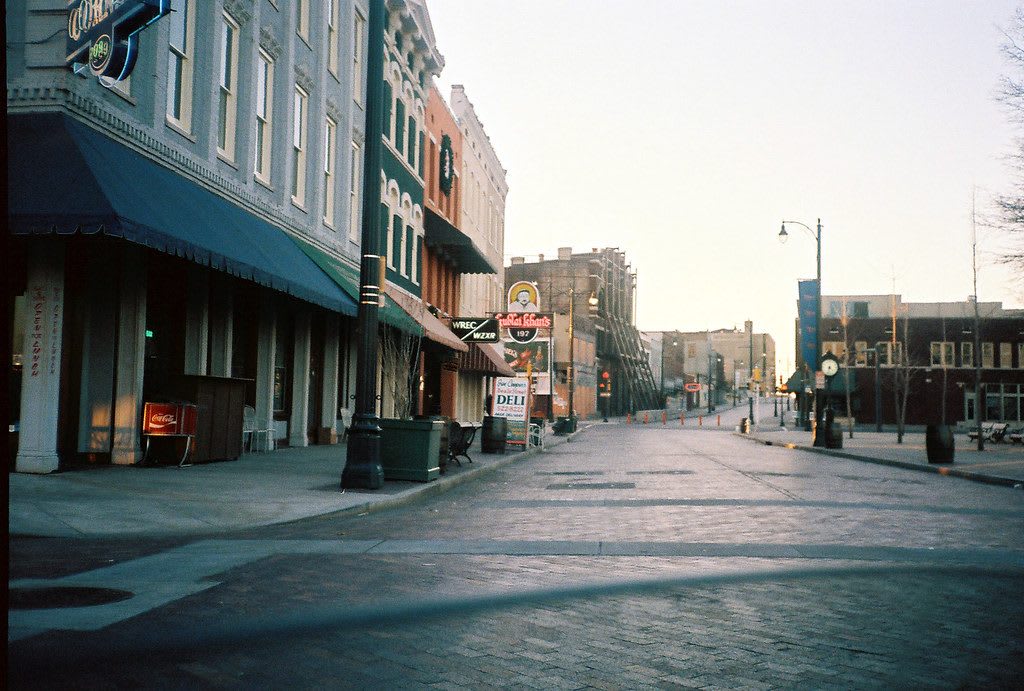
 chames richalds / CC BY 2.0 via Flickr
The Story
Beale Street runs east from the Mississippi over land the Chickasaw gave up in the treaty of 1818. Robertson Topp laid it out in 1841. During the Civil War the city's Black population roughly tripled, and freed people built a business and church district here, with Black barbers, draymen, a Freedman's Bank and, in 1864, Beale Street Baptist Church, the oldest surviving Black church building in Tennessee.
Robert R. Church Sr., a freedman often called the first Black millionaire in the South, opened Church's Park and Auditorium here in 1899 and hired W. C. Handy to lead its orchestra. Handy put the rural blues on paper, and "Beale Street Blues" followed in 1916. Ida B. Wells co-edited the Free Speech and Headlight from the Beale Street Baptist Church. When a mob took her friend Thomas Moss and two other men, Calvin McDowell and Will Stewart, from the county jail and killed them in March 1892, she wrote against it, urged Black Memphians to leave, and began her investigation of lynching. A mob destroyed the paper's presses, and she settled in Chicago.
Urban renewal in the 1960s left Beale nearly empty, and Congress named it the Home of the Blues in 1977. Today the blocks near the river are bars, neon and souvenir shops, busiest after dark. Go by day to read the markers, see Church's Park and the church, and stand at Handy Park, then decide whether to stay for the music.
Visitor Info
On the Map
Nearby
The closest stops worth working into your route
Historical markers nearby
Roadside plaques and monuments within a short detour