County guide · North Carolina
Wake County
2 places to stop and 75 historical markers in Wake County, North Carolina.
Towns: Raleigh (72), Cary (2), Wake Forest (2), Apex (1)
Places to stop
historical · Raleigh
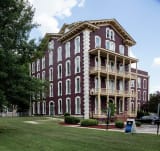
Shaw University
The Raleigh university founded for freed people in 1865, with Estey Hall of 1873, where Ella Baker gathered the student sit-in leaders who formed SNCC in April 1960.
natural · Cary
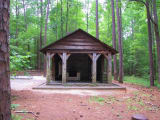
William B. Umstead State Park
A 5,000-acre forest between Raleigh and Durham, built by the CCC on worn-out farms and split by race from 1950 until 1966, the Reedy Creek side for Black visitors.
Historical markers
Raleigh · Erected 1992
'Elmwood'
John Louis Taylor, the state's first chief justice, bought 100 acres of Joel Lane's old grant from John Haywood in February 1813 for $300, built soon after and taught…
Raleigh · Erected 1971
Alexander B. Andrews
Andrews became president of the Western North Carolina Railroad in 1880 and pushed its mountain line on with extra convict laborers he obtained for the work.
Raleigh · Erected 2003
Andrew Johnson
Johnson was three when his father, Jacob, died soon after pulling three drowning men from the water, and his mother, Polly, took in washing to keep the family.
Raleigh · Erected 2010
Anna J. Cooper
Cooper was born to Hannah Stanley, enslaved in the household of Dr. Fabius J. Haywood, whom scholars believe was her father.
Raleigh · Erected 2004
Artificial Limbs
The limbs were made in the building that had turned out bayonets for the Confederacy, near the end of the Raleigh and Gaston line.
Raleigh · Erected 1968
Berry O'Kelly School
Berry O'Kelly was born about 1861 in Chapel Hill to an enslaved woman, Frances Stroud, who died soon after, and he grew up in Mason Village, a freedmen's settlement…
Raleigh · Erected 1954
Camp Bryan Grimes
Fear of a Spanish raid ruled out Wilmington, so Raleigh's Chamber of Commerce gave land on the city's edge, and 294 tents went up by the railroads in May 1898.
Raleigh · Erected 1988
Central Prison
Prisoners built their own prison, working fourteen years in granite quarried just outside what became the east wall, and the castle-like building cost $1.25 million.
Raleigh · Erected 1991
Charles N. Hunter
Hunter was born enslaved, the son of the artisan Osborne Hunter, in a household owned by William Dallas Haywood, and lost his mother at three.
Raleigh · Erected 2001
Clarence Poe
Poe opposed lynching and Thomas Dixon's race-baiting, yet from 1913 he campaigned for a countryside divided by race, Black and white farmers massed on separate land on…
Raleigh · Erected 1963
Dorothea Dix Hospital
For decades the hospital leaned on its patients' work: by the early 1900s about 174 acres were farmed, mostly by unpaid patients, to cut the cost of food.
Raleigh
Dr. M.T. Pope House
Manassa Thomas Pope was born in 1858 in Rich Square, graduated from Shaw University and took his medical degree from Leonard Medical School in 1886.
Raleigh · Erected 1982
Edward A. Johnson
Johnson was born enslaved in Wake County, one of eleven children; his mother, Eliza, was held by Sylvester Smith.
Raleigh · Erected 2008
Eugenics Board
Most cases reached the board from county welfare superintendents, who filed a medical history and a "social history" speculating about a person's sexual behavior.
Raleigh · Erected 2009
Executive Mansion
From the end of the Civil War until 1891 North Carolina's governors rented houses or lived in hotels such as the Yarborough House, which Gov.
Raleigh · Erected 2014
First N.C. State Fair
Raleigh was not ready for the crowds. Organizers asked residents to open their homes to visitors, and on the busiest day of the first fair 4,000 people came.
Raleigh · Erected 1990
First Presbyterian Church
William McPheeters, a Virginian called to Raleigh in 1810 to head the Raleigh Academy and serve as 'Pastor to the City,' organized the congregation in January 1816 from…
Raleigh · Erected 2003
Freedmen's Convention
One hundred six men from thirty-four counties came, some of whom slipped away from home at night and walked far to avoid being stopped.
Apex
Friendship School
Friendship School went up in the 1923-24 school year as a two-teacher building on four acres, at a total cost of $2,790.
Raleigh · Erected 1990
Gales Family
Winifred Gales came from a Tory family in Newark, England, yet she joined her husband Joseph in agitating for political and religious reform.
Raleigh · Erected 1954
Governor's Palace
James Calder built the house between 1814 and 1816 at the foot of Fayetteville Street, a brick residence whose plan followed the Wickham House in Richmond, and William…
Raleigh · Erected 1990
Haywood Hall
John Haywood, state treasurer for forty years, built the house on lots 190 and 191 after the law required state officials to live in Raleigh, and he and Eliza Williams…
Raleigh · Erected 2022
Holt Family
Their son Joe lived in Oberlin Village, near the nearly new Daniels Junior High, yet was assigned to segregated Ligon across town, two buses and a walk away, with fare…
Raleigh · Erected 1965
Isaac Hunter's Tavern
Hunter's tavern, licensed by the Johnston County court in 1769, stood on the stage road from Cross Creek to Petersburg.
Raleigh · Erected 1984
J. Melville Broughton
Broughton, the only Wake County native to serve as governor, led the state through most of World War II.
Raleigh · Erected 2008
James H. Harris
Freed at about eighteen by a Granville County certificate, Harris worked as a carpenter in Raleigh, then left for two years at Oberlin and a stay in Chatham, Ontario…
Raleigh · Erected 1975
James H. Young
Raleigh voters put Young on the board of aldermen in 1883, but the Democratic majority removed him and three other Black Republicans for holding federal jobs.
Raleigh · Erected 1988
Jane McKimmon
The work began with a small group of girls in a tomato club, and in its first year McKimmon reached 416 women in fourteen counties; thirty years on, 75,000 women in all…
Raleigh · Erected 1988
Joel Lane House
Lane's house was a licensed ordinary, a known stop for travelers. When the state commission came looking for a capital in 1792, its members spent eight days at Lane's…
Raleigh · Erected 2008
John Chavis
Chavis came to Raleigh with an education few Americans of any color had: private study under John Witherspoon at Princeton and a course at Liberty Hall Academy in…
Raleigh · Erected 1976
John L. Taylor
John Louis Taylor came from London to Virginia at twelve with his brother James, left William and Mary unfinished for want of money, and was admitted to the bar in…
Raleigh · Erected 1959
John S. Ravenscroft
His colleague W. M. Green called Ravenscroft a "High-Churchman" yet "in no sense, a Party-man," fearless in asserting the church's apostolic authority, and evangelical…
Raleigh · Erected 2000
Josephus Daniels
Wilson rewarded Daniels, whose paper had driven the white supremacy campaigns of 1898 and 1900, with the Navy in 1913.
Raleigh · Erected 1971
Josiah W. Bailey
Bailey won his Senate seat in 1930 by beating Furnifold M. Simmons, the party boss who had once been his ally.
Raleigh · Erected 1949
L. O'B. Branch
Branch went to war for the Confederacy, the government formed to keep Black people enslaved, after arguing that Washington had no right to coerce seceding states.
Raleigh · Erected 1988
Lamar Stringfield
Stringfield's father, a Baptist minister, helped found Meredith College near the family's Elm Street home.
Raleigh
Latta University Site: 1892-1922
Morgan London Latta opened his school on October 6, 1892, with fifty students, and it was incorporated in 1894.
Raleigh · Erected 2004
Leonard Medical School
Shaw's founder, Henry Tupper, raised $5,000 from his brother-in-law Judson Wade Leonard and $3,900 more, enough for a 34-room dormitory for medical students, and in 1881…
Raleigh · Erected 2018
Lunsford Lane
Lane's money came from a smoking tobacco his father taught him to cure, which he sweetened and made at night after house work for the Haywood family, and reed-and-clay…
Wake Forest · Erected 2019
Mangum Terrace
Priestley Mangum Jr. built his first terraces in 1885 on his farm west of Wake Forest with the help of Tom Jones, an African American farmhand.
Raleigh · Erected 2008
Methodist Orphanage
Cassie Bright was the first child admitted, in January 1901, and by year's end twenty-eight children lived here, sent on the word of Methodist pastors in fifty-six…
Raleigh · Erected 2017
N.C. Colored State Fair
The idea took shape in 1879 in Alexis Long's barbershop in Raleigh, where Charles and Osborne Hunter met associates.
Raleigh · Erected 2014
N.C. Division of Archives and History
Created by the legislature on March 7, 1903, the commission did little until a 1907 law, built on a plan R. D. W.
Raleigh · Erected 1979
N.C. Pharmaceutical Association
Edward Morse Nadal, a Wilson druggist, sent the May 1880 letter urging the state's pharmacists to organize and back a licensing law, and nearly 100 came to the August…
Raleigh · Erected 2003
N.C. State Museum of Natural Sciences
Trouble, a sperm whale that came ashore at Wrightsville Beach in 1928, was the museum's mascot, and Mayflower, a North Atlantic right whale collected in 1874, is shown…
Raleigh · Erected 2008
North Carolina Bar Association
J. Crawford Biggs, a law professor at Chapel Hill, called sixty-seven lawyers to the meeting, and 142 enrolled as charter members; an attempt in 1885 had lapsed into…
Raleigh · Erected 1975
North Carolina Dental Society
Eight graduates of the Baltimore College of Dentistry, the school that created the D.D.S.
Raleigh · Erected 1988
North Carolina Museum of Art
The Samuel H. Kress Foundation answered the 1947 state money with 71 works, mostly Italian Renaissance, and more Kress gifts followed in 1961.
Raleigh · Erected 2003
North Carolina Museum of History
Fred Olds, a Raleigh newspaperman and the State Guard's quartermaster general, began gathering land grants, marriage bonds, wills, governors' portraits and relics on his…
Raleigh · Erected 1987
North Carolina State Fair
The fair began as the State Agricultural Society's tool for teaching scientific farming, and from 1855 the legislature gave the society $1,500 a year.
Raleigh · Erected 1970
North Carolina State University at Raleigh
A. and M. opened in October 1889 with seventy-two students, one building and six staff, among them its first president, Alexander Q. Holladay.
Raleigh · Erected 1959
Oakwood Cemetery
Oakwood grew from a forced move. In 1867 the Ladies Memorial Association of Wake County, given short notice to take Confederate soldiers' bodies out of the Federal…
Raleigh · Erected 1986
Old Breastworks
The ring of earthworks around the capital was dug largely by enslaved men. Governor Zebulon B.
Raleigh · Erected 1996
Peace College
The red brick Main Building went up from 1859 under the Holt brothers of Warrenton, Thomas designing and Jacob building, and it was raised with enslaved labor.
Raleigh · Erected 1982
Pettigrew Hospital
Edmund Burke Haywood, born at Haywood Hall in 1825, ran Raleigh's military hospitals for the Confederacy, the government formed to keep Black people enslaved, from his…
Raleigh · Erected 1986
R. Stanhope Pullen
Pullen made his fortune mainly in real estate after inheriting from his widowed aunt Penelope Smith, whose capital he had kept whole through the war.
Raleigh · Erected 2016
Saint Mary's
Aldert Smedes, an Episcopal priest, kept the school open through the Civil War, when it became a refuge for relatives of both Union and Confederate officers.
Raleigh · Erected 2022
Sitdowns
On February 10, 1960, about 130 students from Shaw University and Saint Augustine's College moved through nine Raleigh stores in shifts, from the downtown Woolworth's…
Raleigh · Erected 2012
St. Agnes
The first patients came to a vacant president's house on the St. Augustine's campus in October 1896, with Sarah Hunter as superintendent and Dr. Lawson A.
Raleigh · Erected 1988
St. Augustine's College
The first classes met in an Army barrack at the old state fairgrounds, given by Gen. Oliver Otis Howard, and opened on January 13, 1868, under J.
Raleigh · Erected 2011
State Bank Building
The bank, chartered in 1810, gathered its money near Raleigh during the War of 1812 for fear British raiders would loot its coastal offices.
Raleigh · Erected 1976
State Capitol
Masons laid the cornerstone on July 4, 1833, and the outer walls are gneiss quarried in southeastern Raleigh and hauled in on the horse-drawn Experimental Railroad.
Raleigh · Erected 1998
Student Nonviolent Coordinating Committee
The young people who came to Shaw that Easter weekend included Diane Nash of Fisk, Marion Barry of Tennessee State, John Lewis and James Bevel from the Nashville…
Raleigh · Erected 1970
The Governor Morehead School
The school opened in 1845 with deaf pupils, blind students joined in 1851, and under William D.
Raleigh · Erected 2015
The Governor Morehead School
For Black children who were deaf or blind, schooling in North Carolina began with a federal and state bargain: the War Department paid rent for a building and supplied…
Raleigh
The Graves-Fields House
The village around this house grew from 16 acres that Jesse Pettiford, a free Black tenant farmer, bought along the road west of Raleigh in 1858.
Raleigh
The Reverend Plummer T. Hall House
Hall's congregation, later Oberlin Baptist Church, was one of several institutions the freedpeople of Oberlin built for themselves.
Raleigh · Erected 1985
Thomas R. Jernigan
Born at Barfield in Hertford County, Jernigan practiced law in Winton before Grover Cleveland sent him as consul to Kobe in 1885.
Raleigh · Erected 1972
W. N. H. Smith
Raised in Murfreesboro and schooled at Yale, Smith came within a single vote of the speakership as a freshman congressman in the 1859-60 contest, after two Pennsylvania…
Wake Forest · Erected 1963
Wake Forest College Birthplace
Calvin Jones came to medicine without college. Born near Sheffield, Massachusetts, in 1775, he was licensed at seventeen after an apprenticeship.
Cary · Erected 2017
Walter Hines Page
Page left North Carolina in 1885 and sent home letters mocking the men who ran the state as 'mummies.' In 1899 he founded a publishing house with Frank N.
Raleigh · Erected 1972
William Boylan
Boylan came south from New Jersey in 1796 to learn printing under his uncle Abraham Hodge in Fayetteville.
Raleigh · Erected 1992
William Polk
Polk bore the Revolution's marks, wounded at the Canebrake in December 1775 and again at Germantown, where his jaw was shattered.
Raleigh · Erected 1986
William W. Holden
What brought Holden down was his fight with the Ku Klux Klan. In February 1870 Klansmen lynched Wyatt Outlaw, a Black town commissioner and constable in Graham, and that…
Raleigh · Erected 1957
Willis Smith
Smith reached the Senate by beating Frank Porter Graham, the former university president appointed after J. Melville Broughton's death in 1949.