County guide · North Carolina
Cumberland County
2 places to stop and 37 historical markers in Cumberland County, North Carolina.
Towns: Fayetteville (28), Godwin (6), Fort Bragg (1), Wade (1), Spring Lake (1), Linden (1), Hope Mills (1)
Places to stop
historical · Fayetteville
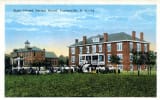
Fayetteville State University
The historically Black university that grew from the 1867 Howard School, founded on land seven Black men bought, where Charles W. Chesnutt was principal.
historical · Fayetteville
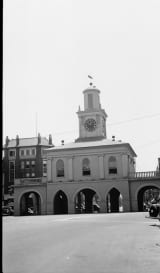
Market House
The 1832 arcaded market and town hall in the traffic circle at the heart of Fayetteville, where enslaved people were sold, built on the site of the state house of 1789.
Historical markers
Fayetteville · Erected 1951
Babe Ruth
The train south to Fayetteville was likely the nineteen-year-old's first trip beyond Baltimore.
Fayetteville · Erected 2000
Bank of the United States
Fayetteville won its branch as a river town where roads met. With only three banks in the state, citizens argued for central location and river navigation, and the…
Fayetteville · Erected 1979
C. M. Stedman
Stedman graduated from Chapel Hill with highest honors in 1861 and went straight into the Fayetteville Independent Light Infantry, fighting at Big Bethel that June.
Fayetteville · Erected 1960
Campbelton
The town was the colony's bid to hold the backcountry trade. The 1762 act laid out a trading town on the Cape Fear, with Wilmington as its seaport, to draw produce from…
Fayetteville · Erected 1991
Cape Fear Baptist Church
Stephen Hollingsworth was among the earliest settlers of Bladen, granted 640 acres there on September 9, 1735, and later more land in New Hanover.
Fayetteville · Erected 1989
Charter of the University of N.C.
Fayetteville's 1789 was crowded. In November a convention there ratified the federal Constitution, and within days the General Assembly, meeting on the same site…
Fayetteville · Erected 2016
Chas. W. Chesnutt
Chesnutt's first story, The Goophered Grapevine, ran in the Atlantic Monthly in August 1887, the first work by a Black author the magazine printed, and it was collected…
Godwin · Erected 1961
Confederate First Line
The first line's few guns fought to the end on the morning of March 16, 1865. Two 12-pounder howitzers of Le Gardeur's New Orleans battery and a Napoleon of Stuart's…
Fayetteville · Erected 1974
Cornwallis
Cornwallis came to Cross Creek counting on the river. He meant to rest and refit his army here after Guilford Courthouse, with shoes and stores brought up the Cape Fear…
Fayetteville · Erected 1948
Cross Creek
Cross Creek began with a mill. John Newberry, a Pennsylvania Quaker, built one on the creek in 1754, and merchants Richard Lyon and Hugh Fullerton opened a store beside…
Godwin · Erected 2000
David M. Williams
Williams learned his trade in prison. In 1921 Deputy Al Pate was shot dead in a raid on one of the stills Williams ran near Godwin, and Williams, who always denied…
Fayetteville · Erected 1972
Dunn's Creek Quaker Meeting
Dunn's Creek was troubled from the start. In 1746 Thomas Nicholson and others came from the Eastern Quarterly Meeting as a committee to quiet disputes there, and the…
Godwin · Erected 1961
Federal Artillery
Union guns opened from a rise beyond the swamps, left of the main road, on the morning of March 16, 1865.
Godwin · Erected 1961
Federal Hospital
About 400 men of the Union Twentieth Corps and cavalry were wounded here on March 16, 1865, in rain that fell most of the day.
Fayetteville · Erected 1950
First Presbyterian Church
The church rebuilt after the fire of 1831 keeps its most unusual feature in the attic. Inside the scorched brick walls of the 1816 building, A. J.
Fort Bragg · Erected 1986
Fort Bragg
Named in 1921 for Braxton Bragg, a North Carolinian who became a general of the Confederacy, which fought to keep Black people enslaved, the post became Fort Liberty in…
Fayetteville · Erected 1973
Frank P. Graham
Graham's Senate career was short and its ending famous. Appointed in March 1949, he led the 1950 Democratic primary with 49 percent, a point short of winning outright…
Fayetteville · Erected 2018
Ft. Bragg School Integration
Poole, a 1921 graduate of what is now UNC Greensboro, became the first head of the Fort Bragg school system in 1948.
Fayetteville · Erected 1977
Henry Evans
Evans came from Virginia around 1780, a free-born shoemaker bound for Charleston, and stayed to preach to Fayetteville's Black residents; in time white townspeople came…
Fayetteville · Erected 2005
Hiram R. Revels
The Mississippi legislature chose Revels by 81 votes to 15 to finish an unexpired Senate term, and his seating became a fight.
Fayetteville · Erected 1936
James C. Dobbin
Dobbin's best-remembered speech came out of grief. In 1848 his wife, Louisa Holmes Dobbin, was dying, and Dorothea Dix, in North Carolina to campaign for a state…
Fayetteville · Erected 1996
John England
In 1821 England found fewer than 150 adult Catholics in North Carolina and no organized church.
Fayetteville · Erected 2016
Lafayette
Admirers stood in mud and pouring rain to greet him. Lafayette reached Fayetteville in early March 1825 after nights at Murfreesboro's Indian Queen Inn and Henry…
Fayetteville · Erected 2010
Lewis Leary
A harness maker like his father, Leary left Fayetteville for Oberlin, Ohio, where several of his sisters had married, and there he married Mary Patterson.
Fayetteville · Erected 1999
Moore's Camp
Moore's men held this camp for six days, playing for time. Nearly sixty Cross Creek residents came in to volunteer, and by February 19 small militia and minuteman units…
Godwin · Erected 1961
Oak Grove
Oak Grove stood between the lines. Probably built by Alexander Smith, who kept a ferry on the Cape Fear here, the house passed to his son John, who in 1815 enslaved…
Wade · Erected 1950
Old Bluff Church
The church took its name from the bluffs on the Cape Fear above Cross Creek, where Hector McNeill lived, known to his neighbors as Bluff Hector.
Fayetteville · Erected 2010
Omar ibn Said
Captured in a war near his Futa Toro home about 1807 and sold at Charleston, Umar ibn Said fled a cruel rice planter on foot and reached Fayetteville in 1810.
Fayetteville · Erected 1957
Plank Roads
Fayetteville wanted the backcountry's trade, and the long road's western end went to whichever town would pay.
Spring Lake · Erected 2014
Pope Air Force Base
Lt. Harley Pope and W. W. Fleming were scouting an airmail route from Camp Jackson in January 1919, following railroad tracks without instruments, when their Jenny ran…
Linden · Erected 1980
Rev. James Campbell
Campbell had stopped preaching once before he came south. Licensed in Pennsylvania in 1735, he fell into doubt about his own salvation in 1739 until a sermon by George…
Godwin · Erected 1961
Rhett's Brigade
The brigade was Charleston heavy artillery, men who had garrisoned the harbor forts and now carried muskets as infantry for the Confederacy and its slaveholding cause.
Hope Mills · Erected 2015
Rockfish Factory
Most of Rockfish's 148 workers in 1850 were women, often widows: 100 of them were female, and children worked there too.
Fayetteville · Erected 1940
Sherman's Army
For enslaved people across the Carolinas the army's road led out of bondage, and thousands followed it here.
Fayetteville · Erected 1973
The Fayetteville Observer
Edward Jones Hale's paper fought secession hard in the months before the war, then backed the Confederacy and its war to keep slavery, and Hale helped elect Zebulon…
Fayetteville · Erected 1976
U.S. Arsenal
Its value came south from Virginia. Machinery for the Model 1841 rifle, taken from the burned Harpers Ferry Armory, was set up here, and more than a hundred Harpers…
Fayetteville · Erected 1986
Warren Winslow
Winslow's grandfather had been a chaplain in the British army. Speaker of the state senate in 1854, he became governor when David Reid left for the U.S.