County guide · Nebraska
Douglas County
4 places to stop and 29 historical markers in Douglas County, Nebraska.
Places to stop
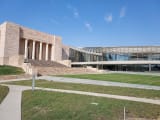
cultural · Omaha
Joslyn Art Museum
Omaha's free art museum, a 1931 Art Deco memorial with two modern pavilions, and the keeper of Karl Bodmer's watercolors from the upper Missouri in 1833 and 1834.
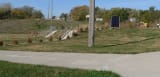
historical · Omaha
Malcolm X Birthsite
The North Omaha lot where Malcolm Little was born in May 1925 and his family was driven out by the Klan, saved by Rowena Moore and now planned as a cultural center.
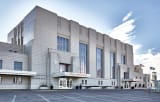
architectural · Omaha
The Durham Museum (Omaha Union Station)
Omaha's 1931 Union Station, Gilbert Stanley Underwood's Art Deco depot for the Union Pacific, closed to trains in 1971 and kept as a city museum with its waiting room intact.
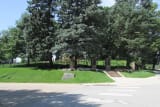
historical · Omaha
Winter Quarters and the Mormon Pioneer Cemetery
The Latter-day Saint camp of 1846 to 1848 on Omaha land in what is now Florence, where hundreds died the first winter, and the cemetery and trail center beside it.
Historical markers
Historical marker
Ak-Sar-Ben Field and the U.S. Air Mail
Jack Knight was scheduled to fly only the North Platte to Omaha leg on the night of February 22, 1921.
Erected 2011
Before Creighton
Creighton itself began with a widow's will. Edward Creighton, born in Belmont County, Ohio, in 1820, surveyed the telegraph route from Omaha to Sacramento in the winter…
Historical marker
Boettger Farm
Fred V. Grau found the plant in 1935, a weed with lavender flowers in rocky soil on a southeastern Pennsylvania farm, while a Penn State agronomist.
Historical marker
Capitol Hill
The capital fight broke the legislature apart in January 1858. On January 7 a bill to move the capital out of Omaha was introduced, and in the uproar that followed…
Historical marker
Captain William Clark and Private Reuben Field
Reuben Field was born about 1772 in Culpeper County, Virginia, and grew up in Jefferson County, Kentucky, where his family moved about 1784.
Historical marker
Creighton University
The second brother on the plaque outlived the first by thirty-three years and spent much of it paying for this campus. John A.
Historical marker
Crook House
The plaque's line about the commanding officer's home skips a stretch. From 1905 the house served Fort Omaha as an officers' club and mess hall, and only in 1930 did it…
Historical marker
Duchesne Academy
The school's name honors Rose Philippine Duchesne, born at Grenoble in 1769. She entered the Visitation order in 1788 and in 1804 brought her community into…
Historical marker
Father Flanagan's Boys' Home
Father Flanagan died far from Overlook Farm. Born on July 13, 1886, in County Roscommon, Ireland, and ordained in Innsbruck, Austria, in 1912, he went to Japan and Korea…
Erected 1985
Forest Lawn Memorial Park
Cincinnati cemetery designer Joseph Earnshaw surveyed and platted the grounds on his lawn plan, which worked with the land as found: groves of trees and shrubs on the…
Historical marker
Fort Atkinson
Long's men built their winter quarters on September 19, 1819, about half a mile above Manuel Lisa's trading post, and named the camp Engineer Cantonment after their…
Historical marker
Fort Omaha
Before the balloon school came airships. In 1907 the Army built a large steel hangar at Fort Omaha for dirigible experiments, added a balloon house in 1908 and saw the…
Historical marker
George and Sarah Joslyn Home
The house went on working long after the family. Omaha Public Schools made it the district's headquarters in 1944, added an office annex in 1958 that took in walls of…
Historical marker
Historic Prospect Hill--Omaha's Pioneer Cemetery
Black Omahans were buried on this hill from the 1860s on. In 1981 young people from the Girls Club of Omaha, now Girls Inc., combed the cemetery's records for a study…
Erected 2015
Kobs Pioneer Cemetery
Reaching this cemetery takes a walk. It lies in the northeast corner of Glacier Creek Preserve, beyond the reach of cars, and the Nebraska State Historical Society's…
Erected 2010
Kountze Memorial Lutheran Church
The father the church honors was Christian Kountze, an immigrant from Saxony; Augustus, born in Osnaburg, Ohio, in 1826, was one of his seven children.
Historical marker
Lewis and Clark Campsite: July 27, 1804
On July 29 the captains sent the Missouri man to the Oto camp with a companion: a French engagé the journals write as le Liberty, la Liberty, LiBerty and once Jo.
Erected 2013
Lincoln Highway at Elkhorn
The bricks are still here because people kept choosing them. The Douglas County Board resolved in 1975 to maintain and preserve the road, and five reproduction Lincoln…
Historical marker
Malcolm "X"
Louise Little's own story runs through Omaha. Born Louise Langdon in La Digue, Grenada, she met Earl Little through the Universal Negro Improvement Association in…
Erected 2012
Nebraska School for the Deaf
The ban began as Senate File 173, introduced on February 1, 1911 to require oral, aural and lip-reading instruction to the exclusion of sign, and Governor Aldrich signed…
Historical marker
Omaha
The race Omaha lost in England is the one remembered. At Royal Ascot on June 18, 1936, he started the 11-to-8 favorite in the Gold Cup, so agitated beforehand that he…
Historical marker
Oto Indians
In their own languages the Otoe are Jiwere and the Missouria Nutachi, and the united Otoe-Missouria Tribe is headquartered today at Red Rock, Oklahoma.
Historical marker
Platte River History
The likely Elkhorn crossing lies about six miles east, where in 1847 the river ran about 160 feet wide and four feet deep, too fast to drive wagons through.
Erected 2020
Potter's Field
For decades the field also supplied dissecting tables. Adam Fletcher Sasse's history of the site, drawn from Omaha newspapers, says that by the 1930s it was commonly…
Erected 2014
Poynter Hall
The dean the building honours was born in 1875 in Eureka, Illinois, and was the son of William Poynter, Nebraska's tenth governor from 1899 to 1901.
Historical marker
Shipley Cemetery
The cemetery itself lies in Section 32 of Fort Calhoun Township, on the line between Washington and Douglas counties, and a transcription from a June 2002 visit lists…
Historical marker
The Bank of Florence
The bank's manager, James Monroe Parker, lived in the rooms upstairs, which the museum keeps as they looked when his family left around 1860.
Historical marker
Trans-Mississippi and International Exposition of 1898
Kountze Park, between Pinkney and Pratt streets, lies within the old Grand Court. The ground belonged to the banker Herman Kountze, on the flat between Omaha and the…
Historical marker
Winter Quarters
The first handcart company began walking from Iowa City on June 9, 1856, after crossing the Atlantic.