Every major ski resort in northern Utah is built on top of something that failed.
That is not a metaphor. Before the lifts, these canyons ran on silver, on uranium money, on sheep, on timber — industries that boomed and then collapsed, or were regulated out of existence, or wrecked the land so thoroughly that someone had to come restore it. Skiing did not arrive in the Wasatch as a fresh idea on empty mountains. It moved into the vacancies left by the extraction economies that came before it. The tramways that had hauled ore were rebuilt to haul people. The mining companies that were going broke became, almost by accident, the first lift operators. The pattern repeats from one canyon to the next, and once you see it, you cannot stop seeing it.
The silver ran out first
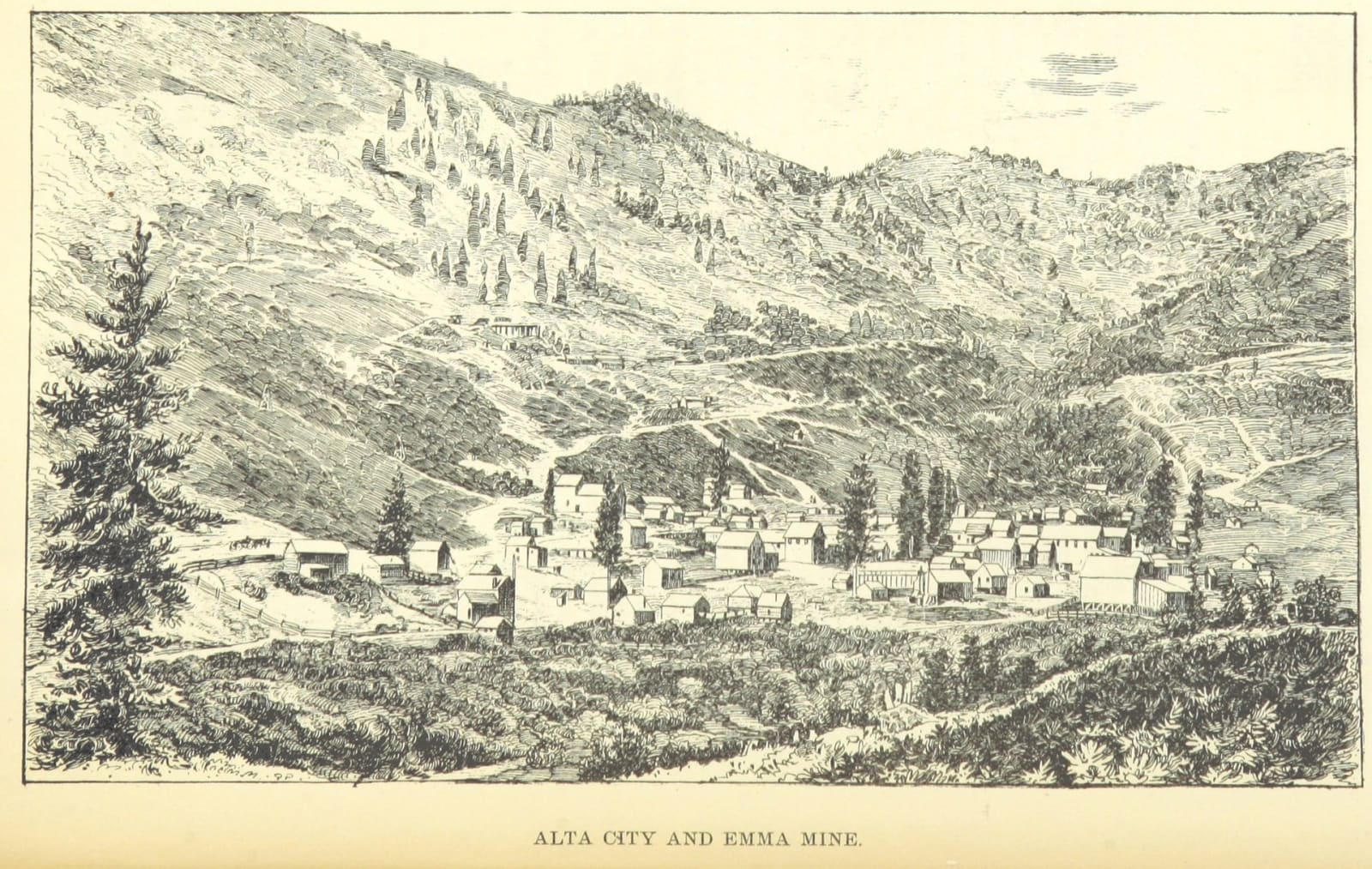
Silver was discovered in Little Cottonwood Canyon in 1864. By 1872 the town of Alta had something like three thousand residents and more than 180 buildings, nearly all of them oriented around getting metal out of the ground and money out of the metal. It did not last. The price of silver fell, the richest veins played out, and Alta emptied as fast as it had filled. By the 1930s it was a near-ghost town with a problem common to mining country: a great deal of abandoned, expensive infrastructure and no reason left for it to exist.
In 1938 a group of Salt Lake businessmen raised about ten thousand dollars, leased the slopes from the Forest Service, and bought a surplus aerial tramway that had been built to move silver ore. They rebuilt it into a single-seat chairlift. When it opened to skiers on January 15, 1939, it was only the second chairlift in the western United States, and a ride up it cost twenty-five cents. The machinery that had carried rock now carried people, up the same mountain, for the opposite reason.
What happened next at Alta became its own kind of legacy. The snow that made the skiing also made the avalanches, and in 1939 the Forest Service stationed its first snow rangers there — the beginning of avalanche research and control in North America. After the war a 10th Mountain Division veteran named Monty Atwater took over the work and, lacking anything subtler, eventually talked the military into letting him fire a surplus 75mm howitzer at the slopes to bring the snow down on his own terms. The canyon that had once buried miners was now being deliberately, scientifically managed for the same snow that had buried them. A mile down the canyon, Snowbird opened in 1971 on the same silver-scarred ground, and the two resorts have shared the canyon — and a good deal of its powder — ever since.
A dying company's last idea
Park City tells the same story louder. It was one of the great silver camps of the West — seventy-some producing mines, more than a hundred miles of shafts and tunnels threaded under the hills, a town that boomed for decades and then, when the mines began closing after the Second World War, slid so far that the New York Times once called it a doddering ghost town. By the 1950s the entity still holding it together was United Park City Mines, a company that had consolidated the old claims and was steadily losing money.
Their last good idea was to stop digging and start grooming. The company won a low-interest federal loan, put out-of-work miners to work clearing lift lines, and on December 21, 1963, opened a ski resort called Treasure Mountain — today Park City Mountain — with the longest gondola in the country. The clearest expression of what the place really was came from the lift they built next. For its first several winters, skiers reached the upper mountain by riding a mine train nearly three miles underground through the old workings of the Spiro Tunnel, then taking a hoist 1,800 feet up to the surface. They called it the Skier Subway. People bought lift tickets to ride through a silver mine to get to the snow.
The town's own shorthand puts it best: silver built it, snow saved it. The resort is now the largest lift-served ski area in the United States, a little over seven thousand acres of terrain laced with the headframes and tailings of the industry it replaced. Just over the ridge, on land that had been the same web of mining claims, Deer Valley opened in 1981 as the polished, ski-only version of the same inheritance — built out from a slope the Civilian Conservation Corps had first cut for a small area called Snow Park back in 1947.
The uranium man and the restroom
Some of the money that built Utah skiing did not come from the Wasatch at all. Robert Barrett made a fortune mining uranium around Moab during the atomic boom of the early 1950s, then moved north to Salt Lake City and took up skiing at Alta. The story, told the same way by nearly everyone including the resort he founded, is that he was refused the use of a restroom at Alta — the facilities were reserved for overnight lodge guests, because the area had to truck its sewage down the canyon — and that he was angry enough to do something permanent about it. He bought up the available land in the next canyon over and, in 1957, opened his own resort across Big Cottonwood: Solitude.
The name was not his invention. Silver miners had called that patch of mountain Solitude decades earlier, and the resort simply kept it. Even the grudge, it turns out, was built on top of mining — a uranium fortune spent buying ground that silver men had already named, a few miles from Brighton, the local hill the Salt Lake valley had been skiing since the 1930s.
A sheep range and a doctor
Not every failed industry here was a mine. In the first decades of the twentieth century a man named Frederick Cobabe — orphaned at fifteen, paid in sheep by the shepherd he worked for — slowly assembled some eight thousand acres of high range above Eden, on the back side of the Ogden valley. Grazing had badly eroded that country, and Cobabe spent years working to rehabilitate the watershed his herds depended on, which is its own quiet foreshadowing of what came next door.
His son Alvin inherited the land and the livestock company in 1948, then sold the business in the mid-1950s to put himself through medical school, kept the acreage, and came back a country doctor. He had jumped off the family barn roof on skis as a boy and never lost the habit; in the early 1960s he strung a rope tow across the ranch, and on February 19, 1972, he opened it formally as Powder Mountain. It is now one of the largest ski areas in the country by sheer acreage, and it has stayed deliberately, almost stubbornly uncrowded — a working sheep ranch that a physician turned into a mountain and then refused to overbuild.
The watershed they had to rebuild
The clearest case of all is the one that was created on purpose to repair the damage. By the 1930s the slopes of Wheeler Basin, east of Ogden, had been so heavily grazed and logged that the runoff was sending destructive floods down into the city below. Alarmed Ogden residents organized, and between 1940 and 1945 a coalition of the city, the county, the Rotary Club, and the chamber of commerce bought up roughly five thousand acres of the ruined basin and handed it to the Forest Service to be restored and protected. The stated goal was to turn the wreckage into, in one reporter's phrase, a huge public playground.
The ski pioneer Alf Engen looked at the recovering basin in 1938 and saw a ski area. The first tow was running by 1939; the CCC cut the access road in 1940. That became Snowbasin, one of the oldest continuously operating ski areas in the country — a resort that exists because the land beneath it had been wrecked badly enough that someone had to rescue it first. Decades later the oil magnate Earl Holding, who also owns Sun Valley, bought Snowbasin in 1984 and poured in enough money to make it the downhill and super-G venue for the 2002 Winter Olympics. The Olympic course now drops down a mountain that began its modern life as a flood-control project.
The country that traded one boom for another
Extraction always leaves a mark. Mining country is supposed to end in the familiar way — tailings piles, sealed shafts, a few stubborn buildings, a name on a map and not much else. A great deal of the American West looks exactly like that, and stays that way.
Northern Utah mostly does not, and the reason is that here the wreckage got reused instead of abandoned. The ore tram became a chairlift. The mine tunnel became a subway to the snow. The failing mining company became a resort operator; the uranium fortune and the sheep range and the flood-control purchase all turned, within a single generation, into places people now drive hours to reach. The thing that saved these mountains was, in nearly every case, a direct inversion of the thing that had nearly used them up.
You can still read it on the ground if you look. Ride the Allen Peak tram at Snowbasin and you are crossing a restored watershed. Take the Silver to Slopes tour at Park City and a guide will walk you past the headframes standing between the runs. Stand at the base of Alta and you are standing in an old silver camp that simply decided, when the metal gave out, to sell the snow instead. The boom never really ended up here. It just changed what it was selling.