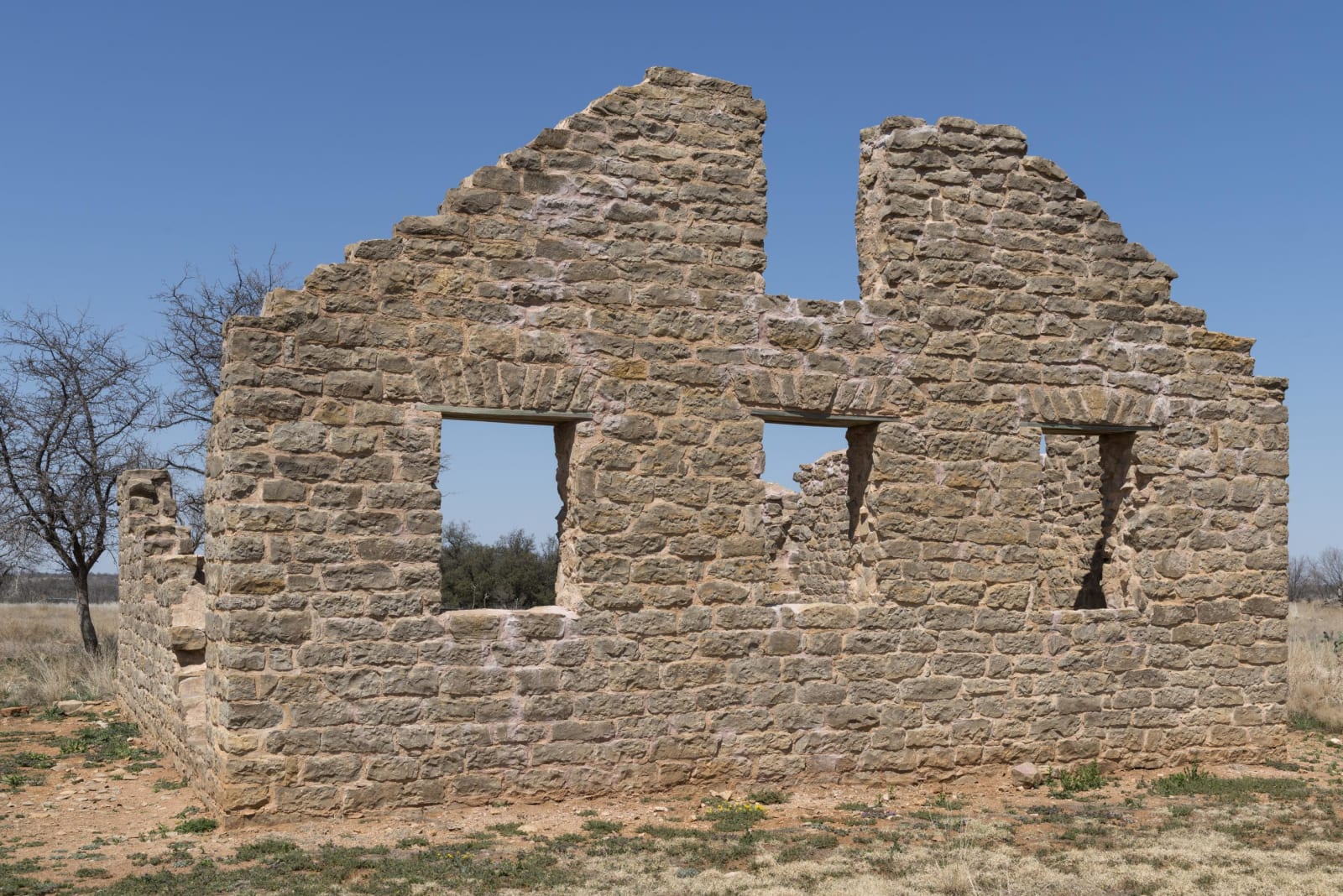
After the Mexican War, settlers pushing into Texas found most of the state still held by the Comanche and their neighbors. In 1848 the War Department authorized a line of posts from the Rio Grande to the Red River. As settlement kept moving west, in 1849 Capt. Randolph B. Marcy was sent to find the best route through the Comanchería for emigrants bound for the California gold fields. His recommendations produced a second, advanced line of forts.
The line of the 1850s
The new posts went up quickly. Fort Belknap, the northern anchor, was founded on the upper Brazos on June 24, 1851. Five companies of the Fifth Infantry reached the Clear Fork of the Brazos on November 14 to build Fort Phantom Hill. On December 16 Gen. Persifor F. Smith ordered two more posts, one on the San Saba and one on the Concho, and Fort McKavett began as a camp on the San Saba on March 14, 1852. Fort Chadbourne followed on Oak Creek on October 28.
None of them had walls. They were bases for patrols, which rode out after raiding parties and sometimes carried the war north onto the plains as far as Kansas. The Handbook of Texas says Belknap gave settlers confidence. They came in such numbers that the counties around it were organized, and the fort became the hub of a network of roads, the Butterfield Overland Mail among them.
The line ended with secession. On February 9, 1861, Gen. David E. Twiggs surrendered every federal post in Texas, and Fort Chadbourne was handed over to Confederate Col. Henry McCulloch on February 28.
The line after the war
When the Army came back, it drew a new line farther out. Lt. Col. Samuel D. Sturgis led four companies of the Sixth Cavalry to the Clear Fork in present Shackelford County on July 31, 1867, and founded Fort Griffin. That November a site where the North and Main Concho meet was chosen for a post to replace Fort Chadbourne, which lacked water, and Fort Concho grew there. Fort Richardson, at Jacksboro, was officially established in February 1868, seventy miles from the Indian Territory, the northernmost post in Texas. In 1872 it had the largest garrison of any Army post in the country, 666 officers and men.
The old posts did not vanish. Belknap, Phantom Hill and Chadbourne became subposts of Fort Griffin, which supplied their small garrisons, and their soldiers escorted stagecoaches, wagon trains and surveying parties. Chadbourne itself was abandoned in 1868, short of water, wood and adequate buildings.
Overtaken again
The second line did not last either. By 1879 the southern buffalo herd was gone and Fort Griffin and its outposts sat inside settled country. On May 31, 1881, Capt. J. B. Irvine closed Griffin and marched its last company south to Fort Clark, and the town beside it emptied soon after.
The chain can still be followed. Fort Belknap, Fort Richardson, Fort Griffin, Fort Phantom Hill, Fort Chadbourne, Fort Concho and Fort McKavett each keep their own story.