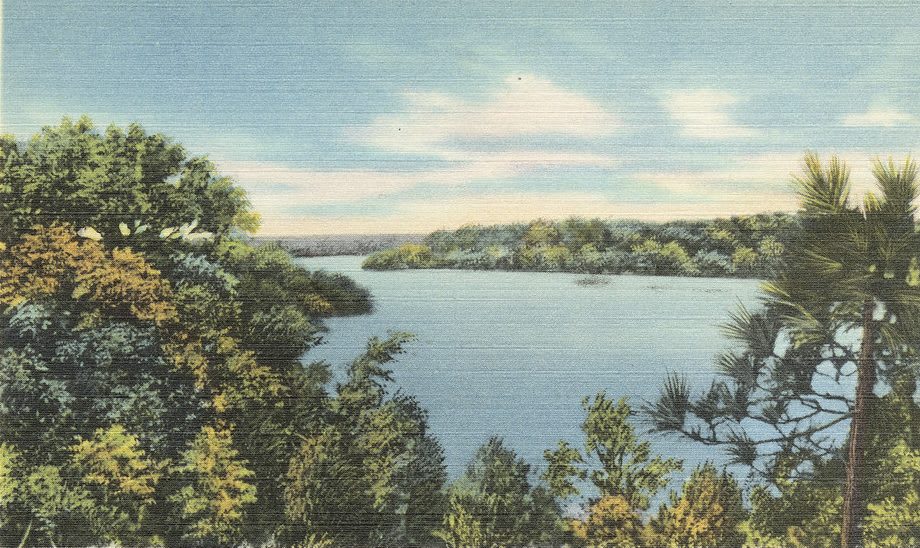
Before the Civil War, loggers on the Altamaha cut only what they could reach from the banks. When railroads pushed into the interior of the coastal plain after the war, the longleaf forest came down within fifty years. From about 1870 to 1930, raftsmen from the Ocmulgee, Oconee and Ohoopee floated hewn pine down to the sawmills at Darien.
Squaring the timber
The work began in the fall, when men felled tall longleaf pines and left the logs to cure for months before squaring them with a broad ax. On high water they drifted the timbers out of the swamps and creeks and tied them into a raft. Two stout logs formed a V at the bow so the raft would glance off the banks at sharp bends. By folklorist Delma Presley's reckoning a raft weighed about 360,000 pounds; accounts of its length run from the size of a basketball court to 175 feet. Sweeps 45 to 50 feet long served as both oars and rudders, and a crew needed at least three: a pilot calling the turns, an assistant pilot, and a roustabout who also cooked. Settlers from the British Isles were among the first raftsmen, and Black men worked the rivers too; Presley writes that both shared the work and its rewards.
A raft leaving Lumber City, where the Ocmulgee and Oconee join to make the Altamaha, needed about twelve days to reach Darien. The crews named the river as they learned it: Devil's Whirl, Devil's Elbow, Hell's Shoals, Little Hell and Old Hell Bight; Point Pullaway, and the worse Point-Pullaway-and-be-Damned. At Rag Point a new hand tied a piece of clothing to a willow for luck.
Darien and the walk home
By the late 1800s Darien was the leading lumber port on the southern Atlantic coast, and in 1900 it shipped more than 100 million board feet. The trade's lore carries the work song Pay Me My Money Down, still sung on the Georgia coast. Once the raft was sold, the crew walked home, six or seven days on foot. A novice was handed a maul to carry and told on the third day that he could throw it away.
The upriver pine, once thought endless, was overcut. The Darien and Western Railroad, finished in 1895, came too late. The Hilton and Dodge Lumber Company, the last of Darien's big mills, went bankrupt in 1916, and steady wages at timber companies drew men off the river.
The last raft
In 1982 Presley, a Georgia Southern professor, organized Project R.A.F.T., to Restore Altamaha Folklife Traditions. On April 3 a raft left McRae's Landing on the Ocmulgee near Lumber City with Captain Bill Deen, 90, as pilot. It measured 85 by 30 feet and weighed almost 50 tons, with 35-foot sweeps and a crew of eight. The novelist Brainard Cheney, raised on a farm near Lumber City, whose River Rogue of 1942 drew on the rafting trade, spoke along the way. The raft reached Darien on April 20, about 140 miles downstream. A monument at the landing, reached only by boat since its road closed in 2023, marks the trip.
Downstream, the Altamaha takes in the Ohoopee at Big Hammock Natural Area, where a sand ridge rises above the rafters' river.