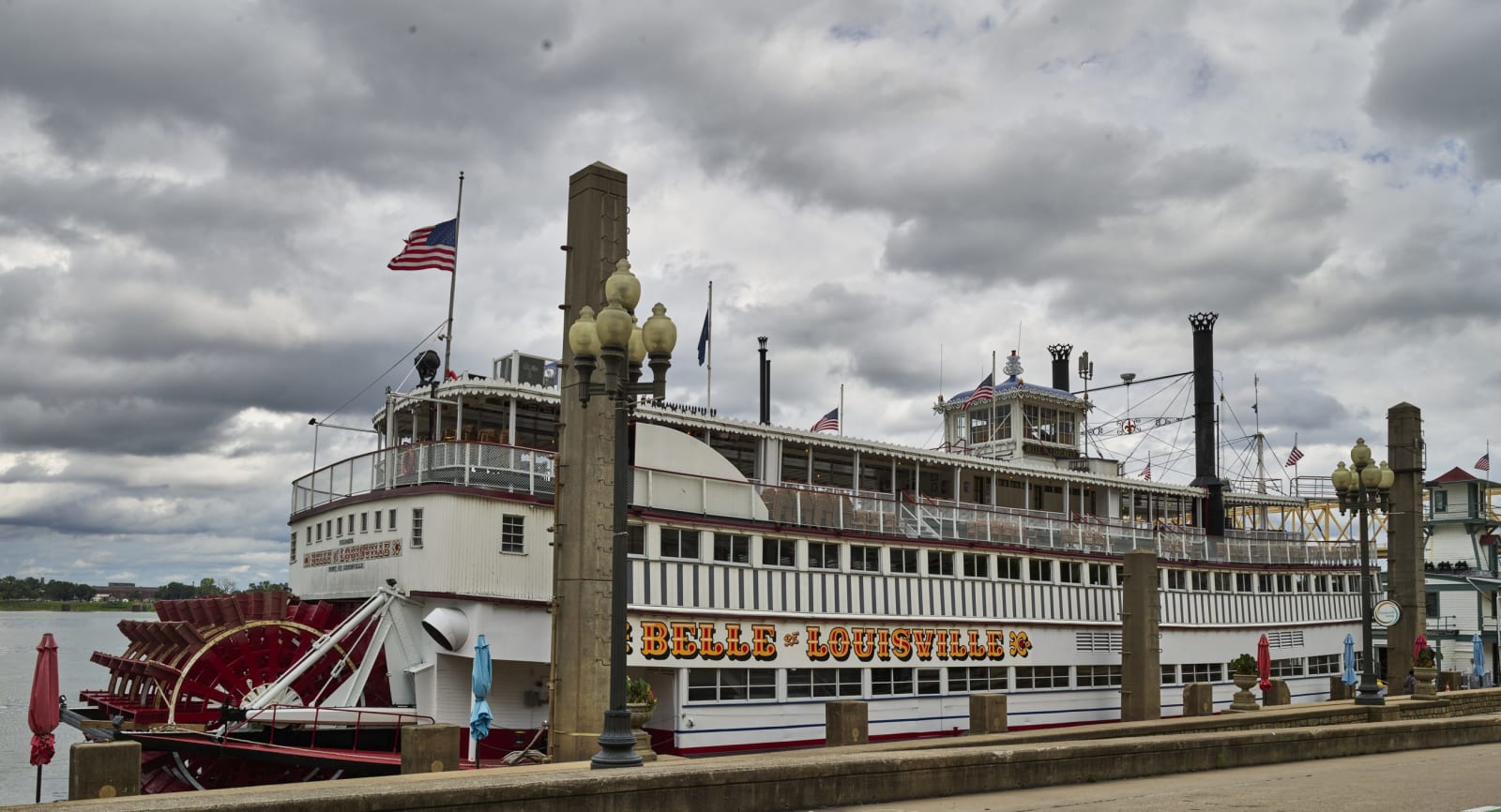
The steamboat at the foot of Fourth Street in Louisville was launched in Pittsburgh as the Idlewild. James Rees and Sons built her in 1914 on the Allegheny River for the West Memphis Packet Company, which wanted one boat for three trades: day packet, excursion boat and ferry. She was christened on October 18, 1914, and left for Memphis on January 8, 1915, with "Safety First" lettered on her pilothouse.
Ferry, taxi and barge boat
At Memphis she crossed the Mississippi to Hopefield Point, Arkansas, carrying passengers, cotton, lumber and grain. In November 1925 the Tri-State Ferry Company of Cairo, Illinois, bought her for its run to Bird's Point, Missouri. The National Park Service's landmark study says the Memphis ferry and packet trade had faded by 1928, when she went to a packet company in Hardin, Illinois, and turned to excursions, mostly on the Ohio. By 1931 she was at Louisville ferrying crowds between Fontaine Ferry Park and the Rose Island resort upriver.
During World War II she was fitted to push oil barges on the Mississippi and the Ohio, and accounts say she also served as a floating USO nightclub for troops along the Mississippi.
The Avalon years
J. Herod Gorsage of Peoria bought her in April 1947. In February 1948, by the Park Service's dating, she became the Avalon, a name chosen at the request of Captain Ben Winters, who had long commanded her; other accounts put the renaming in 1947 and call it his deathbed wish. E. A. Meyer of Cincinnati bought her in 1950, and for about fifteen years the Avalon tramped the river system, calling at towns from Omaha on the Missouri and Stillwater on the St. Croix to Nashville on the Cumberland. In 1953 her owners cut 30 feet from the texas deck and switched her boilers from coal to oil. Her two lever engines are older than the boat: the spelling "Pittsburg" on their brasses points to about 1889 or 1890.
In February 1962 the Avalon's company filed for bankruptcy. On May 24 the boat was auctioned to Marlow W. Cook, the Jefferson County judge, for the county Fiscal Court, at a price usually given as $34,000. Some taxpayers objected, and critics called her Marlow's Folly. On October 14, 1962, before about 3,000 people, she was rechristened the Belle of Louisville.
The Belle
Most accounts date her first race against the Cincinnati boat Delta Queen to April 30, 1963, and the bigger boat won; the Park Service study records an earlier contest in June 1962. The race became a fixture of Derby week. She was listed on the National Register in 1972 and named a National Historic Landmark in 1989, and the landmark study calls her the only remaining Western Rivers day packet boat. In August 1997 she partly sank at her moorings when water poured in through a city water line, and a former crew member was later convicted of sabotage. She was repaired and went back to work, and in October 2014 Louisville held a five-day festival for her hundredth birthday.
The city still owns her, and she ties up at the downtown wharf beside Louisville Waterfront Park, where the river's older history is told.