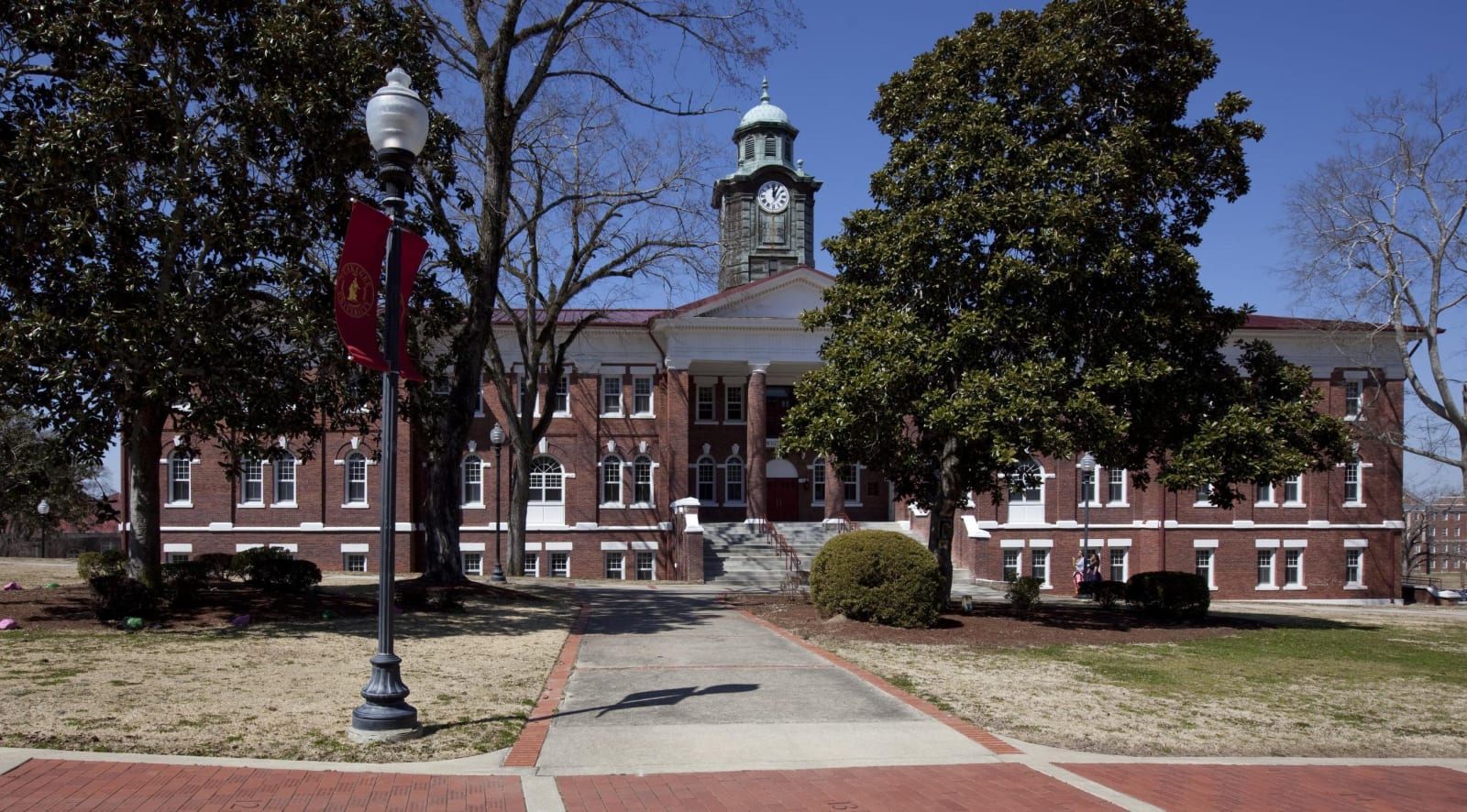
When the federal government agreed to build a hospital for Black veterans of World War I, it chose Tuskegee. The pressure behind it came from veterans, Black physicians, the NAACP and the Black press. Tuskegee Institute donated 300 acres north of its campus, and the hospital was built to treat tuberculosis and the mental illness of war, then called shell shock. Veterans Hospital No. 91 opened in 1923 with 600 beds and 250 patients.
Robert Russa Moton, Booker T. Washington's successor at the Institute, had accepted the arrangement on the understanding that Black physicians would staff the hospital, at least in part. Local white officials expected a white staff, and the Veterans Bureau announced one. The superintendent, Colonel Robert H. Stanley, was white, and he reached Tuskegee two days before Moton was told of his appointment, although the Harding administration had promised to consult him.
The march past the Institute
Moton wrote to President Warren G. Harding asking that Black doctors at least be allowed to qualify for the posts. The NAACP and the National Medical Association, the Black physicians' society, took the case national, calling it hypocrisy for segregationists to demand white staff for Black patients. When Veterans Bureau director Frank T. Hines ordered a Black staff installed, the first man to arrive, an auditor, left town quickly under local pressure. In July 1923 TIME reported that about 700 masked Klansmen had marched silently through Tuskegee and past the Institute. The NAACP telegraphed Harding asking for troops to protect Moton and the Black doctors. Historian Vanessa Northington Gamble has said the opponents "did not want a Black-controlled hospital in the middle of Alabama."
Accounts of Moton's stand differ: TIME reported that summer that he did not want an entirely Black staff; later historians describe him as outraged by the all-white plan.
Joseph Ward's hospital
Four Black physicians began work in November 1923 despite continued threats. In July 1924 Hines appointed Joseph H. Ward medical officer in charge. Born in Wilson, North Carolina, in 1872, Ward had run a 20-bed hospital for Black patients in Indianapolis and served in France as a major in the Army Medical Corps, by a senator's account the only Black man commissioned at that rank in the corps during the war. He replaced white employees with Black ones, and Esther Bullock became the hospital's first Black chief nurse. By the end of 1924 Black physicians ran the hospital. It became a general hospital that year, and over the next decade half of all Black veterans who received hospital care were treated at Tuskegee.
After Ward
In December 1935 Ward faced a hearing on 26 charges, among them mismanagement of government funds. He admitted two: that he had sometimes taken government food, and had not dismissed staff who did. Witnesses named a utility officer, Walter S. Burke, as the main agitator. Ward was dismissed on January 31, 1936, and never held federal office again. After World War II Tuskegee Airmen were among the hospital's patients. The campus, still a working VA hospital, was listed on the National Register in 2012.
The school that gave the land is the Tuskegee Institute National Historic Site, and the airmen trained at Moton Field, north of town.