In the spring of 1874 buffalo hunters and businessmen out of Dodge City built a trading post on the Canadian River, in what is now Hutchinson County, about a mile from the ruins of the adobe post William Bent had built there around 1843. Charles Rath and his partner Wright opened a store, Charlie Myers and Leonard another, and James Hanrahan a saloon. The hunters had already emptied the herds farther north. They came south for the last of them, into country where the Medicine Lodge treaty of 1867 had told the southern nations they could keep hunting, and where rations promised under the same treaty were short or did not arrive.
A prophet's promise
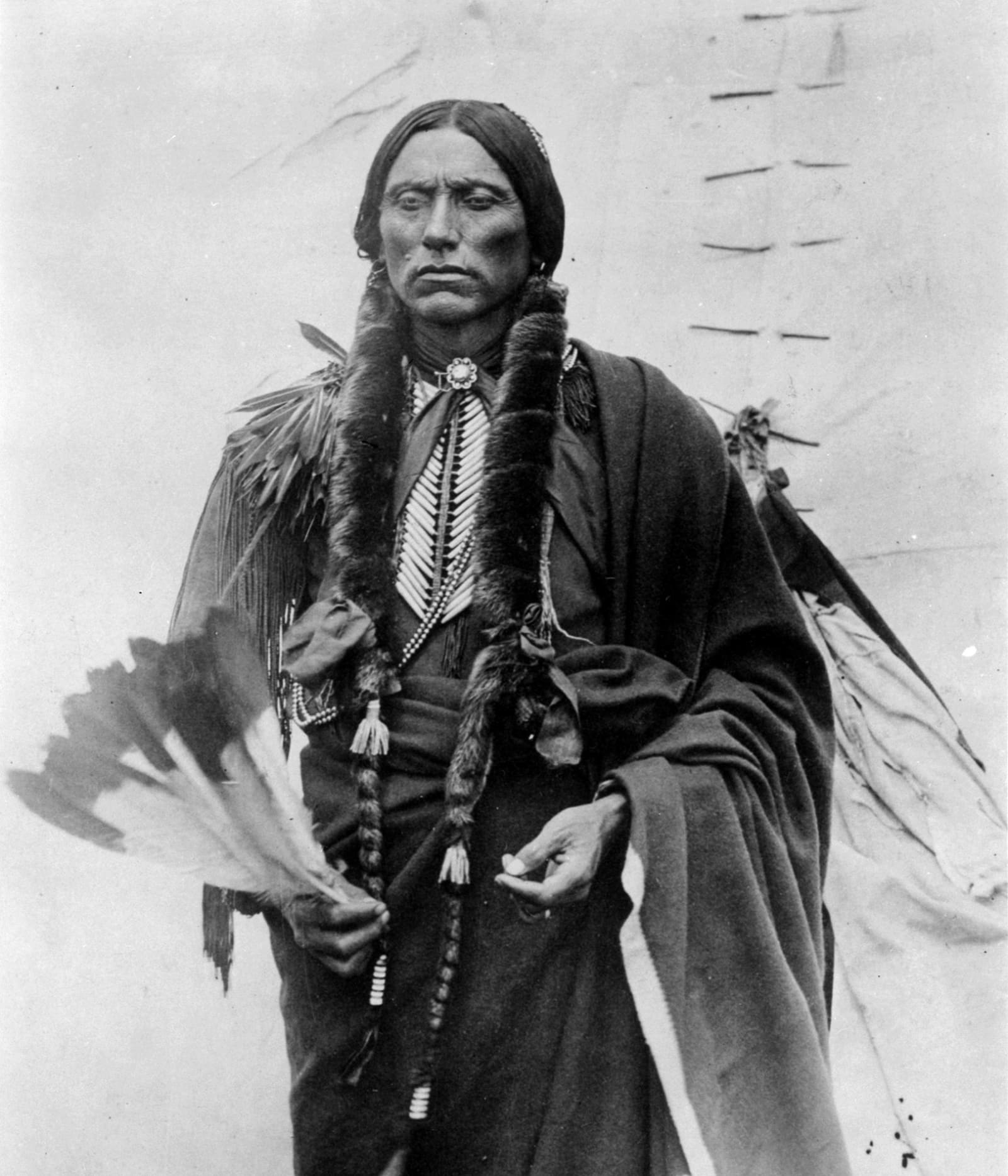
The answer of the Comanche, the Numunuu, came from Isatai, a young medicine man of the Quahadi band, later known as White Eagle. He had foretold the vanishing of a comet in 1873 and the drought that followed, and he said he could make the white men's bullets fall harmless. In May 1874 he called the Comanche bands to a Sun Dance, said to be the first the Comanche had held. The Yapparika chiefs White Wolf and Tabananica pointed to the hide merchants as the real threat, and a war party of Comanche, Kiowa, Cheyenne and Arapaho warriors rode west under Isatai and the young Quahadi leader Quanah Parker. Its size is uncertain. The Handbook of Texas gives about 700; the Texas Historical Commission's guide to the war gives 200.
The charge at dawn
On June 27 most of the hunters were already awake, repairing a broken ridgepole, when the charge came at dawn. Twenty-eight men and one woman held the three buildings with long-range buffalo rifles. Two of the defenders died in the first rush and a third in the charges that followed. William Olds, who ran the post's restaurant, was killed when his own gun went off as he came down from a lookout. About fifteen warriors were killed by the Handbook's count, and many more were wounded, Quanah among them. The fighting ended about noon, and a loose siege lasted four or five days.
Isatai had watched from a distant hill. He blamed his failed medicine on a Cheyenne who had killed a skunk before the battle, and several Cheyennes beat him for it. On the second day, when fifteen or twenty Cheyennes showed themselves on a mesa, Billy Dixon fired from inside the post and a rider fell nearly a mile away. Dixon himself never claimed credit for the shot. By the fifth day more than a hundred hunters had gathered, and the warriors were gone.
What it began
Within weeks the army had a plan to drive every band in the Panhandle back to the reservations, and the Red River War followed. A rancher gave the battle ground to the Panhandle-Plains Historical Society in 1924, and the society's museum began excavating it in 1975. It is told here without directions. The Hutchinson County Museum in Borger tells the fight with models, and the Comanche Nation tells its own history at the Comanche National Museum and Cultural Center in Lawton.