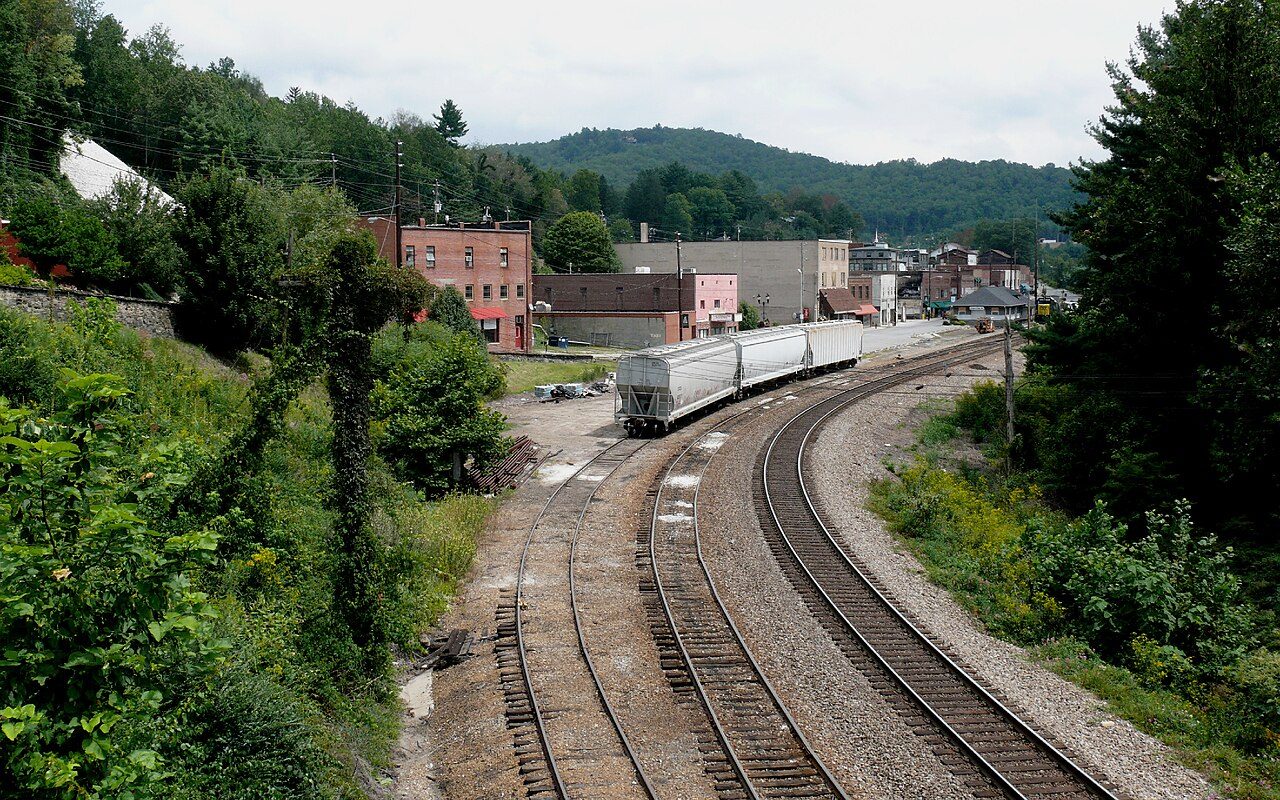
Along the North Toe River, in a belt about 25 miles long across Mitchell, Avery and Yancey counties, the rock is shot through with pegmatite, a granite that cooled so slowly its crystals grew large. It is roughly two-thirds feldspar, a quarter quartz and a tenth mica. Geologists date it to somewhere between about 336 and 380 million years ago. For most of its mining history the quartz was what got thrown away.
Mica first
Native miners worked the mica long before European settlers came, and mining here is believed to have begun before 1500. At the Sink Hole Mine near Bakersville, trees growing on the old waste piles were about 300 years old when they were measured in the 1800s. Later miners in Mitchell County dug into trenches and pits those earlier miners had opened.
Commercial production began in 1867, when Thomas L. Clingman, the former senator, was hired by a New York mica dealer to look into the deposits and fixed the site of the modern Sink Hole Mine. A boom began in 1878 as mica went into electrical insulation for Thomas Edison's electric motor, and by the 1890s Spruce Pine was the center of the nation's mica mining. Sheet mica glazed stove windows and insulated toasters and radio tubes, and in World War II it was a strategic mineral; with European supply cut off, mines in the three counties ran overtime.
Feldspar and the flotation cells
Around 1900 a Baltimore prospector, William E. Dibbell, saw value in the feldspar left over at mica mines such as Flat Rock. A pottery supplier in East Liverpool, Ohio, wanted more, and that demand produced the Carolina Minerals Company of Penland and the Deer Park Mine. By 1917 North Carolina led the country in feldspar, which went into bathtubs, tile, glass and dinnerware.
The quartz came out of the same rock and mostly went to waste. Between 1944 and 1949 the feldspar companies, the Tennessee Valley Authority and the North Carolina State University Minerals Research Laboratory in Asheville worked out a froth flotation process that separates feldspar, quartz, mica and garnet. With clean separation, the quartz became the most valuable of the three. When solid-state electronics arrived in the 1960s, the sheet mica mines closed, the Sink Hole among them.
The purest quartz
The quartz here carries unusually little iron, potassium or aluminum. Refined by repeated flotation, acid and heat, it reaches 99.999 percent purity or better. Fused into crucibles, it holds the molten silicon from which the ingots for computer chips are grown, and estimates give the district 70 to 90 percent of the world's high-purity quartz. Sibelco, a Belgian company that entered Spruce Pine through Unimin in the 1970s, and The Quartz Corp of Norway run the high-purity quartz operations.
Both companies shut down ahead of Hurricane Helene, which devastated Spruce Pine and Mitchell County in September 2024. Sibelco restarted on October 10. A town council member estimated that three-quarters of Spruce Pine has some tie to the mines.
The Museum of North Carolina Minerals stands at Blue Ridge Parkway milepost 331, where NC 226 crosses at Gillespie Gap. Penland School of Craft is a few miles away on the North Toe.