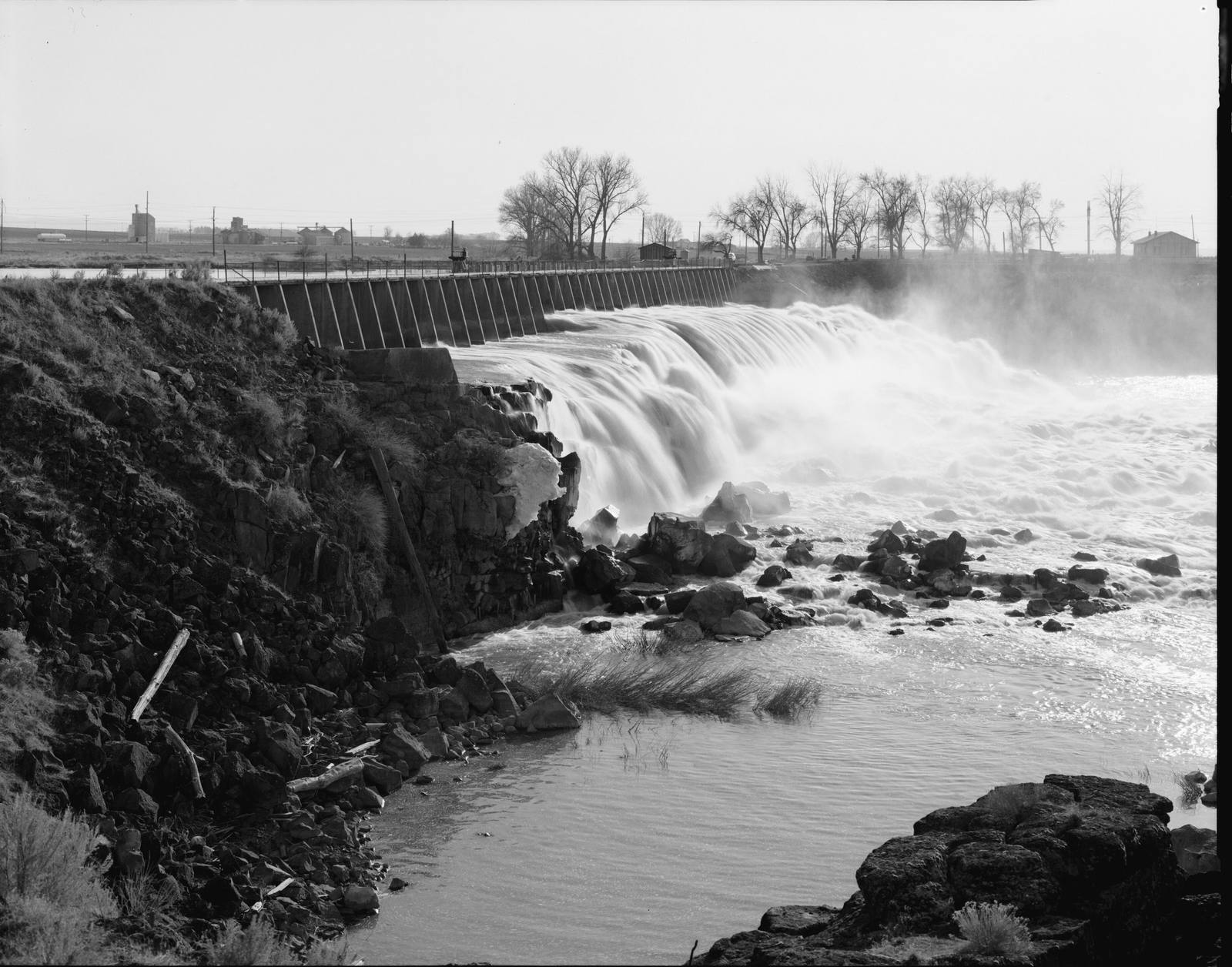
The first fur traders to try the Snake River here gave up on it. In October 1811 the overland party of John Jacob Astor's Pacific Fur Company, bound for the mouth of the Columbia, came down the Snake in cottonwood canoes. Below the site of Milner a canoe struck a rock and split, and a veteran voyageur, Antoine Clappine, drowned. A few miles on, the whole river poured through a slot in the rock that one of the Scots in the party named Caldron Linn. They cached what they could not carry, abandoned the river and walked. For the next ninety years the Snake in this stretch was something to cross, not something to use, sunk in a canyon too deep to reach from the plain above.
The man in the canyon
Ira Burton Perrine got to the canyon in the 1880s and farmed its floor, where there was water. What he wanted was the sagebrush plain above it, and from 1893 on he spent years trying to persuade investors to dam the river and lift it out onto the flat.
The law that made it possible passed in 1894. The Carey Act offered each western state up to a million acres of federal desert if the state would see it irrigated and settled. Private companies would build the dams and canals and sell water rights to settlers; the state would sell the land itself for next to nothing; and when the settlers had paid, the canals would become theirs. It was reclamation without federal money, and in most places it failed.
It nearly failed here too. Perrine's Twin Falls Land and Water Company was organized in 1900 and took up water rights and a survey of about a quarter of a million acres. In 1902 most of its backers pulled out. One stayed: Stanley Milner, a Salt Lake City banker. With him, and with eastern money from Frank Buhl and Peter Kimberly of Pennsylvania, the project survived, and in 1903 the company contracted with the State of Idaho to build.
March 1, 1905
The dam went across the Snake a few miles above Caldron Linn, and more than five hundred men with mules and scrapers dug the canals. The first townsite drawing, in July 1903, was a disappointment. Twin Falls was platted anyway, in 1904, before the water had arrived.
On March 1, 1905, Frank Buhl turned the wheel that closed Milner Dam's gates and opened the main canal. The Twin Falls Canal Company's own history says that on that night Shoshone Falls went dry, the river having gone out across the desert above it. Within a few seasons the canals carried water to fields where there had been only sagebrush, and the country filled so fast that it was called magic, and has been since. Twin Falls was incorporated six weeks after the gates closed. Buhl, Kimberly, Filer, Hansen and Murtaugh grew on townsites the company had set aside, most of them named for men who paid for it or built it.
In 1909 the settlers accepted the system and the company became the Twin Falls Canal Company, owned by the farmers it serves. It still waters more than two hundred thousand acres south of the river, and it is counted the most successful project the Carey Act ever produced.
What the river pays
The price is visible downstream. Milner Dam still takes nearly the whole Snake in a dry summer; below it, in some seasons, the riverbed runs empty until the springs of the canyon walls refill it. The waterfall that went dry in 1905 now runs on a schedule of water rights and a minimum scenic flow, as the page on Shoshone Falls explains, and the drive along US-30 follows the river as it comes back to life. Perrine has a bronze in Twin Falls, and his name is on the bridge that crosses the canyon he farmed.