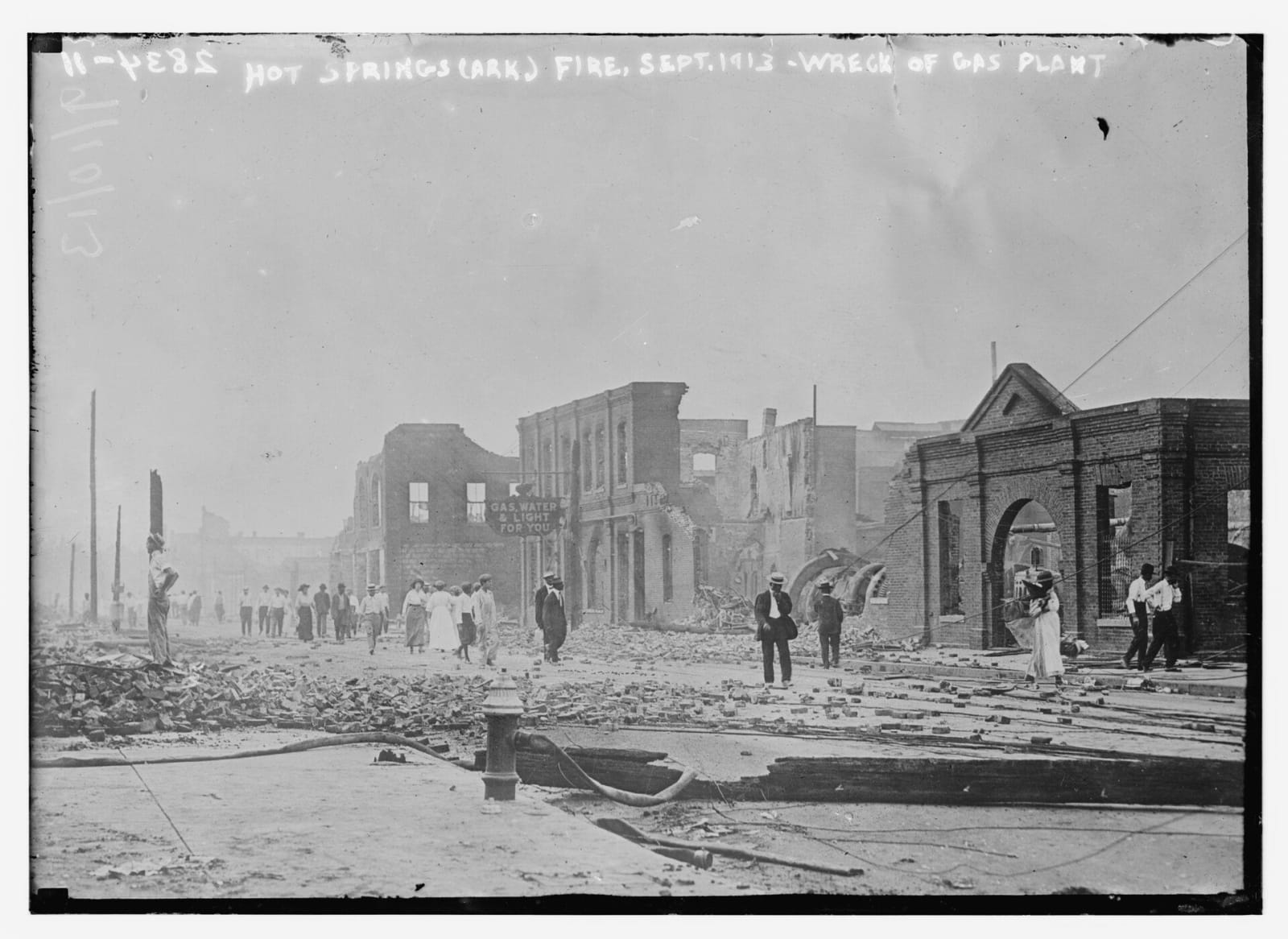
By 1910 Hot Springs had 14,434 people. Before the Civil War it had 201. The hot springs had drawn the crowds. On Friday, September 5, 1913, just before 2:15 in the afternoon, Ulma Madlock was ironing at a house on Church Street when the iron set a curtain alight. A breeze did the rest.
The afternoon
The Encyclopedia of Arkansas says the fire split after about an hour and ran up and down Malvern Avenue. A group led by the city treasurer, George Housley, dynamited the People's Laundry at 356 Malvern and the blast did not stop it. The electric plant burned, water pressure fell as pipes burst, and hoses melted in the heat. Crews from Little Rock came by train at eight that evening and found their hoses did not fit the Hot Springs hydrants. The wind dropped at dusk, and a thunderstorm put out the last embers the next morning. The city says firefighters saved Central Avenue with dynamite.
Accounts of the size differ. The Encyclopedia's Crystal Bathhouse entry says fifty downtown blocks. The Arkansas Democrat-Gazette counted sixty, about half the city, with 700 homes, 155 businesses, two hotels, several churches, a theater, the railroad depot, the county courthouse and the five-year-old high school. Damage was put at $10 million. The Encyclopedia reports more than 2,500 people homeless.
Malvern Avenue
The avenue was the center of the town's Black business district. At 415 Malvern stood the Crystal Bathhouse, which opened on April 1, 1904, and was the first bathhouse in Arkansas built to serve African Americans exclusively. Before it, segregated bathhouses often held Black patrons to the worst hours. The contractors Michael Jodd and Albert Aldrich built it, and in 1908 they sold it for $22,000 to the Knights of Pythias, a Black fraternal order. Dr. Claude Wade and John T. T. Warren had subleased it from January 1912. The fire destroyed it. The Democrat-Gazette adds that Wade's house burned too and calls him the town's only Black physician.
Black bathers then had few places to go. The Encyclopedia says indigent patients could use the government's free bathhouse, but other Black patrons had to swear a false pauper's oath to get in or settle for a poorer facility. The Knights of Pythias rebuilt. The Pythian Bathhouse and Sanitarium opened on December 27, 1914, designed by W. T. Bailey of the Tuskegee Institute, and it ran until 1974.
Rebuilding
The fire changed how the town was built. Wooden-shingle roofs were banned, the electric and telephone systems were modernized, and the fire department was doubled in size. More of the new buildings were brick. Steve Arrison, head of Visit Hot Springs, told public radio in 2013 that the rebuilding forced the town to modernize.
Central Avenue was saved, and Bathhouse Row stands on it today. The Fordyce Bathhouse is the visitor center at Hot Springs National Park, and it displays the nameplate of Vivian Lemons, who worked at the Lamar Bathhouse from 1960 to 1981, one of the many Black attendants who kept the row running.