Home / Arkansas / Hot Springs & the Ouachitas / Hot Springs National Park
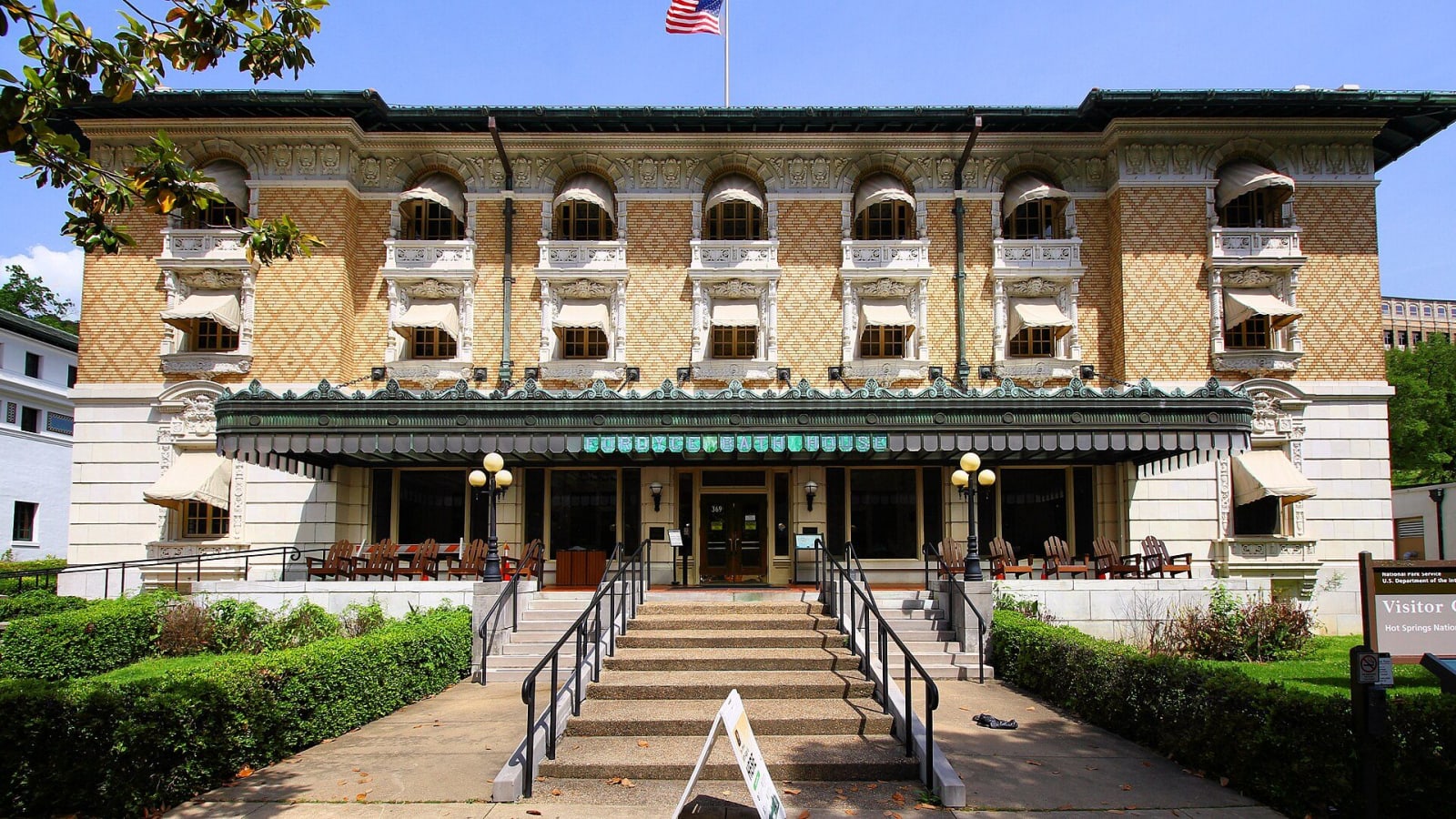
The front of the Fordyce Bathhouse on Bathhouse Row, a three-story building of patterned yellow brick and white stone with a green metal awning, wide entrance steps and an American flag.Larry D. Moore / CC BY 4.0 via Wikimedia Commons
🏛️Historical

Hot Springs National Park

Part ofHot Springs & the Ouachitas

A federal reservation since 1832, where rain from the Ouachita Mountains comes back as 143-degree water along a row of bathhouses.

⏱
Duration
Two hours to a day.
🎟
Admission
No park entrance fee; spring water at the jug fountains is free. Gulpha Gorge Campground charges a fee and takes reservations.
📅
Best Season
Year round; spring and fall are mildest. Bathhouse Row is walkable in any season.

The Story

Hot Springs National Park began as a reservation. Congress set aside the springs and the land around them on April 20, 1832, and the National Park Service counts it as the oldest of the current park units, forty years older than Yellowstone. It became a national park on March 4, 1921. The Encyclopedia of Arkansas says Caddo confederations controlled this country from about A.D. 800, while Quapaw and Choctaw people stayed only for a time, and an 1818 treaty ended the Quapaw claim. The water falls as rain and snow on the Ouachita Mountains, spends roughly 4,400 years underground and returns at about 143 degrees Fahrenheit.

The bathhouses on Central Avenue were rebuilt in brick and stucco between 1912 and 1923, and Bathhouse Row is a National Historic Landmark district. The baths were not open to everyone. After Reconstruction, African Americans worked in the bathhouses but could not freely bathe in them, and the free government bathhouse was remodeled on a segregated plan in 1898. The Pythian Bathhouse, designed by W. T. Bailey of Tuskegee Institute, opened in December 1914 for Black patrons. Desegregation came in 1965, and most bath attendants on the row were African American into the 1980s.

The Fordyce Bathhouse, built in 1914 and 1915, has been the visitor center and museum since 1989, so start there. Entry to the park is free. The park offers spring water at free jug fountains, and a display spring runs behind the Maurice Bathhouse. Two bathhouses on the row sell baths; the park does not.

Visitor Info

⏱
Time Needed
Two hours to a day.
🎟
Admission
No park entrance fee; spring water at the jug fountains is free. Gulpha Gorge Campground charges a fee and takes reservations.
📅
Best Season
Year round; spring and fall are mildest. Bathhouse Row is walkable in any season.
🛣️
Highway
AR-7 (Central Avenue)

On the Map

Nearby

The closest stops worth working into your route

historical0.1 mi away
Buckstaff Bathhouse
The Edwardian bathhouse on Bathhouse Row that opened in 1912 and has run ever since, with a new concessioner expected in 2027.
cultural0.1 mi away
The Gangster Museum of America
A Central Avenue museum on the years when Hot Springs ran an open gambling town, with Owney Madden, the Southern Club and the 1967 shutdown.
natural0.2 mi away
Ouachita National Forest
The oldest and largest national forest in the South, proclaimed in 1907 to protect shortleaf pine, with a supervisor's office in downtown Hot Springs.
natural5.8 mi away
Garvan Woodland Gardens
A 210-acre botanical garden on a Lake Hamilton peninsula that one gardener built over thirty years and left to the University of Arkansas.
recreational10 mi away
Lake Ouachita State Park
The state park on Arkansas's largest lake, built around a spring a homesteader called healing in 1875.
recreational19 mi away
DeGray Lake Resort State Park
A resort park on a 13,400-acre lake made when the Caddo River was dammed, with a lodge, a golf course and a paddle trail through the islets.