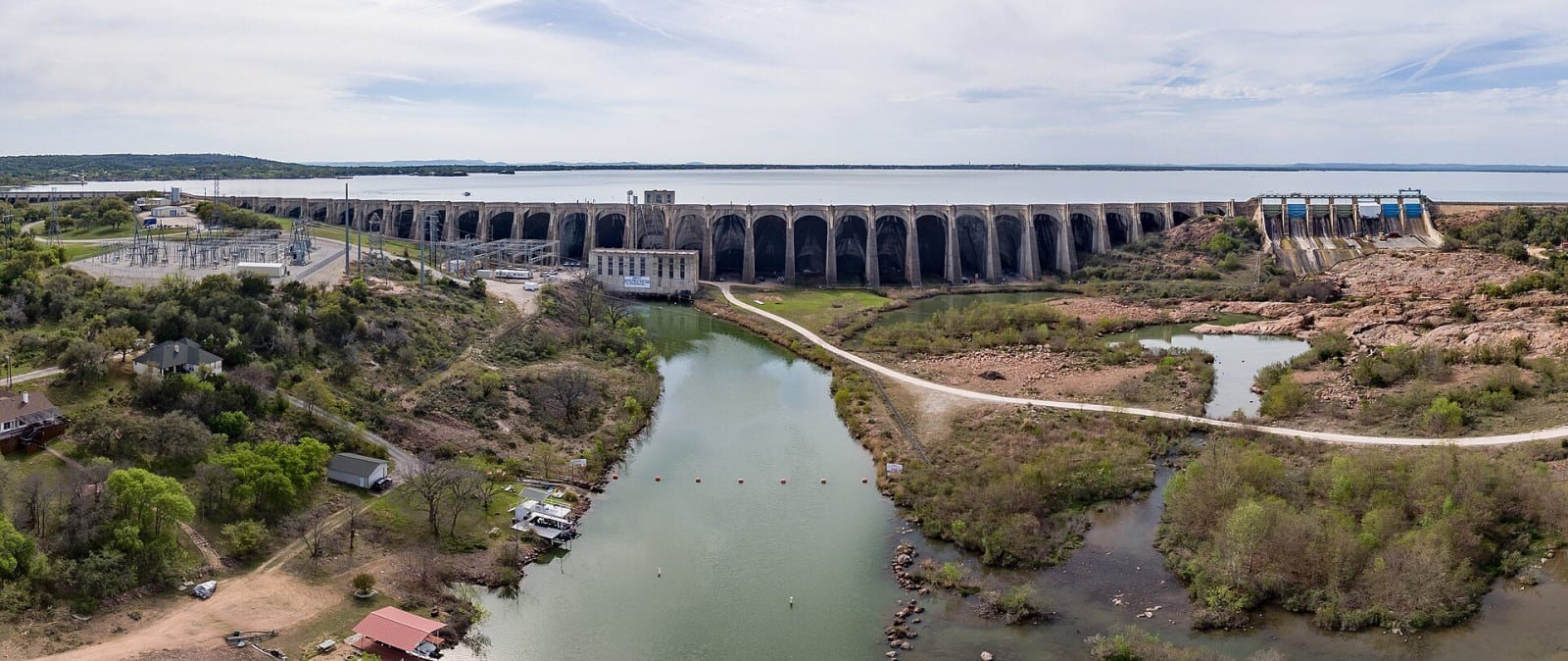
The earliest interest in damming this stretch of the Colorado came from Adam Johnson, who in 1854 marked a site near where Buchanan Dam stands. His water rights passed eventually to a power company, and in 1931 a subsidiary of Samuel Insull's utility empire began a two-mile-long dam near Burnet for hydroelectric power and flood control. The next year Insull's company went bankrupt, leaving the dam less than half built. Alvin Wirtz, a lawyer and former state senator from Seguin, was appointed receiver on behalf of the company's Texas creditors.
A public agency
The only money on offer came from a New Deal agency that would lend to nothing but a public body. Wirtz drafted a bill for a Colorado River Authority modeled on the Tennessee Valley Authority. Introduced in October 1933, it sat through three special sessions, backed by Austin and the downstream counties and opposed by private utilities and West Texas. In the fourth, in October 1934, Governor Miriam A. "Ma" Ferguson won votes by offering to make Dallas, home of the utilities fighting the bill, the site of the Texas Centennial. West Texas objections were met by limiting the district to ten counties of the lower basin, which is why it is the Lower Colorado River Authority. The bill passed on November 10, 1934, and the LCRA opened on February 19, 1935, in temporary offices in the Travis County courthouse. Wirtz moved to Austin in 1934, reportedly run out of Seguin by farmers who believed his dam projects had cheated them of their land.
The flood and the wires
Buchanan Dam was finished in 1938 and named for Congressman James P. Buchanan, and Inks Dam was completed the same year. Heavy flooding in July 1938 tested the new agency, and farmers downstream blamed the LCRA for not opening Buchanan's gates sooner. A United Press dispatch of August 2 reported that Interior Secretary Harold Ickes had sent a federal engineer, C. L. Willis, to investigate. A Texas Senate inquiry exonerated the LCRA but recommended raising Mansfield Dam, then rising at Marshall Ford, by 78 feet. The dam went from 200 to 278 feet and was finished in 1942.
The current had a second job. Lyndon Johnson, elected to Congress in 1937, had promised to use the dams' power to light rural Central Texas. In May 1938 delegates from five counties met in Johnson City to form the Pedernales Electric Cooperative. On November 1, 1939, its first line was energized through a substation at Bertram, and 422 members in Burnet County joined E. "Babe" Smith, who held meter number one, in getting electricity.
The Highland Lakes
In the early 1940s LCRA manager Max Starcke commissioned a study that recommended calling the reservoirs the Highland Lakes, to build interest in recreation. By 1951 the chain of six dams was done. Wirtz died that October, and the dam west of Marble Falls was renamed for him in December.
Inks Lake State Park lies above Inks Dam, and the Inks Dam National Fish Hatchery sits below it. The dam's marker, Buchanan Dam, is upstream.