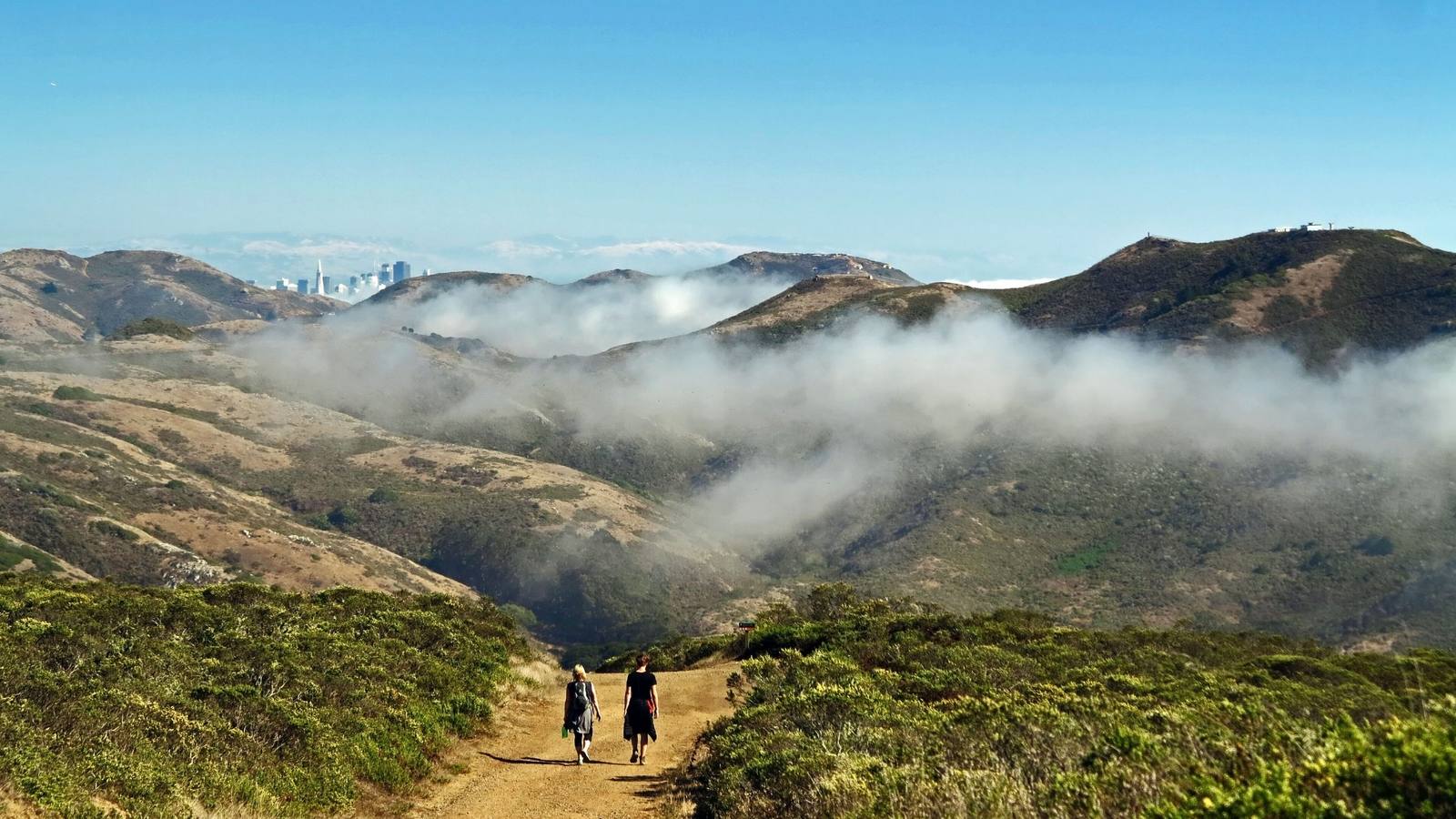
Drive north off the Golden Gate Bridge and the hills on the left are bare: grass, coyote brush, old gun emplacements, a few trails. It is easy to assume they were always going to look like that. In 1965 the county approved something else for them.
The plan
Thomas Frouge was a developer from Pittsburgh with Gulf Oil behind him, and he looked at the headlands between Sausalito and the Army's forts and saw what he called the most beautiful site in the country for a new community. Marincello, as he named it, would house about thirty thousand people on some two thousand acres: fifty apartment towers, hundreds of houses and townhouses, a strip of light industry, a mile-long shopping street, and a landmark hotel on the high ground looking back at the city. The Marin County Board of Supervisors approved it in November 1965. Bulldozers cut a boulevard up the Tennessee Valley, and a pair of stucco gateposts went up at its foot.
The headlands were empty in the first place because the Army had held so much of them for so long. Forts Baker, Barry and Cronkhite kept the ridges for gun batteries, which is why the overlook above Muir Beach still has wartime observation posts dug into its slope. Marincello was the first serious attempt to fill the ground between them.
The flaw
Opposition began at once: petitions, letters, a drive to put the project to a countywide vote, which the county disqualified. What stopped it was smaller. Three local lawyers, Robert Praetzel of San Rafael and Martin Rosen and Douglas Ferguson of Sausalito, went through the county's approvals and found that the zoning had been rushed. The public had been given six days to review it where the law required ten. Representing the City of Sausalito, they sued Marin County, Frouge and Gulf Oil.
The suit opened the file, and the file turned up more: zoning outlines approved in haste, an industrial zone sketched in loosely. Praetzel gave the case more than a thousand unpaid hours. Frouge died in January 1969, at fifty-four, with his city unbuilt. Gulf, which had fallen out with its own developer and then patched things up, kept the project alive, and by 1970 it looked as though it might recover.
On November 2, 1970, a state appeals court ruled that the 1965 approval could not stand and the plan would have to go back through the county from the beginning. The next day the supervisors announced that they would no longer support it. Asked long afterwards whether Marincello had been beaten on a technicality, Praetzel answered, in effect, that the technicality was the law.
The sale
Huey Johnson, western director of The Nature Conservancy, had already been talking to Gulf about selling. With the zoning gone, a sale became the best Gulf could do. In May 1972 the Conservancy bought the land for $6.5 million, with the philanthropist Martha Gerbode among those who helped pay for it, and that October Congress created the Golden Gate National Recreation Area, which took in the headlands. The valley where the towers would have stood is the Gerbode Valley now.
The gateposts came down in 1976.
What is left
Walk south from the Tennessee Valley trailhead and the track underfoot is wider than any trail needs to be. It is the Marincello Trail, the graded line of the city's main boulevard, and it climbs to ridge roads that were laid out as streets. A few lots at the top of Wolfback Ridge never came into the park, because their owner refused the government's offer. Nearly everything else did.
Marincello is usually told as David and Goliath, and it was. It is also a reminder of how the green edge of the bay was actually made. Nobody planned the headlands as a park. They were Army land and ranches, then very nearly a city, and they are open space because a procedural error was caught, a lawsuit was won, and a buyer was waiting when the developer gave up.