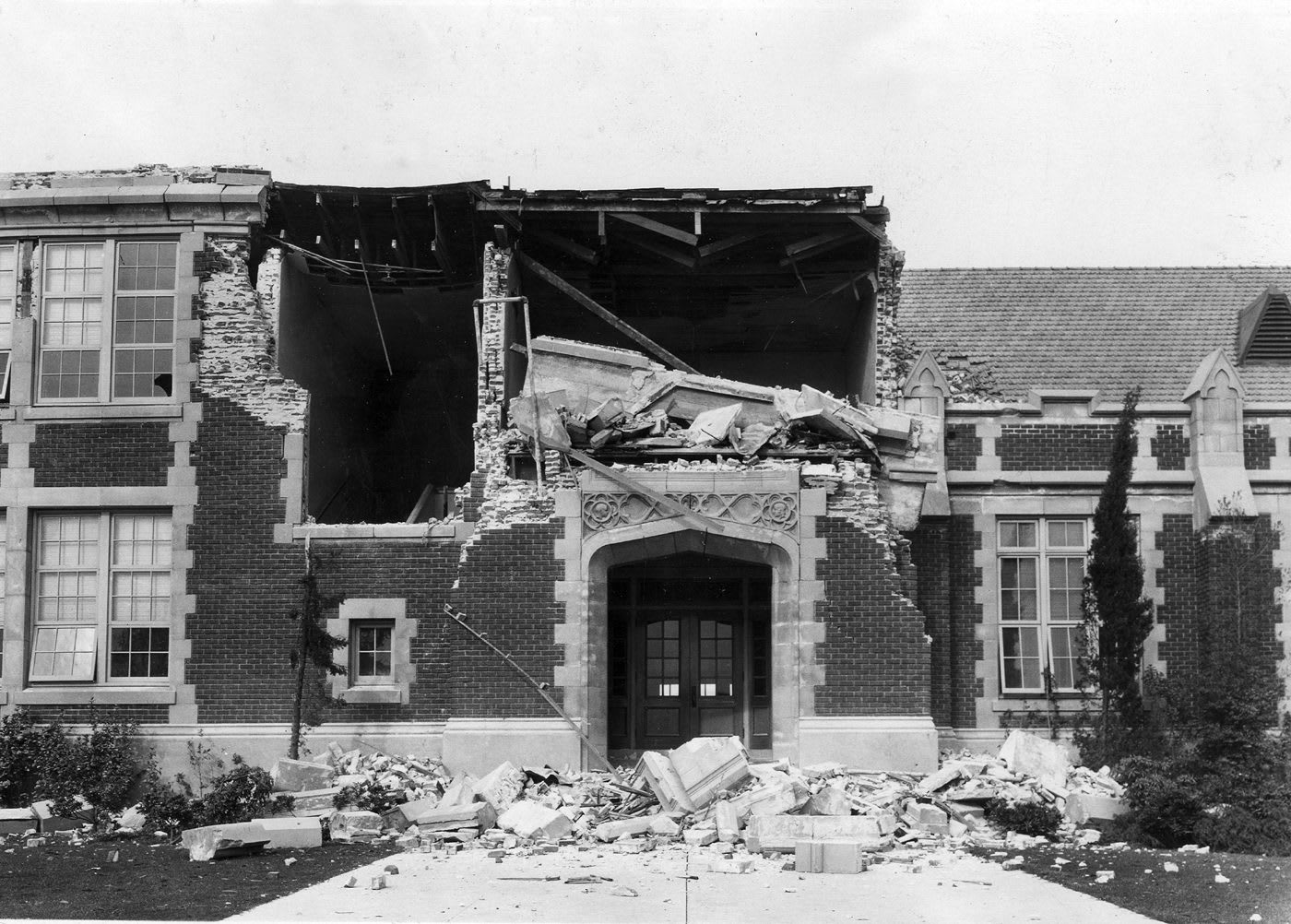
At 5:54 on the evening of Friday, March 10, 1933, the Newport-Inglewood fault slipped about three miles off Huntington Beach, six miles down. The shaking that reached Long Beach lasted well under a minute. It killed around a hundred and twenty people, did some fifty million dollars of damage in 1933 money, and left the city's brick commercial blocks lying in the street.
The most consequential thing about it is what time it happened.
What masonry does
The earthquake was a magnitude 6.4, which is not enormous. It broke no ground at the surface at all. What made it lethal was not the size of the event but the way Southern California had been built.
Unreinforced masonry is brick or block, stacked and mortared, with no steel running through it. It carries weight beautifully straight down and has almost no ability to resist being pushed sideways. Shake it hard enough and the walls peel away from the floors and the building comes down in a heap of loose brick. Most of the dead were killed by falling debris, and most of the falling debris was unreinforced masonry. Fifty-two died in Long Beach. Seventeen died in Compton.
The schools
Then the inspectors got to the schools, and the numbers stopped being ordinary.
More than two hundred and thirty school buildings across Southern California were destroyed, badly damaged, or condemned as unsafe to enter. Seventy were wrecked outright. In Long Beach itself every school in the city was damaged and most were ruined: Poly High, the Jefferson and Franklin and Roosevelt junior highs, the Whittier and Lowell and Muir and Burbank and Mann elementaries. Franklin was load-bearing masonry and it went down completely, and what was left had to be pulled down after. Photographs from the next morning show classrooms with the outside wall simply gone and the desks still standing in rows.
The reason the schools failed so comprehensively was not mysterious, and the investigators did not treat it as mysterious. They found loose subsoil, substandard materials and poor workmanship, sitting on top of a structural type that would have been in trouble regardless.
Five fifty-four
School had let out hours before. On a Friday afternoon in March, the class of building that suffered the worst structural failure in the entire earthquake was empty.
Every assessment made afterward reached the same conclusion and none of them hedged it. Had the fault slipped in the middle of a school day, the dead would have been counted in thousands rather than hundreds. Long Beach's own toll of fifty-two would probably have been near a thousand by itself.
An accident of scheduling is a strange foundation for public policy. California built one on it anyway.
Thirty days
The legislature passed the Field Act on April 10, 1933, and Governor James Rolph signed it. One month, to the day, after the earthquake.
The law did something narrower and more effective than a general building code. It put public school construction under the Division of the State Architect. Every set of plans and specifications for a public school in California would be reviewed and approved by the state before ground was broken, and the construction itself would be supervised by the state while it was going up. Not a standard a district could certify for itself, and not an inspection after the fact. Outside review, and eyes on the work while the work was happening.
The political logic was unusually clean, and people at the time said so plainly. The buildings were paid for with public money. State law compelled children to be inside them. They housed the children of the electorate. And they had just performed worse than nearly anything else in the region. There was nowhere for an objection to stand.
While the argument was being settled, children went to class in tents.
What the law has done
Ninety-odd years and a long list of earthquakes later — Tehachapi, Sylmar, Loma Prieta, Northridge, Ridgecrest — no public school building constructed to Field Act standards has collapsed in a California earthquake.
That sentence is worth reading slowly, and worth reading precisely. It does not say Field Act schools come through undamaged; a good many have not. It says none has come down. For a law drafted in thirty days by a legislature reacting to a disaster in the third year of the Depression, that is close to the ceiling of what public policy achieves.
The Act has been amended many times since, and the pre-1933 buildings were a separate problem that took decades to work through. But the principle held: the state inspects the buildings it requires children to enter.
The fault is still there
The Newport-Inglewood fault has not gone anywhere. It runs up through Huntington Beach, Signal Hill, Compton, Inglewood and Beverly Hills, under some of the most densely built ground in the country, and there is a great deal more sitting on top of it now than there was in 1933.
One reason the response went as well as it did that night was that the fleet was in. Close to a hundred Navy vessels were anchored in San Pedro Bay, with the base on Terminal Island, and within two hours more than three thousand sailors and Marines were ashore doing search and rescue. The fleet is not anchored there any more. Nobody should plan around it.
What is still there is the law, and an office in Sacramento that reads the drawings before anyone pours a footing.