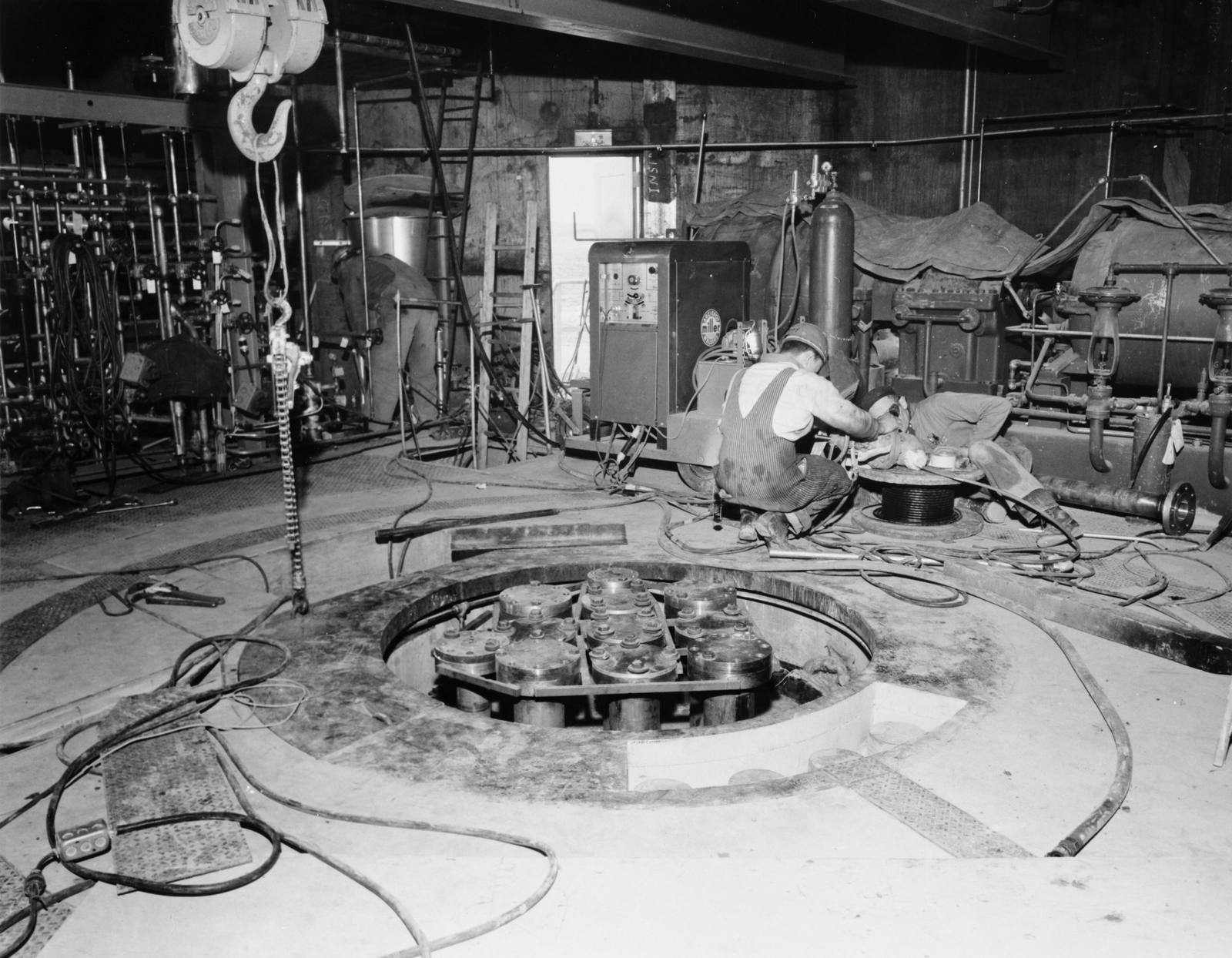
The reactor was called SL-1, Stationary Low-Power Reactor Number One, and nobody thought of it as dangerous. It sat inside the fences of the National Reactor Testing Station on the Snake River Plain, west of Idaho Falls, a small boiling-water plant the Army wanted as a prototype for reactors it could fly to remote places, radar stations in the Arctic, and run with small crews of young servicemen. That was the point of it: a reactor simple enough not to need experts.
The restart
On January 3, 1961, it had been shut down for about eleven days over the holidays. Three men were on the night shift to get it ready to run again: John Byrnes, an Army specialist, twenty-two; Richard McKinley, an Army specialist and Korean War veteran, twenty-seven; and Richard Legg, a Navy Seabee, twenty-six, the shift supervisor. Part of the procedure was to reconnect the control rods to their drive motors, and to do that an operator standing on top of the reactor had to lift the central rod by hand, a few inches, about four at most.
At 9:01 p.m. the central rod came up about two feet.
The core had been built so that this one rod alone could hold it back. With it out, the reactor went prompt critical, its power surging within a few thousandths of a second to thousands of times its rating. The water in the core flashed to steam and the whole reactor vessel jumped several feet in its housing. A shield plug shot up out of the lid and pinned Legg to the ceiling of the reactor room. Byrnes was killed where he stood. McKinley was found alive by the first rescuers and died within about two hours.
Getting them out
The building was so radioactive that rescuers could stay inside only seconds at a time. It took days to recover all three bodies, and when they were recovered they were dangerous to handle. Parts of the bodies were so contaminated that they were removed and buried with other radioactive waste. The men were buried in lead-lined caskets, sealed in metal vaults and covered in concrete. Legg and Byrnes went home to be buried in Michigan and New York. McKinley's widow asked for Arlington. His grave there is the only radioactive burial in the cemetery, and the funeral in January 1961 lasted a few minutes with the family held back at a distance.
Why
The official investigation established what happened and never settled why. It is possible the rod stuck in its channel, as rods in that reactor were known to do, and that Byrnes yanked it free with more force than he meant and it came up too far. It is possible he misjudged. Rumors have supplied darker motives, a failing marriage and a feud between Byrnes and Legg, and a 2009 book laid out the grudge between the two men; nothing has ever been proven, and the truth went into the ground with them. What the investigators could say for certain was that the reactor let one man with his hands on one rod destroy it.
What changed
That was the lesson the industry took. After SL-1, reactors in the United States were designed so that no single control rod could make the core critical if it were pulled all the way out. The Army's dream of small portable reactors for remote bases faded. The wrecked reactor itself was cut apart and buried in a pit on the desert about sixteen hundred feet from where it had stood.
SL-1 remains the only fatal reactor accident in the United States. The site is inside the Idaho National Laboratory and closed to visitors. The public side of this desert's atomic history is at Experimental Breeder Reactor I on US-20/26, the reactor that lit four light bulbs in 1951 and had its own, bloodless meltdown in 1955. SL-1 is the other half of the story, the one told on a headstone in Arlington.