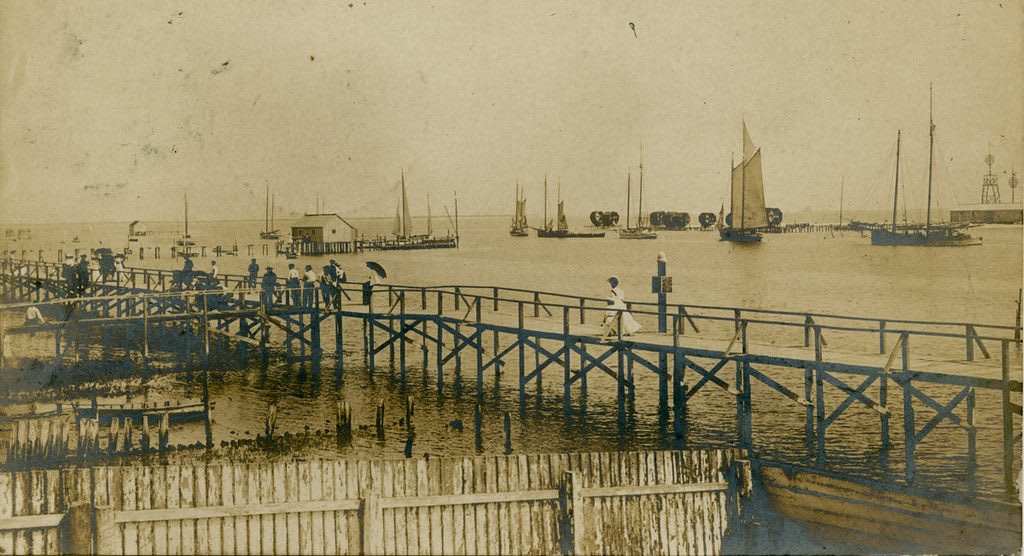
Menhaden are small, oily, bony fish that almost no one eats. Around Beaufort and Morehead City people called them shad or pogie, and for most of a century they were the state's largest saltwater fishery. From the 1890s the factories cooked and pressed the catch into fish meal, oil and fertilizer, and townspeople called the smell money. On autumn Saturday nights, a retired grocer remembered, 75 or 100 pogie boats tied up on Front Street, each with a crew of 18 to 20 men.
The chanteys
Before spotter planes took over in 1946, a lookout in the crow's nest watched for schools. A striker boat with one man rowed out and pointed, and two purse boats, each carrying a dozen or more men, closed a seine around the fish. The net crews were almost all Black, many from North River, Harlowe and Beaufort. Raising tons of fish by hand took the whole crew pulling as one, and they kept time with chanteys: one man sang a line and the crew answered. Fishermen told folklorist Barbara Garrity-Blake that the singing let them lift what muscle alone could not. Ernest "King" Davis, who started at 16 in 1955, remembered that a man who would not sing did not keep his place.
Local 710
In the spring of 1952 the International Fur and Leather Workers Union chartered Local 710 in Beaufort and Morehead City. Hundreds of fishermen and factory hands joined, most or all of them Black. When the companies refused to bargain, members met at a Baptist church and voted in May to strike for higher wages, better conditions and stronger safety rules. By June 6 Beaufort By-Products could send out only one of its three boats. About 200 workers struck three plants in Southport, and 800 fishermen in Reedville, Virginia, stayed ashore. W. H. "Piggy" Potter, an owner of Beaufort Fisheries, called the union Communist and accused it of a civil rights agenda.
Black women organized an auxiliary. At Purvis Chapel AME Zion Church they heard Viola Brown, a leader of the tobacco workers' union in Winston-Salem, and at Mount Zion Missionary Baptist Church the pastor and the church's matriarch, Mary E. "Mother" Johnson, spoke for the strikers. Later in 1952 the CIO expelled the fur workers' union in its purge of unions it called Communist-led, and organizers tried again in the summer of 1953. One morning that summer the Phillips fish factory, on an island at the mouth of the Newport River, burned before the fall season opened. Arson was suspected and never proved, and union men hurried the visiting folk singers Guy Carawan, Frank Hamilton and Ramblin' Jack Elliott out of town.
After the singing
The hydraulic power block came in the early 1960s and hauled the nets that men and songs had raised. Beaufort Fisheries, the state's last menhaden plant, closed in 2005, and a few years later North Carolina banned industrial purse seining for menhaden in state waters. In 2009 and 2010 the Core Sound Waterfowl Museum on Harkers Island and Garrity-Blake gathered the old crews' stories in a project called Raising the Story of Menhaden Fishing.
The pogie boats tied up along Front Street in historic Beaufort, and Purvis Chapel still stands in town.