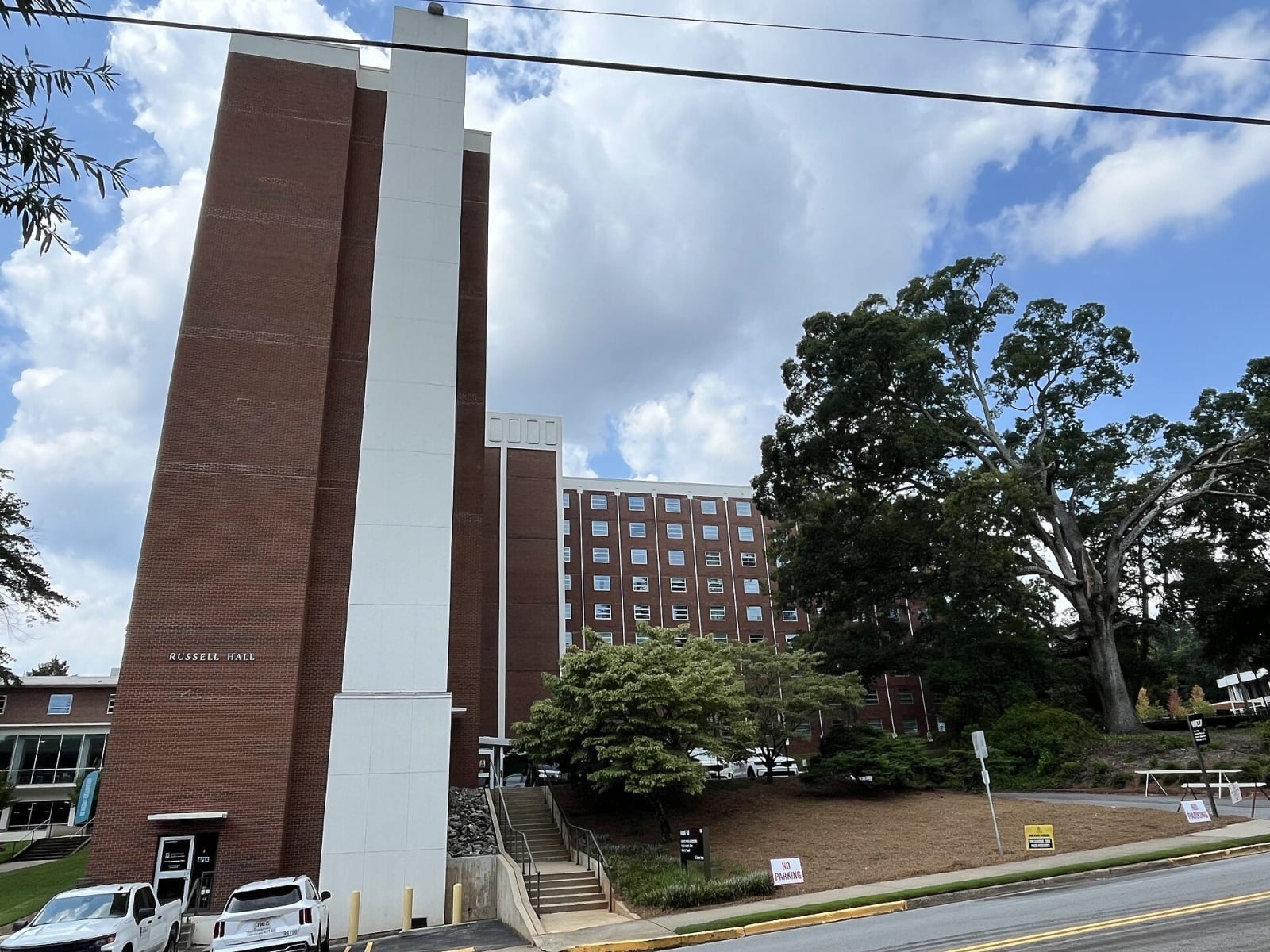
Around 1900 Black families began settling about 22 acres of old plantation land in Athens, bounded by Baxter, Church and South Finley streets, and they called the place Linnentown. By 1960 some fifty families lived there, along unpaved Lyndon Row and a dirt stretch of Peabody Street: plumbers, electricians, beauticians, brick masons, housekeepers and cooks. Hattie Thomas Whitehead grew up at 141 Peabody Street with her parents and six siblings, and Bobby Crook's family ran an inn for Black guests at 167 Peabody.
Paving promised
In December 1954 property owners petitioned the city to pave Lyndon Row and put up a street light. The mayor and council approved paving Lyndon Row in January 1955 and Peabody, South Finley and Church streets in February 1959. The work was never done for Linnentown's residents.
The university had eyed the land for decades. Its trustees set aside $25,000 in 1920 to buy Black-owned property there, according to the county's 2021 resolution, and a 1950 city planning map marked Linnentown for redevelopment. In 1959 Congress amended the federal urban renewal program to let colleges take part without housing the people they displaced. From 1959 to 1961 UGA President Omer C. Aderhold wrote to Mayor Ralph Snow, Chancellor Harmon Caldwell and Senators Richard B. Russell and Herman Talmadge in pursuit of a renewal contract.
Project GA R-50
From 1962 to 1966 the city cleared the neighborhood for the University System under a federally funded program, Urban Renewal Project GA R-50, and Brumby, Russell and Creswell Halls rose on the site. The city took homes by eminent domain, some for as little as $1,450, and families went to public housing or scattered across Athens. The resolution names intimidation, code enforcement turned against owners, unequal appraisals and controlled fires among the means. Crook was eleven when residents learned they had to go, and his family was among the last to leave. By 1966 the city had sold the land to the University System for $216,935. Between 1962 and 1974 R-50 and the neighboring College Avenue project displaced 176 Black families and 122 white families.
Linnentown Lane
In 2018 Joseph Carter, a UGA Libraries employee researching the university's wage history, found the renewal records and met two former residents, Geneva Johnson and Whitehead. The Linnentown Project formed in September 2019, and Whitehead published a memoir, Giving Voice to Linnentown, in 2020. In February 2021 the Athens-Clarke County Commission unanimously passed a resolution acknowledging the injustice, and Mayor Kelly Girtz apologized on the courthouse steps. Georgia's constitution bars the county from paying residents directly, so redress went toward community programs. UGA associate professor Jerry Shannon put the residents' lost wealth at more than $5 million.
The university has said it disagrees with the project's conclusions, and in 2022 it blocked a planned memorial walk and mosaic on the former site; organizers have since moved ahead without UGA. In 2023 the county renamed South Finley Street from Baxter Street to Cloverhurst Avenue as Linnentown Lane, and the signs went up on September 21. "It's about time," Whitehead said at the unveiling.
The University of Georgia's North Campus, with its 2018 Baldwin Hall memorial, is a short walk away.